Written & Reviewed by Akash Biswas, MSW | Former Medicaid Caseworker Trainer | Verified against official Medicaid.gov and CMS guidelines | Last Updated: April 2026
In 2026, Medicaid income limits range from 138% of the Federal Poverty Level (FPL) in expansion states to as low as 13% FPL for parents in some non-expansion states.
For a single adult, 138% FPL equals about $20,782 per year or $1,732 per month. This guide covers every state’s income limits, who qualifies, and how to apply.
Quick Summary:
- Medicaid covers doctor visits, hospital care, prescriptions, and more at little or no cost
- Most adults in expansion states qualify if they earn at or below 138% FPL
- Children often qualify at higher limits — up to 400% FPL in some states
- Long-term care income limits for 2026 are $2,982/month for most states
- Use our free Medicaid Eligibility Calculator for 2026 to check your household in seconds
What Is Medicaid?
Medicaid is a free or low-cost health insurance program. The federal government and your state share the cost together.
It helps people who can’t afford private health insurance. This includes low-income adults, children, pregnant women, seniors, and people with disabilities.
Who Runs Medicaid?
The federal government sets the basic rules. Each state then runs its own version of the program.
That’s why income limits and covered services can vary from state to state. Medicaid is not the same in Texas as it is in California.
How Is Medicaid Different From Medicare?
Medicare is for people 65 and older, or those with certain disabilities. Medicaid is based on income, not age.
Some people qualify for both. They are called “dual eligibles.”
Who Qualifies for Medicaid in 2026?
Medicaid covers several groups of people. Your state determines the exact income limits.
Here are the main groups who may qualify in 2026:
| Coverage Group | General Income Limit |
|---|---|
| Adults (expansion states) | Up to 138% FPL |
| Adults (non-expansion states) | Varies — often very low |
| Children (Medicaid) | 133%–261% FPL (varies by state and age) |
| Children (CHIP) | Up to 400% FPL in some states |
| Pregnant Women | 138%–208% FPL (varies by state) |
| Seniors / Nursing Home (most states) | Up to $2,982/month |
| Medicare Savings Program | 100%–200% FPL |
To understand all the rules that apply to your situation, read our full guide on Medicaid Eligibility in 2026, which covers every coverage group in detail.
What Is the Federal Poverty Level (FPL)?
The Federal Poverty Level is a dollar amount set by the government each year. It is based on household size.
Medicaid uses FPL to decide who qualifies. On January 23, 2026, CMS officially published the new 2026 FPL figures. The increase reflects a 2.6% rise in the Consumer Price Index for All Urban Consumers (CPI-U).
Medicaid Income Limits 2026: Federal Poverty Level Chart
The table below shows the official 2026 FPL figures for the 48 contiguous states and D.C. Alaska and Hawaii have higher thresholds.
2026 FPL by Household Size (48 States + D.C.)
| Household Size | 100% FPL (Annual) | 133% FPL | 138% FPL (ACA Expansion Limit) | 200% FPL |
|---|---|---|---|---|
| 1 | $15,060 | $20,030 | $20,782 | $30,120 |
| 2 | $20,440 | $27,185 | $28,207 | $40,880 |
| 3 | $25,820 | $34,341 | $35,631 | $51,640 |
| 4 | $33,000 | $43,890 | $45,540 | $66,000 |
| 5 | $36,580 | $48,651 | $50,480 | $73,160 |
| 6 | $41,960 | $55,807 | $57,904 | $83,920 |
| Each additional person | +$5,380 | — | +$7,424 | +$10,760 |
Source: CMS CMCS Informational Bulletin, January 23, 2026.
Note on the 138% rule: Federal law says 133% FPL. But CMS adds a built-in 5 percentage point income disregard. The effective applied limit is 138% FPL.
Alaska and Hawaii: These states use higher FPL thresholds. For example, 150% FPL for one person in Alaska is $29,925/year, compared to $23,940/year in other states.
Medicaid Expansion vs. Non-Expansion States in 2026
Under the Affordable Care Act (ACA), states can expand Medicaid to cover more adults. As of 2026, 40 states and DC have expanded Medicaid. Ten states have not.
Expansion States (40 States + DC)
In these states, most adults under 65 qualify if they earn at or below 138% FPL. That is about $22,025 per year for one person. No asset test applies under MAGI rules.
Expansion states include: Alaska, Arizona, Arkansas, California, Colorado, Connecticut, Delaware, DC, Hawaii, Idaho, Illinois, Indiana, Iowa, Kentucky, Louisiana, Maine, Maryland, Massachusetts, Michigan, Minnesota, Missouri, Montana, Nebraska, Nevada, New Hampshire, New Jersey, New Mexico, New York, North Carolina, North Dakota, Ohio, Oklahoma, Oregon, Pennsylvania, Rhode Island, South Dakota, Utah, Vermont, Virginia, Washington, and West Virginia.
Non-Expansion States (10 States)
In these states, childless adults generally cannot get Medicaid no matter how low their income is. Parents may qualify only at very low income levels.
Non-expansion states are: Alabama, Florida, Georgia, Kansas, Mississippi, South Carolina, Tennessee, Texas, Wisconsin, and Wyoming.
Example: In Texas, parents qualify only if they earn about 17% FPL (around $273/month for a family of 3). Alabama limits parents to about 18% FPL.
Income Limits in Expansion vs. Non-Expansion States
| State Type | Income Limit (Single Adult) | Income Limit (Household of 2) |
|---|---|---|
| Expansion states (41 + D.C.) | $20,782/year ($1,732/month) | $28,207/year ($2,351/month) |
| Non-expansion — parents (example: Alabama) | ~13% FPL | Very low |
| Non-expansion — parents (example: Texas) | ~17% FPL | Very low |
| Non-expansion — parents (example: Florida) | ~24% FPL | Very low |
Percentage thresholds from Medicaid.gov MAGI eligibility table. Dollar amounts updated to 2026 FPL figures.
Medicaid Income Limits for Children and CHIP 2026
Children almost always qualify for Medicaid or CHIP at higher income levels than adults. The exact limit depends on the child’s age and your state.
How Children’s Medicaid Works
Federal law requires states to cover children at a minimum income level. Most states go well above that floor.
At 200% FPL in 2026, a family of 3 can earn up to $51,640/year and still qualify.
Children’s Medicaid and CHIP Income Limits by State (Select Examples)
| State | Children Ages 0–1 | Children Ages 1–5 | Children Ages 6–18 | CHIP Upper Limit |
|---|---|---|---|---|
| Alabama | 141% FPL | 141% FPL | 141% FPL | 312% FPL |
| Alaska | 203% FPL | 203% FPL | 203% FPL | N/A (Medicaid only) |
| California | 261% FPL | 261% FPL | 261% FPL | See state notes |
| Florida | 206% FPL | 140% FPL | 133% FPL | 210% FPL |
| Illinois | 313% FPL | 313% FPL | 313% FPL | N/A |
| Iowa | 375% FPL | 167% FPL | 167% FPL | 302% FPL |
| New York | — | — | — | 400% FPL |
| Texas | — | — | — | 200% FPL |
Source: Medicaid.gov MAGI eligibility table (December 2023); MACPAC CHIP eligibility data. Percentage thresholds remain valid. Dollar values updated to 2026 FPL.
Medicaid Income Limits for Seniors: Long-Term Care 2026
Seniors and people with disabilities who need nursing home care face different income rules. Most states use the Federal Benefit Rate (FBR) — not the FPL — to set these limits.
2026 Long-Term Care Key Benchmarks
Effective January 1, 2026:
- Federal Benefit Rate (FBR): $994/month per individual; $1,491/month per couple
- 300% FBR (standard income cap): $2,982/month for a single applicant
- 2025 cap was $2,901/month — the 2026 increase is $81/month per individual
2026 Long-Term Care Medicaid Income Limits — All 50 States
| State | Nursing Home (Single) | HCBS Waiver (Single) | ABD / Regular Medicaid (Single) |
|---|---|---|---|
| Alabama | $2,982 | $2,982 | $1,014 |
| Alaska | $2,982 | $2,982 | $1,845 |
| Arizona | $2,982 | $2,982 | $1,330 |
| Arkansas | $2,982 | $2,982 | $1,064 |
| California | No income cap* | $1,836 | $1,836 |
| Colorado | $2,982 | $2,982 | $994 |
| Connecticut | Less than nursing home cost | $2,982 | $1,413 |
| Delaware | $2,485 | $2,485 | $994 |
| Florida | $2,982 | $2,982 | $1,171 |
| Georgia | $2,982 | $2,982 | $994 |
| Hawaii | No hard limit** | $1,530 | $1,530 |
| Idaho | $3,002*** | $3,002 | $1,047 |
| Illinois | $1,330 | $1,330 | $1,330 |
| Indiana | $2,982 | $2,982 | $1,330 |
| Iowa | $2,982 | $2,982 | $994 |
| Kansas | No set limit**** | Excess over $2,982 to care | $967 |
| Kentucky | $2,982 | $2,982 | $235 |
| Louisiana | $2,982 | $2,982 | $994 |
| Maine | $2,982 | $2,982 | $1,330 |
| Maryland | Less than nursing home cost | $2,982 | $350 |
| Massachusetts | No hard limit* | $2,982 | $1,330 |
| Michigan | $2,982 | $2,982 | $1,330 |
| Minnesota | $1,305 | $2,982 | $1,305 |
| Mississippi | $2,982 | $2,982 | $994 |
| Missouri | All income except $50/mo to care | $1,131–$1,737 | $1,131 |
| Montana | ≤ nursing home cost | $994 | $994 |
| Nebraska | $1,330 | $1,330 | $1,330 |
| Nevada | $2,982 | $2,982 | $994 |
| New Hampshire | $2,982 | $2,982 | $1,008 |
| New Jersey | $2,982 | $2,982 | $1,330 |
| New Mexico | $2,982 | $2,982 | $994 |
| New York | $1,836 | $1,836 | $1,836 |
| North Carolina | Less than Medicaid nursing home rate | $1,330 | $1,330 |
| North Dakota | No set limit | $1,197 | $1,197 |
| Ohio | $2,982 | $2,982 | $994 |
| Oklahoma | $2,982 | $2,982 | $1,350 |
| Oregon | $2,982 | $2,982 | $994 |
| Pennsylvania | $2,982 | $2,982 | $1,016 |
| Rhode Island | $2,982 | $2,982 | $1,330 |
| South Carolina | $2,982 | $2,982 | $1,330 |
| South Dakota | $2,982 | $2,982 | $994 |
| Tennessee | $2,982 | $2,982 | $994 |
| Texas | $2,982 | $2,982 | $994 |
| Utah | No limit* | $1,330–$2,982 | $1,330 |
| Vermont | $2,982 | $2,982 | $1,375–$1,483 |
| Virginia | $2,982 | $2,982 | $1,064 |
| Washington | $2,982 | $2,982 | $994 |
| Washington, D.C. | $2,982 | $2,982 | $1,330 |
| West Virginia | $2,982 | $2,982 | $994 |
| Wisconsin | $2,982 | $2,982 | $1,078 |
| Wyoming | $2,982 | $2,982 | $994 |
*California: Resident keeps only $35/month. No income cap but strict asset rules apply.
**Hawaii: All income except $50/month goes to care.
***Idaho: Uses $3,002/month — slightly above the $2,982 national standard.
****Kansas: All income over $62/month goes to care.
*****Massachusetts: All income except $72.80/month goes to care.
******North Dakota: $115/month personal needs allowance.
*Utah: Income determines contribution amount; no hard cap.
Source: MedicaidPlanningAssistance.org (updated April 23, 2026); MedicaidLongTermCare.org (updated March 2026)
Medicare Savings Programs (MSP) Income Limits 2026
Medicare Savings Programs help low-income Medicare recipients pay their premiums and out-of-pocket costs. CMS confirmed these 2026 limits in its January 23, 2026 bulletin.
2026 MSP Income Limits (48 States + D.C.)
| Program | What It Covers | Monthly Income Limit (Individual) | Monthly Income Limit (Couple) |
|---|---|---|---|
| QMB (Qualified Medicare Beneficiary) | Part A & B premiums + cost-sharing | $1,350 | $1,824 |
| SLMB (Specified Low-Income Medicare Beneficiary) | Part B premium only | $1,616 | $2,184 |
| QI (Qualifying Individual) | Part B premium only | $1,816 | $2,455 |
| QDWI (Qualified Disabled & Working Individual) | Part A premium only | $5,405 | $7,299 |
Alaska MSP Limits (Higher FPL): QMB $1,683 | SLMB $2,015 | QI $2,265 | QDWI $6,735 (individual)
Hawaii MSP Limits: QMB $1,550 | SLMB $1,856 | QI $2,086 | QDWI $6,205 (individual)
2026 MSP Asset Limits: QMB/SLMB/QI: $9,950 (individual), $14,910 (couple) | QDWI: $4,000 (individual), $6,000 (couple)
Spousal Impoverishment Standards 2026
When one spouse enters a Medicaid nursing facility, federal rules protect the other spouse’s income and assets. CMS issued the 2026 spousal impoverishment standards in December 2025.
2026 Spousal Protection Limits
| Protection | 2026 Amount |
|---|---|
| Community Spouse Resource Allowance — Maximum | $162,660 |
| Community Spouse Resource Allowance — Minimum | $32,532 |
| Monthly Maintenance Needs Allowance — Minimum | $2,643.75 (lower 48) |
| Monthly Maintenance Needs Allowance — Maximum | $4,066.50 |
| Home Equity Limit — Minimum | $752,000 |
| Home Equity Limit — Maximum | $1,130,000 |
The Minimum MMNA of $2,643.75 applies through June 30, 2026. The July 2026 figure has not yet been announced.
Notable 2026 State Changes You Should Know
Some states made significant changes in 2026. These could affect your eligibility.
California — Asset Limit Returns
California (Medi-Cal) eliminated its asset test on January 1, 2024. But as of January 1, 2026, California is reinstating a $130,000 asset cap for non-MAGI long-term care programs. This directly affects seniors applying for nursing home or HCBS benefits.
Idaho — Slightly Higher Income Cap
Idaho sets its nursing home and HCBS limit at $3,002/month — just above the standard $2,982 used by most states. This is tied to Idaho’s rounding of the FBR multiplier.
Delaware — Lower Income Cap
Delaware’s nursing home and HCBS cap is $2,485/month — lower than the national standard. This is a state policy choice, not a federal requirement.
Illinois and Nebraska — Nursing Home Cap Is Lower
Both states use $1,330/month as their nursing home income limit. Illinois ties its cap to 133% FPL rather than 300% FBR.
2026 Work Requirements: What You Need to Know
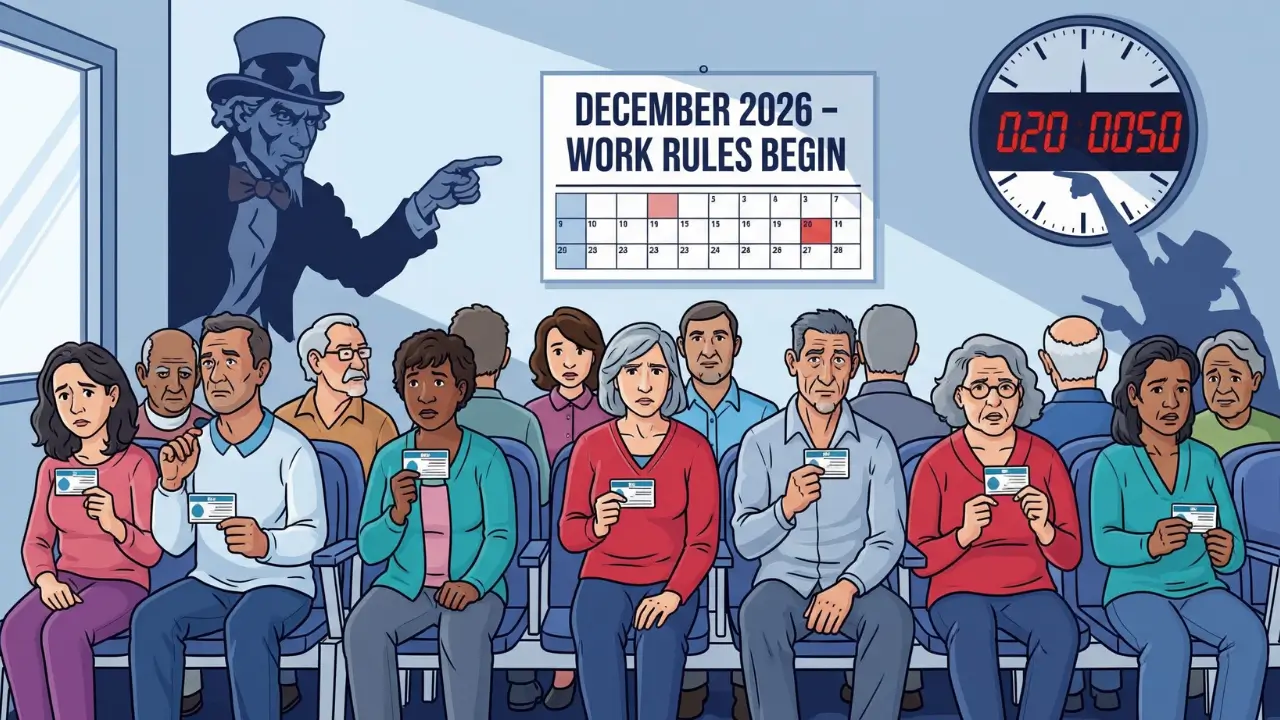
The 2025 federal budget law (signed July 4, 2025) adds work requirements for Medicaid expansion adults. This does not change the income limits. But starting as early as May 2026 in Nebraska and July 2026 in Montana, adults must document 80 hours per month of qualifying activity to keep coverage.
The Congressional Budget Office estimates 5.3 million people could lose coverage from the work requirement alone by 2034. Final federal guidance on exemptions is expected from CMS in June 2026.
What Does Medicaid Cover?
Medicaid covers a wide range of health services. Exact benefits vary by state.
Standard Benefits in All States
- Doctor visits and preventive care
- Hospital stays (inpatient and outpatient)
- Prescription drugs
- Mental health and substance use treatment
- Lab tests and X-rays
- Emergency services
- Family planning services
Additional Benefits Many States Offer
- Dental care for adults (not required, but most states include it)
- Vision care and eyeglasses
- Physical, occupational, and speech therapy
- Non-emergency medical transportation
- Home health aide services
- Nursing home and long-term care
To understand how provider payment rates affect your care access, the 2026 Medicaid Fee Schedule explains how much Medicaid pays doctors and hospitals in each state.
How to Apply for Medicaid in 2026
Applying for Medicaid is free. You can apply any time of year — there is no enrollment window for most groups.
Step-by-Step Application Guide
- Gather your documents. You will need proof of income (pay stubs, tax returns), ID (driver’s license or passport), Social Security numbers for everyone in your household, and proof of residency (utility bill or lease).
- Choose how to apply. You can apply online through your state Medicaid website, by phone, by mail, or in person at your local Medicaid office.
- Complete your application. Answer all questions about your household size, income, and citizenship. Be honest — errors can delay or deny your application.
- Submit and wait. Most states must process your application within 45 days. Disability-based applications may take up to 90 days.
- Respond to requests. Your state may ask for more documents. Reply quickly to avoid delays.
- Get your Medicaid card. If approved, your state will mail your Medicaid card. Coverage often starts on the first day of the month you applied.
Tip: Many states process same-day “presumptive eligibility” for pregnant women and children. Ask about this when you apply.
Find your state’s Medicaid portal:
- Official federal resource: Medicaid.gov
- ACA and Medicaid overview: Healthcare.gov
What Happens After You Apply?
After you submit your application, your state reviews your information. Here is what to expect.
Application Timeline
- Within 1–5 days: Many online applications get an instant eligibility decision
- Within 45 days: Standard processing deadline for most Medicaid applications
- Within 90 days: Extended deadline for disability-based applications
- Retroactive coverage: In many states, Medicaid can cover bills from up to 3 months before your application date
If You Are Approved
You will receive a notice by mail. Your Medicaid card will arrive shortly after.
You can use it right away at any Medicaid-accepting provider. You pay little or no cost for covered services.
If You Are Denied
You have the right to appeal. Your denial letter will explain why and give you a deadline to appeal.
You can also ask for a “fair hearing” — a formal review of your case. Free legal aid organizations can help you with this process.
Frequently Asked Questions
Q: What are the Medicaid income limits for a family of 4 in 2026?
A: In expansion states, a family of 4 can earn up to $45,540/year (138% FPL) and qualify for Medicaid. In non-expansion states, parents face much lower limits — sometimes under 30% FPL. Children in most states qualify through CHIP at higher income levels, often up to 200%–400% FPL depending on the state.
Q: Can I get Medicaid if I work full-time?
A: Yes. Medicaid is based on income, not employment status. If your income falls within your state’s limit, you qualify — even if you work full-time. Starting in 2026 and 2027, some states are adding work requirement rules for expansion adults, but meeting income limits remains the first step.
Q: Does Medicaid cover dental care in 2026?
A: It depends on your state. All states must cover dental care for children. For adults, dental coverage is optional. Most states offer at least emergency dental care. Some states — like California, New York, and Illinois — offer comprehensive adult dental. Check your state’s benefit guide for details.
Q: How long does Medicaid approval take in 2026?
A: Most online applications receive a decision within 1–5 days. By law, states must process most applications within 45 days. Disability-based applications may take up to 90 days. If you need care before approval, ask your state about presumptive eligibility, which gives temporary coverage while you wait.
Q: What is the Medicaid income limit for seniors in 2026?
A: For nursing home or HCBS (home care) Medicaid, most states allow seniors to earn up to $2,982/month in 2026. Some states are lower (Delaware: $2,485; Illinois and Nebraska: $1,330). For regular Medicaid for aged, blind, and disabled (ABD) individuals, limits are much lower — ranging from $235/month in Kentucky to $1,845/month in Alaska.
Q: Does Medicaid have an asset limit in 2026?
A: For MAGI-based Medicaid (most adults and children), there is no asset limit. For long-term care and ABD Medicaid, asset limits apply — typically $2,000 for an individual. California reinstated a $130,000 asset cap for long-term care as of January 1, 2026. Medicare Savings Programs have separate asset limits: $9,950 for individuals and $14,910 for couples in 2026.
Sources & Disclaimer
Sources:
- Medicaid.gov — Official Medicaid Program Information
- CMS CMCS Informational Bulletin — 2026 FPL Standards (January 23, 2026)
- Healthcare.gov — Medicaid & CHIP Overview
- Kaiser Family Foundation (KFF) — Medicaid Expansion Status by State
- MedicaidPlanningAssistance.org — Long-Term Care Income Limits (updated April 23, 2026)
- MACPAC — CHIP Eligibility Data
Disclaimer: CheckMedicaid.com is not affiliated with any government agency. This content is for educational purposes only. Income limits and eligibility rules change. For official eligibility, contact your state Medicaid office or visit Medicaid.gov.
Last Updated: April 2026 | Written & Reviewed by Akash Biswas, MSW, Former Medicaid Caseworker Trainer