
Am I Eligible for Medicaid in 2026? Check Your State's Income Limits
Answer a few quick questions to see if you qualify for Medicaid — fast, free, and secure.
What to Expect
Our secure process is designed to be simple.
- Quick & Easy
Complete the questionnaire in under 3 minutes.
- Completely Confidential
Your information is encrypted and never shared.
- Instant Results
Find out immediately if you likely qualify.
Government health program for low-income people. It is run by each state, so rules are different by state.
- Doctor visits
- Hospital care
- Nursing homes
- Long-term care at home
Federal health insurance program, mostly for people age 65 and older.
It covers:
- Hospital stays
- Doctor visits
- Some medicines
Note: Medicare does NOT pay for long-term care (like nursing homes for long periods).
Help with daily activities. This care can happen at home, in assisted living, or in a nursing home.
Includes help with:
- Bathing
- Dressing
- Eating
- Using the bathroom
When Do People Need Each One?
| Situation | Need |
|---|---|
| Doctor visits & hospital care | Medicare |
| Daily care at home or nursing home | Medicaid |
| Help with bathing, eating, dressing | Long-Term Care |
Can One Person Have Both Medicare and Medicaid?
Yes. This is called being "dual eligible."
- 1st: Medicare pays first (doctors, hospital)
- 2nd: Medicaid pays second (long-term care, extra costs)
One person can have both Medicare and Medicaid to maximize coverage.
Susan is 72. Medicare covers her doctor visits. Medicaid helps pay for her nursing home care and costs Medicare does not cover.
Latest Post
No post found
What to Expect from Medicaid in 2026
2026 is not one big overhaul but a mix of federal rules, budget decisions, and compliance deadlines shaping eligibility, financing, and state programs.
Big Structural Forces
- Post-PHE Oversight: Full compliance required by end of 2026.
- Fiscal Tightening: Driven by increased federal spending projections.
- Program Integrity: Push for frequent eligibility checks and stricter policies.
Eligibility & Renewals
- Renewal Rules: CMS expects full compliance by Dec 2026.
- Verification: Emphasis on ex parte renewals and proper checks.
- Policy Shifts: Proposals for 6-month redeterminations & FMAP phase-out.
- New Limits: Eligibility changes for certain non-citizens (Oct 2026).
Financing & State Impact
- Federal Restrictions: Limits on provider taxes and state-directed payments.
- Funding Proposals: Per-capita caps and reduced FMAP floors.
- Cost Containment: Push toward lower rates, leaner benefits, and tighter managed care.
Program Operations & Telehealth
2026 brings MA/Part D rule impacts on dual eligibles (integrated ID cards, unified assessments), continued federal support for telehealth, and reduced federal matching funds for state administrative work.
Key Watchpoints for 2026
- Final CMS enforcement of renewal compliance
- Congressional decisions on caps, FMAP, and work requirements
- State responses in benefits, telehealth, and managed-care design
How to Apply
Applying for benefits can be simple when you know the right steps. Use our guides to help you through the process.
🏥 How to Apply for Medicaid
A complete walkthrough of the Medicaid application, from preparing your documents to submitting the forms online or in person.
🥗 How to Apply for SNAP
Learn how to apply for SNAP (formerly Food Stamps) in your state, including tips for a successful application.
📄 Key Documents for Medicaid
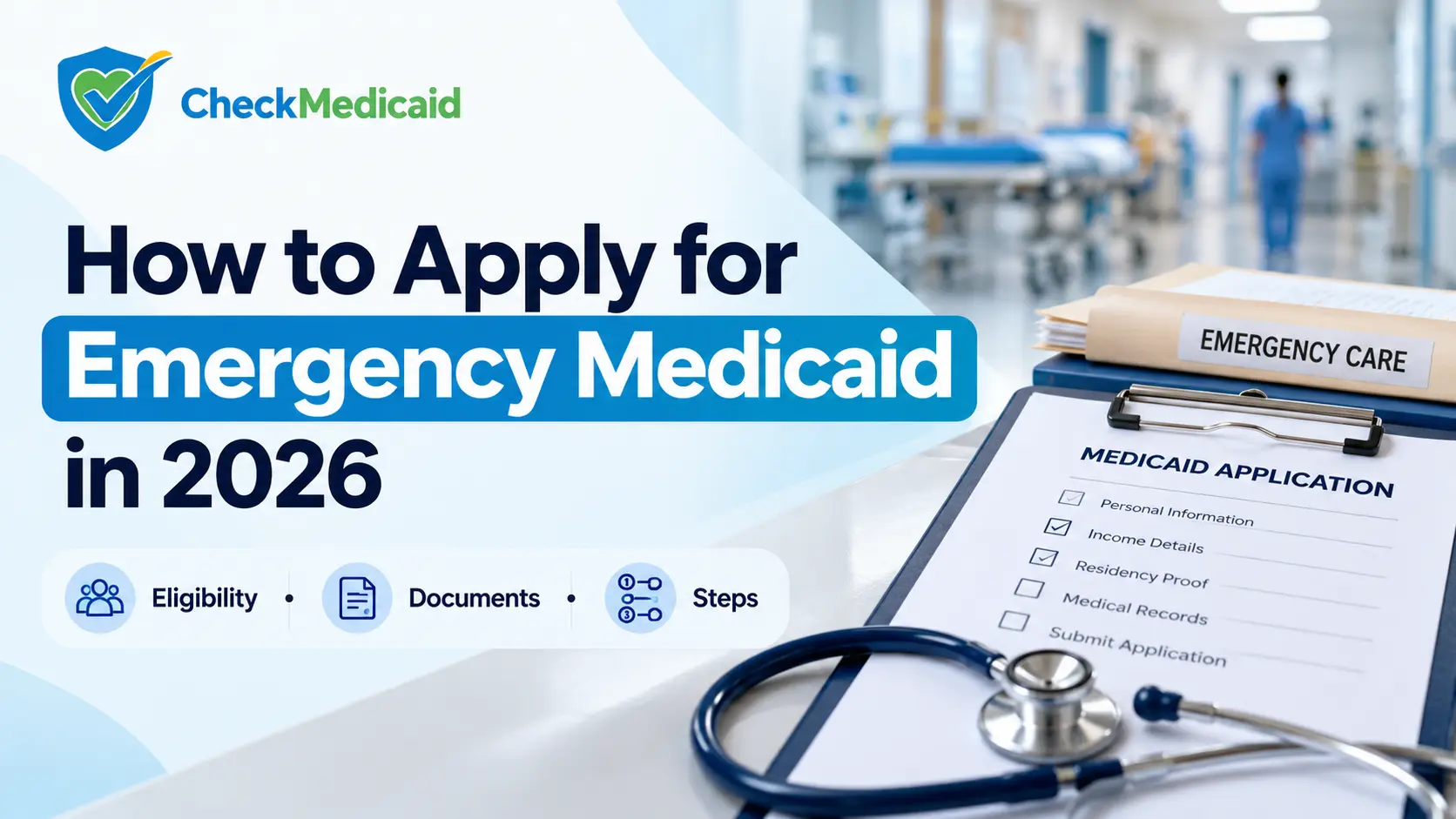
- Proof of identity (driver’s license, ID card, passport)
- Proof of income (pay stubs, tax returns)
- Social Security numbers for all household members
- Proof of citizenship or immigration status
- Health insurance information (if applicable)
📄 Key Documents for SNAP
- Proof of identity (driver’s license, ID card, passport)
- Proof of income (pay stubs, unemployment benefits, child support)
- Proof of residency (lease agreement, utility bills)
- Social Security numbers for all household members
- Expenses information (rent/mortgage, utilities, childcare)
Frequently Asked Questions
Do I qualify for Medicaid in 2026 if I have a job?
Yes. Employment doesn't disqualify you — Medicaid eligibility is based on your household's gross monthly income compared to your state's 2026 limits. Many working adults, especially those with children or lower-wage jobs, still fall within the qualifying range. Use our calculator to see where your household stands.
What are the Medicaid income limits for 2026?
It depends on which Medicaid group you fall into. For children, pregnant women, and expansion adults, limits are tied to the Federal Poverty Level (FPL) — in most expansion states, adults under 65 qualify up to about 138% of FPL. For seniors and people who are aged, blind, or disabled, limits are usually tied to SSI benefit levels instead. Long-term care and nursing home Medicaid have their own separate, generally higher, monthly income caps. Because every state sets its own specific dollar figures, check our state-by-state chart for your exact 2026 numbers.
What are the new Medicaid work requirements starting in 2026?
A 2025 federal law now requires many adults ages 19–64 in the Medicaid expansion group to complete at least 80 hours a month of work, job training, schooling, or community service to keep their coverage, unless they qualify for an exemption. States must have this in place nationwide by January 1, 2027, though several states are rolling it out sooner.
Has my state already started enforcing Medicaid work requirements?
A handful of states moved early: Nebraska began enforcement in May 2026, and Montana and Arkansas followed in July 2026 (Arkansas is notifying enrollees first but won't remove anyone from coverage until 2027). Iowa is set to start in December 2026. Georgia has been running its own version of work requirements since 2023. Every other expansion state is expected to be up and running by the January 1, 2027 federal deadline, so it's worth checking directly with your state Medicaid agency for your specific start date.
Who is exempt from the 2026 Medicaid work requirements?
Common exemptions include people who are pregnant, caring for a young child, enrolled in school at least half-time, or considered medically frail, along with other state-specific hardship categories. Exact exemption rules can differ by state, and the definition of "medically frail" is currently being challenged in court by a group of states, so this area may keep evolving through the rest of 2026.
Will I have to renew my Medicaid coverage more often in 2026?
For many enrollees, yes. The same 2025 federal law that created work requirements also moves eligibility renewals for the expansion population from once a year to twice a year, starting at the end of 2026. That means more frequent paperwork and a higher chance of a gap in coverage if a renewal is missed, so it's important to respond promptly to any notice from your state.
What happens if my income changes after I'm approved for Medicaid?
You're required to report significant changes in household income or size to your state Medicaid agency. A change could affect your eligibility or benefit amount, and with reviews becoming more frequent in 2026, reporting changes as soon as they happen helps you avoid an unexpected loss of coverage later.
Is CheckMedicaid an official government website?
No. This site is an independent informational resource, not a government agency. We provide guides and calculators to help you understand your likely eligibility, but final decisions are always made by your state Medicaid office. Use the official portal link below to actually apply.