
Written & Reviewed by Akash Biswas, MSW | Former Medicaid Caseworker Trainer | Verified against Medicaid.gov and Utah Medicaid official guidelines | Last Updated: May 2026
Quick Summary
- Most adults in Utah qualify if they earn at or below 138% of the Federal Poverty Level (FPL)
- Children and pregnant women qualify at up to 144% FPL
- CHIP covers children up to about 200% FPL
- No asset test for most working-age adults and families
- Seniors and people with disabilities follow different income and asset rules
- 👉 Use our free Medicaid Eligibility Calculator in 2026 to check your income in minutes
What Is Medicaid?
Medicaid is a free or low-cost health insurance program. The federal government and your state share the cost.
It covers millions of low-income people across the U.S. In Utah, the program is managed by the Utah Department of Health and Human Services, with eligibility handled by the Department of Workforce Services (DWS).
Who Qualifies for Medicaid in Utah in 2026?
Utah expanded Medicaid in 2019 under the Affordable Care Act. This means most low-income adults can now qualify — not just parents or people with disabilities.
You may qualify if you fall into one of these groups:
| Eligibility Group | Age | Income Limit |
|---|---|---|
| ACA Expansion Adults | 19–64 | 138% FPL |
| Children | 0–18 | 144% FPL |
| Pregnant Women | Any | 144% FPL |
| CHIP (uninsured children) | 0–18 | ~200% FPL |
| Seniors / Long-Term Care | 65+ | Varies by program |
| People with Disabilities (ABD) | Any | 100% FPL |
To qualify for any Utah Medicaid program, you must also:
- Be a Utah resident
- Be a U.S. citizen or have qualifying immigration status
- Have or apply for a Social Security number
- Meet the income rules for your specific program
To learn how Utah’s rules compare to other states, see our full guide on Medicaid Income Limits by State in 2026.
Utah Medicaid Income Limits 2026
Income is measured using Modified Adjusted Gross Income (MAGI) for most programs. This includes wages, self-employment, Social Security, and other income. Child support received and SSI payments do not count.
There is no asset test for MAGI-based programs. That means savings and property do not disqualify you.
ACA Medicaid Expansion — Adults Ages 19–64 (138% FPL)
| Household Size | Monthly Limit | Annual Limit |
|---|---|---|
| 1 | $1,835 | $22,025 |
| 2 | $2,489 | $29,863 |
| 3 | $3,142 | $37,702 |
| 4 | $3,795 | $45,540 |
| 5 | $4,448 | $53,378 |
| 6 | $5,101 | $61,217 |
| 7 | $5,755 | $69,055 |
| 8 | $6,408 | $76,894 |
Each additional person adds approximately $632/month to the limit.
Source: Calculated from 2026 HHS Federal Poverty Guidelines at 138% FPL
Medicaid for Children Ages 0–18 (144% FPL)
| Household Size | Monthly Limit | Annual Limit |
|---|---|---|
| 1 | $1,915 | $22,982 |
| 2 | $2,597 | $31,164 |
| 3 | $3,278 | $39,336 |
| 4 | $3,960 | $47,520 |
| 5 | $4,642 | $55,704 |
| 6 | $5,323 | $63,876 |
| 7 | $6,005 | $72,060 |
| 8 | $6,686 | $80,232 |
Each additional person adds approximately $682/month.
The unborn child counts as a household member when calculating family size.
Medicaid for Pregnant Women (144% FPL)
Pregnant women qualify under the same 144% FPL threshold as children. Your unborn baby is counted as a family member.
| Household Size (includes unborn) | Monthly Limit | Annual Limit |
|---|---|---|
| 2 | $2,597 | $31,164 |
| 3 | $3,278 | $39,336 |
| 4 | $3,960 | $47,520 |
| 5 | $4,642 | $55,704 |
| 6 | $5,323 | $63,876 |
Postpartum coverage continues for 12 months after delivery. Presumptive eligibility allows prenatal care to start right away while your application is reviewed.
CHIP — Children’s Health Insurance Program (~200% FPL)
Children who earn too much for Medicaid may still qualify for Utah CHIP. CHIP covers uninsured children under age 19.
| Family Size | Monthly Limit | Annual Limit |
|---|---|---|
| 2 | $3,607 | $43,284 |
| 3 | $4,554 | $54,648 |
| 4 | $5,500 | $66,600 |
| 5 | $6,447 | $77,364 |
| 6 | $7,394 | $88,728 |
| 7 | $8,340 | $100,080 |
| 8 | $9,287 | $111,444 |
Source: chip.utah.gov — Effective March 2026
Utah CHIP is managed through three health plans: Molina Healthcare, SelectHealth, and Healthy U.
Long-Term Care Medicaid for Seniors (Ages 65+)
Seniors applying for nursing home or home-based care follow different rules. These programs use “countable income” — not MAGI. Asset limits also apply.
| Program | Income Limit | Asset Limit |
|---|---|---|
| Nursing Home (single) | No income limit* | $2,000 |
| Nursing Home (married, both applying) | No income limit* | $4,000 total |
| Aging Waiver (HCBS) — single | $1,330/month | $2,000 |
| New Choices Waiver — single | $2,982/month | $2,000 |
| Regular Medicaid / ABD — single | $1,330/month | $2,000 |
| Regular Medicaid / ABD — couple | $1,803/month | $3,000 |
For nursing home care, most monthly income goes toward the cost of care. A $45/month Personal Needs Allowance is kept by the resident.
Spousal Protections in 2026
When only one spouse needs long-term care, the other spouse is protected:
- Minimum monthly income kept: $2,644/month
- Maximum monthly income kept: $4,066.50/month
- Assets the at-home spouse may keep: Up to $162,660
- Home equity exemption: Up to $752,000
Utah has a 60-month (5-year) look-back rule. Asset transfers made for less than fair market value within 5 years of applying may cause a penalty period.
Medically Needy / Spenddown Program
If your income is too high for regular Medicaid, you may still qualify through Utah’s Spenddown Program. You subtract qualifying medical bills from your income until you reach the limit below.
- Income limit (single): $1,330/month
- Income limit (couple): $1,803/month
- Asset limit: $2,000 (single) | $3,000 (couple)
Effective: March 1, 2026 – February 28, 2027
2026 Federal Poverty Level (FPL) Reference Table
All Medicaid income limits are based on the 2026 HHS Federal Poverty Guidelines.
| Household Size | Annual (100% FPL) | Monthly (100% FPL) |
|---|---|---|
| 1 | $15,960 | $1,330 |
| 2 | $21,640 | $1,803 |
| 3 | $27,320 | $2,277 |
| 4 | $33,000 | $2,750 |
| 5 | $38,680 | $3,223 |
| 6 | $44,360 | $3,697 |
| 7 | $50,040 | $4,170 |
| 8 | $55,720 | $4,643 |
Each additional person above 8 adds $5,680/year ($473/month).
Source: HHS ASPE 2026 Poverty Guidelines
For a full breakdown by coverage group, visit our guide on Utah Medicaid Eligibility in 2026.
What Does Utah Medicaid Cover?
Utah Medicaid covers a wide range of health services. Most enrollees receive care through a managed care plan.
Here is what is typically covered:
- Doctor visits and preventive care
- Hospital stays (inpatient and outpatient)
- Prescription drugs (through Utah’s preferred drug list)
- Mental health and substance use treatment
- Prenatal and postpartum care
- Vision and dental (limited for adults)
- Lab tests and X-rays
- Home- and community-based services (for qualifying seniors and people with disabilities)
- Long-term care (nursing facility and waiver programs)
Note on GLP-1 medications (e.g., Ozempic): As of January 2026, these require a Type 2 diabetes diagnosis (ICD-10 code) to be covered under Utah Medicaid managed care plans.
How to Apply for Medicaid in Utah
Applying is free. Here are your options:
Step 1 — Gather your documents. You will need proof of income, residency, ID, and Social Security number.
Step 2 — Choose how to apply.
| Method | Details |
|---|---|
| Online | jobs.utah.gov/mycase |
| By phone | DWS Eligibility: 1-866-435-7414 |
| In person | Visit your local DWS office |
| Medicaid questions | 1-800-662-9651 or medicaid.utah.gov |
Step 3 — Submit your application. You can apply any time — there is no open enrollment period for Medicaid.
Step 4 — Wait for a decision. Most applications are processed within 45 days. Disability-related cases may take up to 90 days.
Step 5 — Receive your Medicaid card. Once approved, you will get your card in the mail. Coverage usually begins on the first of the month you applied.
What Happens After You Apply?
After submitting your application, here is what to expect.
Processing Timeline
- Standard applications: Up to 45 days
- Disability-related applications: Up to 90 days
- Pregnancy applications: Faster review — presumptive eligibility may start immediately
Retroactive Coverage
Utah may cover medical bills from up to 3 months before your application date. Ask about this when you apply.
Annual Renewal
You must renew your Medicaid every year. Utah will mail you a renewal notice. Make sure your address is up to date with DWS.
2026 Policy Changes to Know
The One Big Beautiful Bill Act (OBBBA), signed in July 2025, will bring several changes:
- Work requirements of 80 hours/month will be required for expansion adults by January 1, 2027
- Some non-citizen enrollees may lose eligibility starting fall 2026
- CHIP continues through June 2028
Exemptions from work requirements include pregnant and postpartum individuals, caregivers of dependent children, people in substance use disorder treatment, and recently incarcerated individuals.
Utah also proposed a separate state-level work requirement waiver in 2025. As of April 2026, it has not been approved by CMS. Current Medicaid rules remain in effect.
To understand how reimbursement rates may affect your providers, see our guide on the Medicaid Fee Schedule in 2026.
Frequently Asked Questions (FAQ)
Q: What are the Medicaid income limits in Utah for 2026?
A: Most adults qualify at up to 138% FPL — about $1,835/month for one person or $3,795/month for a family of four. Children and pregnant women qualify at up to 144% FPL. CHIP covers children up to about 200% FPL. Seniors and people with disabilities follow different rules based on their program.
Q: Does Utah Medicaid cover dental in 2026?
A: Utah Medicaid covers limited dental services for adults, including emergency extractions and basic care. Children generally receive more comprehensive dental coverage under Medicaid and CHIP. Contact your managed care plan for a full list of covered dental benefits.
Q: How long does Utah Medicaid take to approve?
A: Most standard applications are decided within 45 days. Disability-related cases may take up to 90 days. Pregnant women may receive presumptive eligibility, which allows prenatal care to start right away while the application is reviewed.
Q: Can I get Medicaid if I have a job in Utah?
A: Yes. Having a job does not disqualify you. What matters is your total household income. If your income falls within the limits for your household size and program group, you can qualify — even if you work full time.
Q: What is the asset limit for Utah Medicaid in 2026?
A: There is no asset test for most working-age adults, children, and pregnant women (MAGI-based programs). For seniors and people with disabilities, the asset limit is generally $2,000 for a single person and $3,000 for a couple. The home and one vehicle are typically exempt.
Q: Will work requirements affect my Utah Medicaid in 2026?
A: Not immediately. Work requirements under the federal OBBBA law are not required until January 1, 2027. A separate Utah state waiver has also been proposed but has not yet been approved by CMS as of April 2026. Your coverage is not affected right now.
Sources & Disclaimer
Sources:
- Medicaid.gov — Official Medicaid Information
- Healthcare.gov — Medicaid & CHIP Overview
- Utah Medicaid — medicaid.utah.gov
- Utah CHIP — chip.utah.gov
- HHS ASPE 2026 Federal Poverty Guidelines
- Utah Department of Workforce Services — jobs.utah.gov/mycase
Disclaimer: CheckMedicaid.com is not affiliated with any government agency. This content is for educational purposes only. For official eligibility determinations, contact the Utah Department of Workforce Services at 1-866-435-7414 or visit medicaid.utah.gov.
Last Updated: April 2026
Utah Medicaid Income Limits 2025 (Monthly Income)
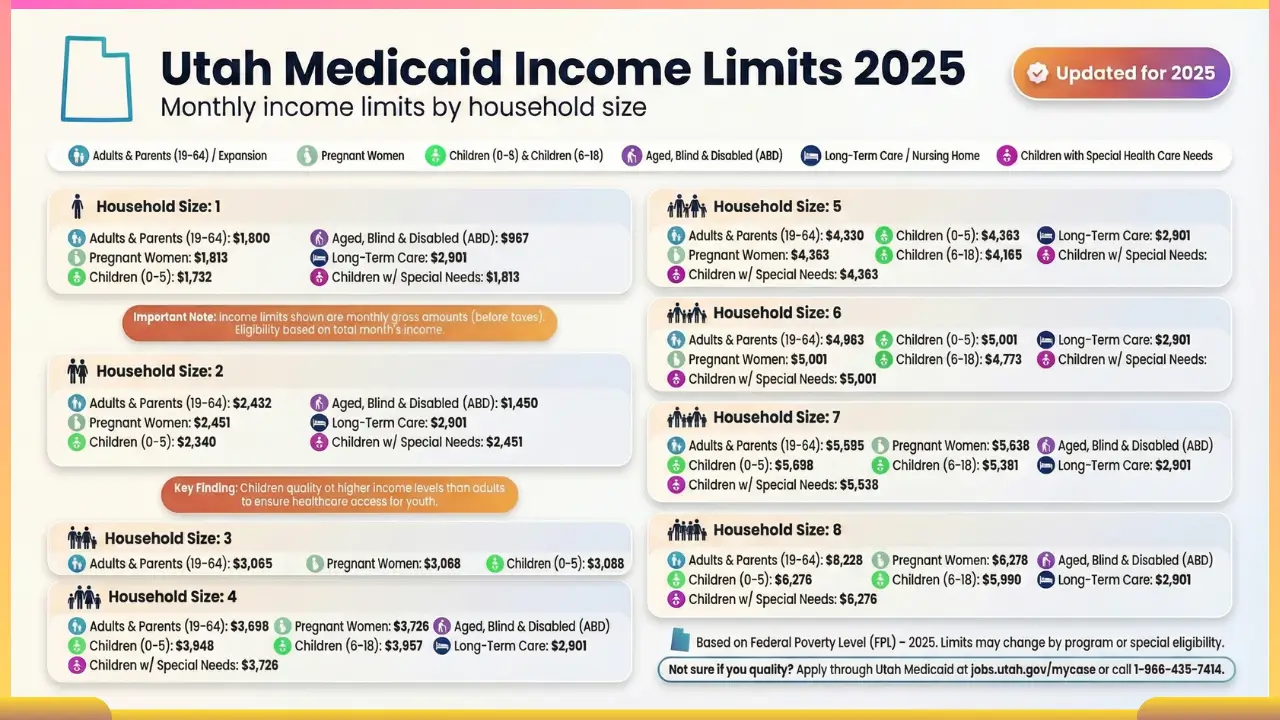
🏠 Household Size: 1 Person
- Adults (19–64) / Expansion Adults (138% FPL): $1,800
- Pregnant Women (139% FPL): $1,813
- Children (0–5): $1,813
- Children (6–18): $1,732
- Parents & Caregivers: $1,800
- Aged, Blind & Disabled (ABD – SSI level): $967
- Long-Term Care / Nursing Home (300% SSI): $2,901
- Children with Special Health Care Needs: $1,813
🏠 Household Size: 2 People
- Adults / Expansion Adults: $2,432
- Pregnant Women: $2,451
- Children (0–5): $2,451
- Children (6–18): $2,340
- Parents & Caregivers: $2,432
- ABD (SSI level): $1,450
- Long-Term Care / Nursing Home: $2,901
- Children with Special Health Care Needs: $2,451
🏠 Household Size: 3 People
- Adults / Expansion Adults: $3,065
- Pregnant Women: $3,088
- Children (0–5): $3,088
- Children (6–18): $2,948
- Parents & Caregivers: $3,065
- ABD (SSI level): $1,450
- Long-Term Care / Nursing Home: $2,901
- Children with Special Health Care Needs: $3,088
🏠 Household Size: 4 People
- Adults / Expansion Adults: $3,698
- Pregnant Women: $3,726
- Children (0–5): $3,726
- Children (6–18): $3,557
- Parents & Caregivers: $3,698
- ABD (SSI level): $1,450
- Long-Term Care / Nursing Home: $2,901
- Children with Special Health Care Needs: $3,726
🏠 Household Size: 5 People
- Adults / Expansion Adults: $4,330
- Pregnant Women: $4,363
- Children (0–5): $4,363
- Children (6–18): $4,165
- Parents & Caregivers: $4,330
- ABD (SSI level): $1,450
- Long-Term Care / Nursing Home: $2,901
- Children with Special Health Care Needs: $4,363
🏠 Household Size: 6 People
- Adults / Expansion Adults: $4,963
- Pregnant Women: $5,001
- Children (0–5): $5,001
- Children (6–18): $4,773
- Parents & Caregivers: $4,963
- ABD (SSI level): $1,450
- Long-Term Care / Nursing Home: $2,901
- Children with Special Health Care Needs: $5,001
🏠 Household Size: 7 People
- Adults / Expansion Adults: $5,595
- Pregnant Women: $5,638
- Children (0–5): $5,638
- Children (6–18): $5,381
- Parents & Caregivers: $5,595
- ABD (SSI level): $1,450
- Long-Term Care / Nursing Home: $2,901
- Children with Special Health Care Needs: $5,638
🏠 Household Size: 8 People
- Adults / Expansion Adults: $6,228
- Pregnant Women: $6,276
- Children (0–5): $6,276
- Children (6–18): $5,990
- Parents & Caregivers: $6,228
- ABD (SSI level): $1,450
- Long-Term Care / Nursing Home: $2,901
- Children with Special Health Care Needs: $6,276
✅ Quick Tips for Readers
- Amounts are monthly gross income limits
- Children have higher limits than adults
- Long-term care uses a fixed SSI-based limit
- ABD limits are much lower than expansion Medicaid
| Household Size | Adults (Age 19–64) (138% FPL) | Pregnant Women (139% FPL) | Children (0–18) (139% FPL for 0-5; 133% for 6-18) | Parents & Caregivers (138% FPL) | Aged, Blind, & Disabled (ABD) (SSI Level) | Long-Term Care / Nursing Home (300% SSI) | Medicaid Expansion Adults (138% FPL) | Children with Special Health Care Needs (139% FPL) |
| 1 | $1,800 | $1,813 | $1,813 (0-5); $1,732 (6-18) | $1,800 | $967 | $2,901 | $1,800 | $1,813 |
| 2 | $2,432 | $2,451 | $2,451 (0-5); $2,340 (6-18) | $2,432 | $1,450 | $2,901 | $2,432 | $2,451 |
| 3 | $3,065 | $3,088 | $3,088 (0-5); $2,948 (6-18) | $3,065 | $1,450 | $2,901 | $3,065 | $3,088 |
| 4 | $3,698 | $3,726 | $3,726 (0-5); $3,557 (6-18) | $3,698 | $1,450 | $2,901 | $3,698 | $3,726 |
| 5 | $4,330 | $4,363 | $4,363 (0-5); $4,165 (6-18) | $4,330 | $1,450 | $2,901 | $4,330 | $4,363 |
| 6 | $4,963 | $5,001 | $5,001 (0-5); $4,773 (6-18) | $4,963 | $1,450 | $2,901 | $4,963 | $5,001 |
| 7 | $5,595 | $5,638 | $5,638 (0-5); $5,381 (6-18) | $5,595 | $1,450 | $2,901 | $5,595 | $5,638 |
| 8 | $6,228 | $6,276 | $6,276 (0-5); $5,990 (6-18) | $6,228 | $1,450 | $2,901 | $6,228 | $6,276 |