Written & Reviewed by Akash Biswas, MSW | Former Medicaid Caseworker Trainer | Verified against PA Department of Human Services and Medicaid.gov official guidelines | Last Updated: June 2026
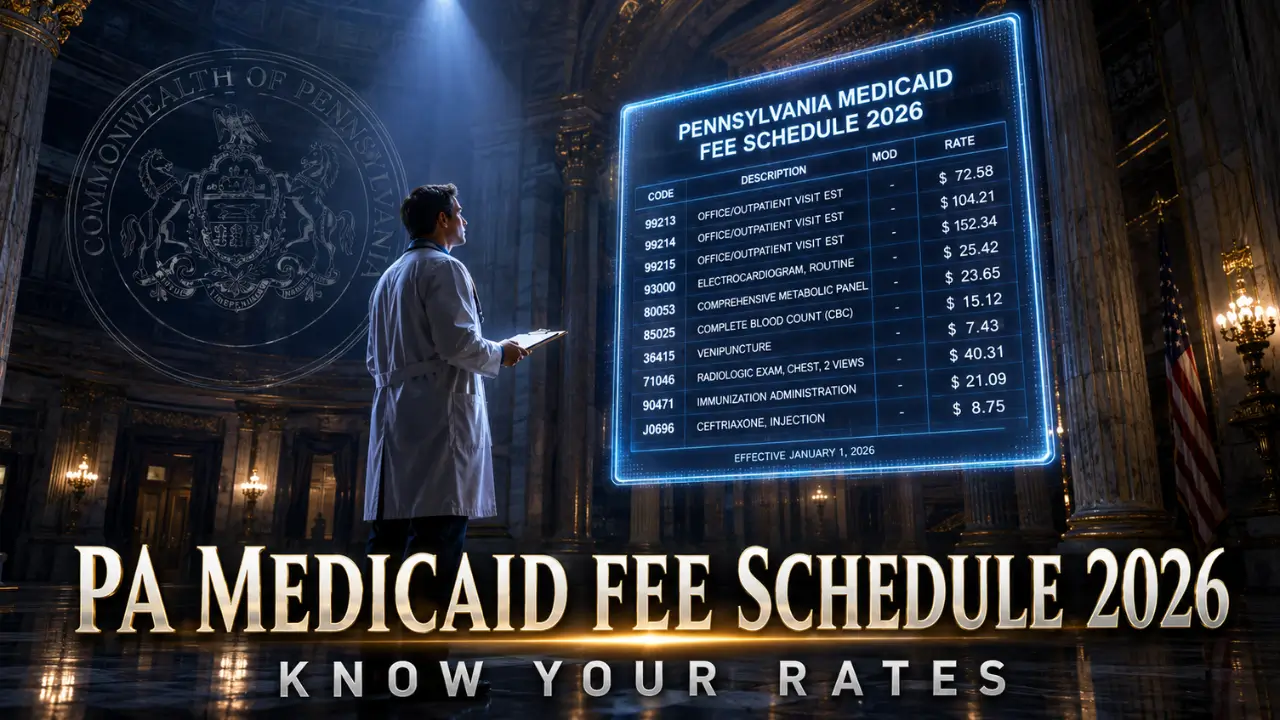
The Pennsylvania Medicaid fee schedule for 2026 is a live, daily-updated database managed by the PA Department of Human Services (DHS).
There is no single static document — providers must look up rates by procedure code using the official online tool.
This guide explains how to access current rates, what changed in 2026, and who qualifies for Pennsylvania Medicaid.
Quick Summary:
- PA Medicaid rates are updated daily in the online DHS fee schedule database
- The biggest 2026 change is the addition of Psychiatric Rehabilitation Services (PRS) to the fee schedule, effective January 1, 2026
- Income limits for regular Medicaid (aged/disabled) are approximately $1,016/month for a single person
- Long-term care and waiver services allow income up to $2,982/month
- Providers must use the PROMISe™ portal or DHS online search tool to look up specific procedure code rates
- 🔗 Use our Medicaid Eligibility Calculator in 2026 to check if your patient qualifies before billing
What Is the Pennsylvania Medicaid Fee Schedule?
The Pennsylvania Medicaid fee schedule is a list of approved reimbursement rates for medical services. It tells providers how much the state will pay for each service.
In Pennsylvania, this schedule is called the PROMISe™ Outpatient Fee Schedule. It is managed by the PA Department of Human Services (DHS) and updated more frequently than most state Medicaid fee schedules.
Who Uses the PA Medicaid Fee Schedule?
The fee schedule is used by hospitals, doctors, therapists, and other health care providers. It applies to services billed directly to Medicaid, also called fee-for-service (FFS) billing.
Providers who work through HealthChoices managed care plans may follow a different rate structure. Those rates are set by each Managed Care Organization (MCO) under contract with the state.
How Often Is It Updated?
The downloadable version of the outpatient fee schedule is updated quarterly. The most recent quarterly update was March 10, 2026.
The online search tool, however, is updated every day. For the most accurate rate, always check the online database directly rather than a downloaded file.
How to Access the Pennsylvania Medicaid Fee Schedule in 2026
As of June 2026, Pennsylvania does not publish one master PDF of all rates. Instead, rates are searchable by procedure code in two ways.
Here is how to find the exact reimbursement rate for any service:
Option 1: PA DHS Online Fee Schedule (No Login Required)
This is the fastest option for looking up a specific code.
Steps to use the tool:
- Go to the PA DHS Medical Assistance Fee Schedule page
- Click “Search Fee Schedule”
- Enter your Procedure Code (CPT or HCPCS) — for example, 99213 for an office visit
- Or enter your Provider Type to see all codes for your specialty
- Check the “Effective Date” column to confirm the rate is active for 2026
This database is updated daily, so it reflects the most current approved rates.
Option 2: PROMISe™ Provider Portal (Login Required)
This portal requires a PA Medicaid Provider ID to log in. Once inside, providers can download the full outpatient fee schedule in Excel, PDF, or CSV format.
The downloadable file is updated quarterly. The last update was March 10, 2026.
Option 3: Medical Assistance Bulletins (MABs)
DHS publishes official rate changes through Medical Assistance Bulletins. These are the formal notices that announce new rates, new procedure codes, or policy changes.
Bookmark the PA Bulletin search page and search for “Medical Assistance” to find the latest transmittals.
2026 Pennsylvania Medicaid Fee Schedule Updates
Several important changes took effect in 2026. Providers should review each one carefully.
Psychiatric Rehabilitation Services (PRS) Added — January 1, 2026
This is the most significant fee schedule change for 2026. PRS services are now billed directly as a State Plan service under Medical Assistance.
Before 2026, PRS was primarily available only through managed care plans as an “in lieu of” service. Now, providers can bill fee-for-service. Specific confirmed rates include:
| Procedure Code + Modifier | Description | Rate (Per 15 Min) |
|---|---|---|
| H0036 + U7 | PRS — Individual | $23.50 |
| H0036 + U9 | PRS — Group | $27.07 |
These rates are sourced from PA DHS Office of Mental Health & Substance Abuse Bulletin OMHSAS-26-01, effective January 1, 2026.
Managed Care Contract Renewals — January 1, 2026
DHS has renewed contracts with all HealthChoices Managed Care Organizations (MCOs) for January 1, 2026 through December 31, 2026. This ensures continuity for providers billing through managed care plans rather than the state fee schedule.
If you are a network provider with a HealthChoices plan, your rates are set by your MCO contract — not the state fee schedule.
Medicare Benchmark Reference
Pennsylvania Medicaid rates are set independently from Medicare. However, some Medicaid contracts reference a percentage of the Medicare allowable rate.
For 2026, the Medicare Physician Fee Schedule conversion factor increased by 2.93%. Providers with Medicaid contracts tied to Medicare rates should check whether this affects their reimbursement. Contact your MCO or DHS contract manager to confirm.
Integrated Community Wellness Centers (ICWC) — January 1, 2026
A minimum fee schedule for ICWC services is in effect from January 1, 2026 through December 31, 2026. A risk-based rate adjustment of up to $49,874,341 has been incorporated into capitation rates for this program.
Supports Coordination (SC) Rates — Effective July 1, 2026
New final fee schedule rates for Supports Coordination services were published March 7, 2026, and take effect July 1, 2026. These rates apply to Medicaid waiver programs for individuals with intellectual disabilities and autism spectrum disorders.
Nursing Facility Care — MA Long-Term Care Penalty Divisor
For 2026, the Medicaid nursing facility penalty divisor is $12,811.50 per month, equal to $421.20 per day. This figure is used when calculating Medicaid eligibility penalties for asset transfers.
2026 Pennsylvania Medicaid Income Limits
The fee schedule only matters for patients who are enrolled in Medicaid. Here are the confirmed 2026 income limits for Pennsylvania. For a full national comparison, see Medicaid Income Limits by State in 2026.
| Category | Monthly Income Limit | Asset Limit |
|---|---|---|
| Regular Medicaid (Aged/Disabled) | ~$1,016 / month | $2,000 |
| Long-Term Care / Waiver (HCBS) | $2,982 / month | $2,000 |
| Community Spouse (minimum allowance) | $2,705 / month | N/A |
| HealthChoices (ACA Expansion, 138% FPL) | $2,002 / month (2026 est.) | None |
Note: The Home and Community-Based Services (HCBS) waiver income limit of $2,982/month allows many seniors to receive care at home instead of in a nursing facility. This is a key benefit of Pennsylvania’s Medicaid waiver programs.
Income limits are based on Modified Adjusted Gross Income (MAGI) for most adult groups. For aged, blind, and disabled programs, different counting rules apply.
Source: PA DHS Medicaid and Medicaid.gov
Who Qualifies for Pennsylvania Medicaid in 2026?
Medicaid in Pennsylvania covers several groups of people. To understand full eligibility requirements across all categories, visit our guide on Medicaid Eligibility in 2026.
Eligibility Categories
| Group | Key Requirement |
|---|---|
| Adults (ACA Expansion) | Income at or below 138% FPL (~$20,120/year for a single person) |
| Children (CHIP/Medicaid) | Varies by age; up to 300% FPL for CHIP |
| Pregnant Women | Up to 200% FPL during pregnancy |
| Aged (65+) | Income ~$1,016/month; must meet asset test |
| Blind or Disabled | SSI-related criteria; income ~$1,016/month |
| Long-Term Care / Waiver | Income up to $2,982/month; functional need required |
Pennsylvania accepted the ACA Medicaid expansion. This means low-income adults without children can qualify. Income is measured against the Federal Poverty Level (FPL).
What About Assets?
For aged, blind, and disabled applicants, there is a $2,000 asset limit for a single person. The family home, one vehicle, and personal belongings are generally excluded from this count.
For ACA expansion adults, there is no asset limit.
What Does Pennsylvania Medicaid Cover?
Pennsylvania Medicaid covers a broad range of health services. Coverage varies slightly depending on whether a person is enrolled in fee-for-service or a HealthChoices managed care plan.
Core Benefits
- Doctor visits (primary care and specialist)
- Hospital care (inpatient and outpatient)
- Emergency services
- Prescription drugs
- Mental health and behavioral health services
- Psychiatric Rehabilitation Services (PRS) — expanded in 2026
- Substance use disorder treatment
- Lab tests and X-rays
- Preventive care and screenings
- Dental services (limited for adults; full coverage for children)
- Vision care
- Medical equipment and supplies
- Home and Community-Based Services (HCBS)
- Nursing facility care
Dental Coverage in Pennsylvania Medicaid
Adult dental benefits are available but limited. Specific rates must be looked up by procedure code. For example, use code D0120 (periodic oral evaluation) in the DHS online fee schedule to find the current reimbursement rate.
Children enrolled in Medicaid or CHIP receive more comprehensive dental benefits.
Sector-Specific Fee Schedule Insights
Some service areas have unique billing considerations in 2026. Here is what providers in key sectors need to know.
Home and Community-Based Services (HCBS)
Home care is one of the most active areas of Medicaid policy debate in Pennsylvania right now.
The current effective reimbursement rate for home care workers is approximately $20.63 per hour. However, provider organizations report this rate is not enough to recruit and retain workers. Industry advocates argue a rate of $25.00 or more per hour is needed to maintain an adequate workforce.
Action item for HCBS providers: Monitor Medical Assistance Bulletins closely. Legislative adjustments to home care codes — such as W1793 — are possible mid-year. Any rate increase must be passed through to direct care workers under DHS rules.
Academic Medical Center (AMC) Professional Services
A uniform percentage increase to fee schedule rates for AMC professional services is in effect from January 1, 2026 through December 31, 2026. A separate payment term of up to $38,000,000 applies to qualifying institutions.
This was confirmed by a Medicaid.gov state resource approval dated December 4, 2025.
Behavioral Health — Managed Care vs. Fee-for-Service
Since January 1, 2026, providers billing PRS services have the option of fee-for-service billing through the State Plan. Prior to this, PRS was only available through HealthChoices managed care plans.
This is a major change for behavioral health organizations. If you previously billed PRS through your MCO only, you may now have the option to bill directly to Medicaid.
How to Apply for Pennsylvania Medicaid in 2026
The fee schedule is for providers. But patients must be enrolled before any claims can be paid. Here are the steps to apply.
- Check your income. Compare your household income to the limits in the table above.
- Gather documents. You will need proof of income, identity, residency, and household size.
- Apply online. Go to COMPASS — Pennsylvania’s online benefits portal.
- Apply by phone. Call 1-800-692-7462 to apply or get help.
- Apply in person. Visit your local County Assistance Office (CAO).
- Submit your application. Processing typically takes up to 45 days, or 90 days for disability cases.
You can also apply through a hospital, community health center, or Medicaid outreach worker.
What Happens After You Apply?
After you submit your Pennsylvania Medicaid application, here is what to expect.
Step 1 — Review: DHS reviews your application and verifies your information. This can include checking income records electronically.
Step 2 — Decision: Most applicants receive a decision within 45 days. Disability cases may take up to 90 days.
Step 3 — Notification: You will receive a letter by mail with the decision. If approved, the letter will include your coverage start date and enrollment information.
Step 4 — Medicaid Card: Approved members receive a Pennsylvania ACCESS card (EBT-style card) for Medicaid services. Keep this card safe and bring it to all medical appointments.
Step 5 — Plan Enrollment: Most members are enrolled in a HealthChoices managed care plan. You will choose a plan and a primary care provider (PCP).
Renewal: Pennsylvania Medicaid must be renewed annually. You will receive a renewal notice before your coverage expires.
Pennsylvania Medicaid Fee Schedule vs. Other States
Wondering how Pennsylvania compares to national Medicaid rates and coverage? Use our Medicaid Fee Schedule in 2026 guide for a national overview and state comparisons.
Pennsylvania generally ranks in the mid-tier for Medicaid reimbursement rates nationally. The state’s daily-updated online fee schedule is more transparent than many other states, which only update quarterly or annually.
Frequently Asked Questions (FAQ)
Q: Where can I find the Pennsylvania Medicaid fee schedule for 2026?
A: The official fee schedule is searchable at the PA DHS Medical Assistance Fee Schedule page. It updates daily. Enter any CPT or HCPCS procedure code to see the current reimbursement rate. A downloadable version is available through the PROMISe™ provider portal with a Provider ID login. The last quarterly download update was March 10, 2026.
Q: What changed in the Pennsylvania Medicaid fee schedule in 2026?
A: The biggest 2026 change is the addition of Psychiatric Rehabilitation Services (PRS) as a fee-for-service State Plan benefit, effective January 1, 2026. Supports Coordination rates were also updated, effective July 1, 2026. Managed care contracts were renewed for the full calendar year. Check Medical Assistance Bulletins for any mid-year updates.
Q: Does Pennsylvania Medicaid cover dental in 2026?
A: Yes, but adult dental coverage is limited. Children in Medicaid and CHIP receive more comprehensive dental benefits. Specific adult dental rates are found by searching procedure codes (e.g., D0120) in the online DHS fee schedule database. Contact your HealthChoices plan to confirm which dental services are covered under your plan.
Q: What is the income limit for Pennsylvania Medicaid in 2026?
A: For regular Medicaid (aged/disabled), the limit is approximately $1,016/month for a single person. For the ACA Medicaid expansion (HealthChoices), the limit is 138% of the Federal Poverty Level — about $22,025/year for a single adult. Long-term care and waiver programs allow income up to $2,982/month.
Q: How long does Pennsylvania Medicaid take to approve?
A: Most Pennsylvania Medicaid applications are processed within 45 days. If your application involves a disability determination, it can take up to 90 days. You can check your application status online through the COMPASS portal or by calling 1-800-692-7462.
Q: Can providers bill PRS services fee-for-service in Pennsylvania in 2026?
A: Yes. As of January 1, 2026, Psychiatric Rehabilitation Services (PRS) are available as a State Plan fee-for-service benefit. Providers can now bill directly to Medicaid using specific H0036 procedure codes with applicable modifiers (e.g., U7 or U9). Previously, PRS was only available through HealthChoices managed care plans.
Sources & Disclaimer
Sources:
- Pennsylvania Department of Human Services — MA Fee Schedule
- Medicaid.gov — Official U.S. Medicaid Information
- Healthcare.gov — Medicaid & CHIP Overview
- PA DHS OMHSAS Bulletin 26-01 — PRS MA Fee Schedule, effective January 1, 2026
- PA Bulletin, March 8, 2026 — Supports Coordination Rate Update
- Medicaid.gov State Resource: PA_Fee_Oth_Renewal_20260101-20261231
Last Updated: June 2026
Disclaimer: CheckMedicaid.com is not affiliated with any government agency. This content is for educational purposes only. For official eligibility determinations, contact the Pennsylvania Department of Human Services or visit Medicaid.gov.