By Akash Biswas / Updated August 24, 2026
- Home / Medicaid Update / Medicaid Work Requirements 2026–2027
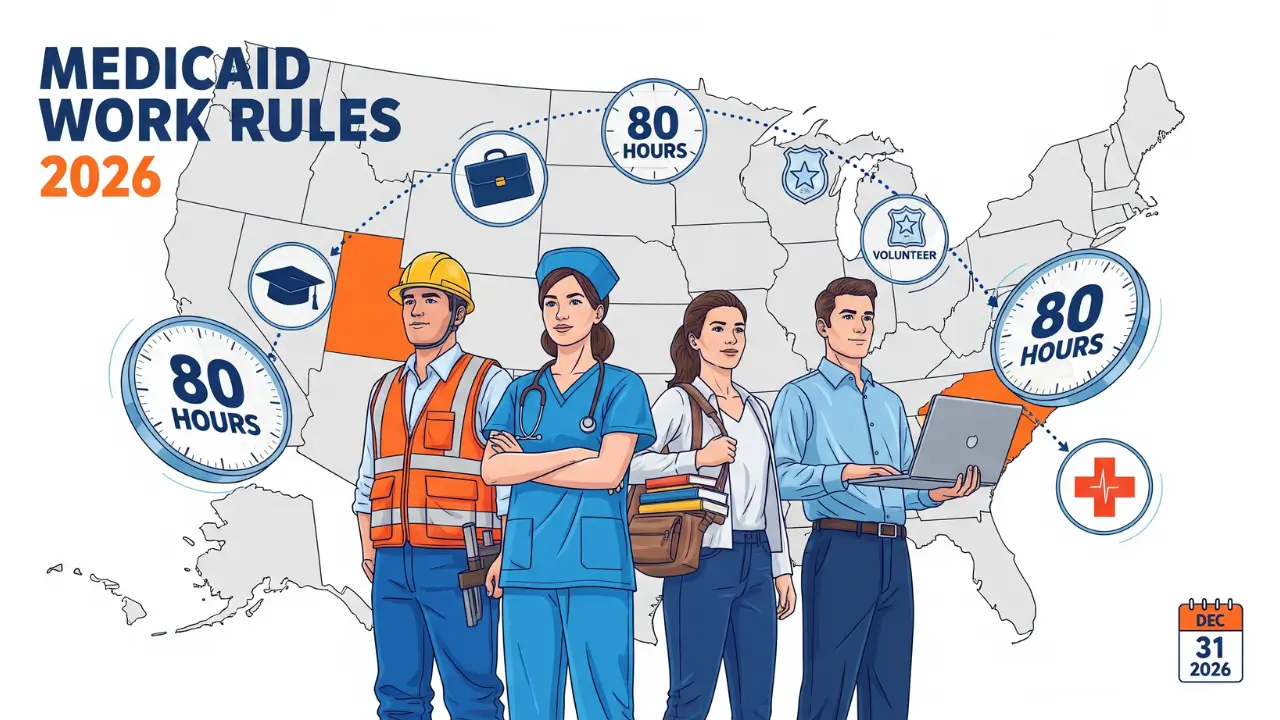
A new federal rule requires many Medicaid enrollees to report 80 hours a month of work, school, or volunteering to keep their coverage.
Most states must have this in place by January 1, 2027, but Georgia and Nebraska already enforce it — and Nebraska has already ended coverage for enrollees who missed their hours.
What changed since our last update: A federal judge denied a 25-state lawsuit’s request to pause the rule on July 30, 2026. The rule is moving forward on schedule while the underlying legal challenge continues in court.
Quick Answer
- A 2025 law called the One Big Beautiful Bill Act (H.R. 1) requires most states to condition Medicaid coverage on 80 hours a month of work, school, job training, or volunteering — or income of about $580 a month — for certain adults ages 19–64.
- The federal deadline for states to have this running is January 1, 2027. Georgia (since 2023) and Nebraska (since May 1, 2026) already enforce it.
- You may be exempt if you’re pregnant or postpartum, a parent/caregiver of a young child, a tribal member, “medically frail,” or already meeting SNAP or TANF work rules.
- On July 30, 2026, a federal judge denied a 25-state lawsuit’s bid to block the rule, so implementation continues on the original timeline while the case proceeds on the merits.
- Estimates of how many people could lose coverage range from about 2.3 million (CMS’s own projection for 2027) to as many as 7 million by 2028 (Robert Wood Johnson Foundation), depending on the source and time frame.
- Your state must have contacted you between June 30 and August 31, 2026, to explain how this affects you. Keep your address, phone number, and email updated with your state Medicaid agency so you don’t miss that notice.
- This guide explains the federal framework. For your exact deadline and reporting steps, check your state’s official Medicaid portal — rules vary by state.
What Are Medicaid Work Requirements?
Medicaid work requirements — officially called community engagement requirements — are rules that require certain Medicaid enrollees to show they’re working, studying, or volunteering to keep their coverage.
They come from the One Big Beautiful Bill Act (H.R. 1), which Congress passed and President Trump signed on July 4, 2025.
The Centers for Medicare & Medicaid Services (CMS) then wrote the detailed rules: initial guidance in December 2025, followed by an Interim Final Rule on June 1, 2026, which took effect July 31, 2026.
What Counts as “Work”
You can meet the requirement with 80 hours a month of any mix of:
- Paid work
- Volunteering
- Job training or a state-approved work program
- School (at least half-time)
You can also qualify by showing monthly earnings of about $580 — the federal minimum wage times 80 hours — instead of logging activity hours. States generally accept pay stubs, school schedules, or volunteer records as proof.
Who Has to Meet the Requirement?
This rule targets adults ages 19–64 who are covered through the ACA Medicaid expansion group. It does not apply to most children, seniors, or people who qualify for Medicaid through disability.
Which States Are Affected
Forty states have expanded Medicaid under the Affordable Care Act. Together with Washington, D.C., that’s 41 places. Georgia, Tennessee, and Wisconsin also fall under the rule because they cover some adults through separate federal waivers — bringing the total to 44 states and D.C. that must implement some version of this requirement.
Non-expansion states — Florida, Texas, Kansas, Mississippi, South Carolina’s traditional program, Wyoming, and Alabama among them — never covered this adult group the same way, so the federal rule mostly doesn’t apply there. (South Carolina is a partial exception — see its state entry below.)
For a full breakdown of who qualifies for Medicaid overall, see our Medicaid Eligibility in 2026 guide, or check your household’s numbers against our Medicaid income limits by state chart.
Who Is Exempt
You likely don’t have to report hours if you are:
- Pregnant or within 12 months after giving birth
- A parent or caregiver of a child age 13 or younger, or of someone with a disability
- “Medically frail” (see below — this is the center of an active lawsuit)
- A member of a federally recognized American Indian or Alaska Native tribe
- A former foster youth under age 26
- Already meeting SNAP or TANF work requirements
- Currently or recently incarcerated (within the past 3 months, in some contexts)
- In a qualifying substance use disorder treatment program
The “Medically Frail” Exemption — and Why States Are Suing Over It
This is the most contested part of the rule, so it’s worth explaining in full rather than summarizing.
Congress wrote five specific categories into the law. You may qualify as medically frail if you:
- Are blind or disabled, as defined under Supplemental Security Income (SSI) rules
- Have a substance use disorder
- Have a disabling mental disorder
- Have a physical, intellectual, or developmental disability that significantly limits your ability to perform daily activities
- Have a serious or complex medical condition
Meeting any one of these five categories was supposed to be enough on its own. But CMS’s June 2026 rule added a requirement that isn’t in the statute: your condition must also “significantly impair your ability to comply with the community engagement requirement” — in effect, you have to show your illness or disability specifically makes it hard for you to work, not just that you have a qualifying diagnosis.
That extra step is why a coalition of states sued. On June 29, 2026, attorneys general from 25 states and Washington, D.C. — led by California and Massachusetts — filed suit in federal court in Massachusetts, arguing CMS narrowed the exemption beyond what Congress intended.
What Happened in Court
On July 30, 2026, U.S. District Judge Richard Stearns denied the states’ request to pause the rule while the case proceeds. He found the states hadn’t shown they’d suffer irreparable harm, in part because CMS has agreed to reimburse 90% of states’ costs to build the new eligibility systems. He also noted that Congress — not CMS — set the January 1, 2027 deadline.
Importantly, this ruling only decided the request to pause the rule. It did not decide whether CMS’s stricter “medically frail” definition is actually legal — that broader case is still active. In practice, this means the rule keeps moving forward on schedule for now, but the medically frail definition could still change if the states win on the merits later.
What’s Happening Right Now (August 2026)
States are in the middle of what health policy watchers are calling a “crunch period.” A few things are happening at once:
- States had to notify affected enrollees between June 30 and August 31, 2026 about how the rule applies to them.
- Nebraska, the first state enforcing the new federal-style rule, began ending coverage in early August 2026 for enrollees who didn’t report their hours — the state’s Medicaid director said roughly 200 people lost coverage in the first week alone, with each case reviewed multiple times before the enrollee was notified.
- CMS received tens of thousands of public comments on the rule, many raising concerns that the illness and disability exemptions are too narrow. A survey by the American Cancer Society Cancer Action Network found 90% of cancer patients and survivors said their illness had already forced them to miss work, school, or volunteering — and three-quarters said proving that on paperwork would be difficult.
- The American College of Physicians has raised concerns that doctors, who determine whether a patient qualifies as medically frail, aren’t trained to make employment or vocational assessments.
If your state is in “soft launch” mode (see the table below), missing your hours right now likely won’t cost you coverage yet — but Nebraska’s experience shows that once a state is actively enforcing, missed reporting can lead to real coverage loss quickly.
State-by-State Status
| State | Status | Key Details |
|---|---|---|
| Georgia | Active since 2023 | Pathways to Coverage waiver; current extension runs through Dec. 31, 2026 |
| Nebraska | Active since May 1, 2026 | First state enforcing the new federal-style rule; already ending coverage for enrollees who miss hours |
| Arkansas | Soft launch since July 1, 2026 | Tracking hours and sending notices now; no coverage loss for missed hours before Jan. 1, 2027 |
| Montana | Soft launch/implementation since July 1, 2026 | Also introduces new Medicaid premiums for some enrollees; no penalty before Jan. 1, 2027 |
| Iowa | Early rollout planned Dec. 1, 2026 | New applicants won’t have to meet the requirement for initial eligibility |
| Arizona | Preparing for 2027 | Waiver applies to ages 19–55 only; includes a 5-year lifetime limit on coverage for people subject to the requirement |
| Ohio | Preparing for 2027 | Uses broader qualifying categories screened at application/renewal (age 55+, active addiction treatment, serious mental illness, or intensive physical health needs can count without separate hours tracking) |
| South Carolina | Separate, smaller waiver | Never expanded Medicaid broadly; its Palmetto Pathways to Independence waiver extends coverage with work rules to about 11,400 parents/caregivers, with roughly 65,000 more on a waitlist |
| Pennsylvania | Preparing for Jan. 1, 2027 deadline | State officials estimate around 310,000 residents could lose coverage |
| California, New York, Illinois, Washington | Preparing for the Jan. 1, 2027 federal deadline | No early start announced; all are plaintiffs in the medically frail lawsuit |
| Florida, Texas, Mississippi, and other non-expansion states | Largely unaffected | These states never expanded Medicaid to this adult group |
Most other expansion states — Ohio, West Virginia, Louisiana, North Dakota, Indiana, and the rest — haven’t started early enforcement and are expected to build their systems to meet the national deadline. For more on Georgia’s program specifically, see our Georgia Pathways to Coverage 2026 guide. If you’re also affected by SNAP’s separate work rules, see SNAP Work Requirements 2026.
How Many People Could Lose Coverage?
You’ll see different numbers depending on the source, because they measure different things — some look at a single year, others project out to 2028 or 2034, and some count only people who are truly ineligible versus everyone at risk of falling through paperwork gaps.
| Source | Estimate | Time Frame |
|---|---|---|
| CMS (Interim Final Rule projection) | ~2.3 million fewer enrolled | Federal fiscal year 2027 |
| Commonwealth Fund | ~5.3 million | As the rule fully phases in |
| Urban Institute | 3 million to 7 million | Not specified / varies by state implementation |
| Robert Wood Johnson Foundation | Up to 7 million | By 2028 |
| Congressional Budget Office | More than 5 million | By 2034 |
Researchers across these organizations generally agree on one thing: most coverage loss is expected to come from people who are actually eligible or exempt but get tripped up by reporting paperwork — not from people who fail to meet the requirement itself.
What Happens If You Don’t Report Your Hours?
This depends entirely on your state’s current phase.
- In “soft launch” states like Arkansas and Montana, missing your hours right now won’t cost you coverage before January 1, 2027.
- In active-enforcement states like Georgia and Nebraska, missing your hours at renewal can lead to coverage loss much sooner — Nebraska is already doing this.
- Most states are required to send you a warning notice before taking any action. Keep your contact information current with your state Medicaid agency so you don’t miss it.
How to Report Your Work Hours
- Log in to your state’s Medicaid portal (for example, Gateway in Georgia or Access in Arkansas).
- Find the “Work Requirement” or “Community Engagement” section.
- Upload proof — pay stubs, a school schedule, or volunteer records.
- Confirm your exemption status if one applies to you.
- Update your address, phone number, and email so you receive renewal and status notices.
Once you submit your hours, your state reviews them at your renewal date. Your coverage stays active as long as your hours or exemption are approved. If you disagree with a decision, you have the right to appeal — check your state Medicaid agency’s appeals process for the exact steps.
If you’re unsure whether you currently qualify for Medicaid at all, our Medicaid Calculator can help you check your general eligibility before you worry about the work requirement specifically. Providers who accept Medicaid continue billing under your state’s Medicaid Fee Schedule 2026, so your day-to-day care shouldn’t change while you stay in compliance.
FAQ
Q: What is the Medicaid work requirement for 2026–2027?
A: It’s a federal rule requiring many adults ages 19–64 in the Medicaid expansion group to report 80 hours a month of work, school, training, or volunteering — or show income of about $580 a month — to keep coverage. It comes from the 2025 One Big Beautiful Bill Act. National enforcement starts January 1, 2027, though Georgia and Nebraska already enforce it.
Q: Which states already enforce Medicaid work requirements?
A: Georgia (since 2023) and Nebraska (since May 1, 2026) actively enforce work rules, and Nebraska has already ended coverage for some enrollees who missed reporting. Arkansas and Montana began “soft launch” tracking on July 1, 2026, without penalties yet. Most other states are still preparing for the January 1, 2027 deadline.
Q: Who is exempt from Medicaid work requirements?
A: Exemptions include pregnant and postpartum people, parents or caregivers of young children, tribal members, and people who are “medically frail.” As of June 2026, the medically frail exemption also requires proof that your condition limits your ability to work — a change that’s currently being challenged in court.
Q: Why are states suing over the “medically frail” rule?
A: Congress listed five categories that should automatically qualify someone as medically frail. CMS’s June 2026 rule added a requirement that the condition must also significantly impair the person’s ability to work. Twenty-five states and D.C. sued over this in June 2026. A federal judge declined to pause the rule on July 30, 2026, but the underlying legal challenge is still active.
Q: Will I lose Medicaid if I miss my work hours?
A: It depends on your state. States in “soft launch,” like Arkansas and Montana, won’t cut coverage for missed hours before January 1, 2027. States with active enforcement, like Georgia and Nebraska, may end coverage sooner — Nebraska has already done this for enrollees who didn’t report.
Q: How many people are expected to lose Medicaid because of this rule?
A: Estimates vary by source and time frame — from about 2.3 million in CMS’s own 2027 projection to as many as 7 million by 2028 per the Robert Wood Johnson Foundation. Most researchers agree that much of this loss is expected to come from paperwork and reporting problems rather than people who don’t actually meet the requirement.
Q: Does the work requirement apply in every state?
A: No. It applies mainly in the 40 states plus D.C. that expanded Medicaid, plus Georgia, Tennessee, and Wisconsin through separate waivers. Non-expansion states like Florida, Texas, and Mississippi are largely unaffected by this specific rule.
Q: What should I do right now?
A: Check your state’s official Medicaid portal for your exact start date, update your contact information so you don’t miss any notices, and see if you fall into an exemption category. If you get a notice about your medical frailty status or work hours, respond by the deadline listed — don’t assume it doesn’t apply to you.
Written & Reviewed by Akash Biswas, MSW | Former Medicaid Caseworker Trainer | Verified against official CMS, KFF, and state agency sources | Last Updated: August 24, 2026
Sources
- Centers for Medicare & Medicaid Services, Nationwide Framework press release, June 1, 2026
- Centers for Medicare & Medicaid Services, Community Engagement Requirement Interim Final Rule fact sheet, June 1, 2026
- KFF, Medicaid Work Requirements Tracker
- KFF, The Medical Frailty Exemption from Medicaid Work Requirements: Key Takeaways from the CMS Interim Final Rule, July 1, 2026
- Center for Health Care Strategies, A Summary of Federal Medicaid Work Requirements, June 24, 2026
- Georgetown University Center for Children and Families, Medicaid Work Reporting Requirements: States Ask a Federal Court to Protect Medically Frail Individuals from CMS Overreach, July 2, 2026
- Stateline, Judge rejects states’ bid to block Medicaid work rules, July 31, 2026
- Axios, Medicaid’s work requirement crunch arrives, August 3, 2026
- Nebraska DHHS, Work Requirements
- Congressional Budget Office, Estimated budgetary effects of P.L. 119-21
- Commonwealth Fund, Medical Frailty Exemptions Will Help with Medicaid Work Requirements
- Robert Wood Johnson Foundation, Millions Could Lose Health Coverage Due to New Rules
- The Philadelphia Inquirer, Pennsylvania is among 25 states suing over federal Medicaid rules, July 10, 2026
- GoodRx Health, How to Meet the Medicaid Work Requirement: A State-by-State Guide (state waiver detail cross-reference)
Disclaimer: CheckMedicaid.com is not affiliated with any government agency. This content is for educational purposes only. For an official eligibility decision or your exact state deadline, contact your state Medicaid agency or visit Medicaid.gov.