Medicaid eligibility in 2026 depends on your state, your coverage category, and your income compared to the Federal Poverty Level (FPL).
On top of that, a major federal law is reshaping the rules over the next two years.
This guide covers the 2026 income limits, expansion status by state, special eligibility categories, and what’s confirmed versus still developing for 2027.
Answer Summary
- Expansion states (41 + D.C.): Most adults qualify with income up to 138% FPL — about $1,835/month or $22,025/year for one person in 2026.
- Non-expansion states (10): Alabama, Florida, Georgia, Kansas, Mississippi, South Carolina, Tennessee, Texas, Wisconsin, and Wyoming have not adopted full ACA expansion; adults without children usually can’t qualify at any income, and parent limits are often far below the poverty line.
- Partial exceptions: Wisconsin covers childless adults up to 100% FPL through its own program; Georgia covers adults up to 100% FPL through its Pathways to Coverage waiver, which requires 80 hours/month of work or activity.
- Children: Median eligibility is 255% FPL (Medicaid + CHIP combined), though it varies widely by state.
- Pregnant individuals: Covered up to at least 138% FPL nationwide; median upper limit is 213% FPL, and most states go to 200% FPL or higher.
- Parents: Median eligibility is just 36–40% FPL for the standard parent/caretaker pathway — far below the adult expansion limit, even in expansion states.
- Seniors and people with disabilities: Use separate 2026 federal standards tied to SSI, not the FPL — including a $994/month SSI benefit rate, a $2,982/month long-term-care income cap, and a $162,660 maximum Community Spouse Resource Allowance.
- Coming October 1, 2026: Federal Medicaid/CHIP eligibility narrows for immigrants — refugees, asylees, and some other previously eligible groups lose federally funded coverage.
- Coming January 1, 2027: Nationwide work requirements (80 hours/month) and six-month eligibility redeterminations begin for expansion adults (Nebraska already started early; Georgia has required work activity since 2023).
- Coming October 2028 and January 2028: New cost-sharing (up to $35/service) for expansion adults over 100% FPL, and a $1 million home equity cap for long-term care eligibility.
- CBO estimate: Up to 11.8 million people could lose Medicaid coverage by 2034 because of these combined federal changes.
How Medicaid Eligibility Works
Medicaid is jointly run by the federal government and each state. Washington sets minimum rules, but states decide many of the details — including exact income cutoffs for parents, whether to cover childless adults, and how generous coverage is for children and pregnant women.
That’s why the same income can qualify you for Medicaid in one state and leave you uninsured in another.
Most people are evaluated using Modified Adjusted Gross Income (MAGI) rules, which apply to children, pregnant individuals, parents, and other adults.
Seniors and people with disabilities are usually evaluated under separate, non-MAGI rules tied to Supplemental Security Income (SSI) standards rather than the FPL. Our full guide to Medicaid Eligibility in 2026 breaks down each of these coverage groups individually.
2026 Federal Poverty Level Guidelines
The U.S. Department of Health and Human Services published the 2026 poverty guidelines in the Federal Register on January 15, 2026, effective January 13, 2026.
The update reflects a 2.63% increase in consumer prices between 2024 and 2025. Because of the October 2025 federal government shutdown, the Bureau of Labor Statistics could not publish that month’s inflation data, so HHS calculated this update using the 11 available months of 2025 compared with all of 2024.
Not every state adopted the new figures on day one. Many states continued using the 2025 guidelines for a few more months before transitioning to the 2026 numbers between February and April 2026, which is normal administrative practice and does not reduce anyone’s benefits.
| Household size | 48 contiguous states + D.C. | Alaska | Hawaii |
|---|---|---|---|
| 1 | $15,960 | $19,950 | $18,360 |
| 2 | $21,640 | $27,050 | $24,890 |
| 3 | $27,320 | $34,150 | $31,420 |
| 4 | $33,000 | $41,250 | $37,950 |
| 5 | $38,680 | $48,350 | $44,480 |
| 6 | $44,360 | $55,450 | $51,010 |
| 7 | $50,040 | $62,550 | $57,540 |
| 8 | $55,720 | $69,650 | $64,070 |
For households larger than 8, add $5,680 per additional person (48 states/D.C.), $7,100 (Alaska), or $6,530 (Hawaii). Source: HHS/ASPE, Federal Register, effective January 13, 2026.
Medicaid Expansion Status: Which States Cover Adults Up to 138% FPL
Under the Affordable Care Act, “expansion states” cover nearly all adults with income up to 138% of the FPL, with the federal government picking up a larger share of the cost.
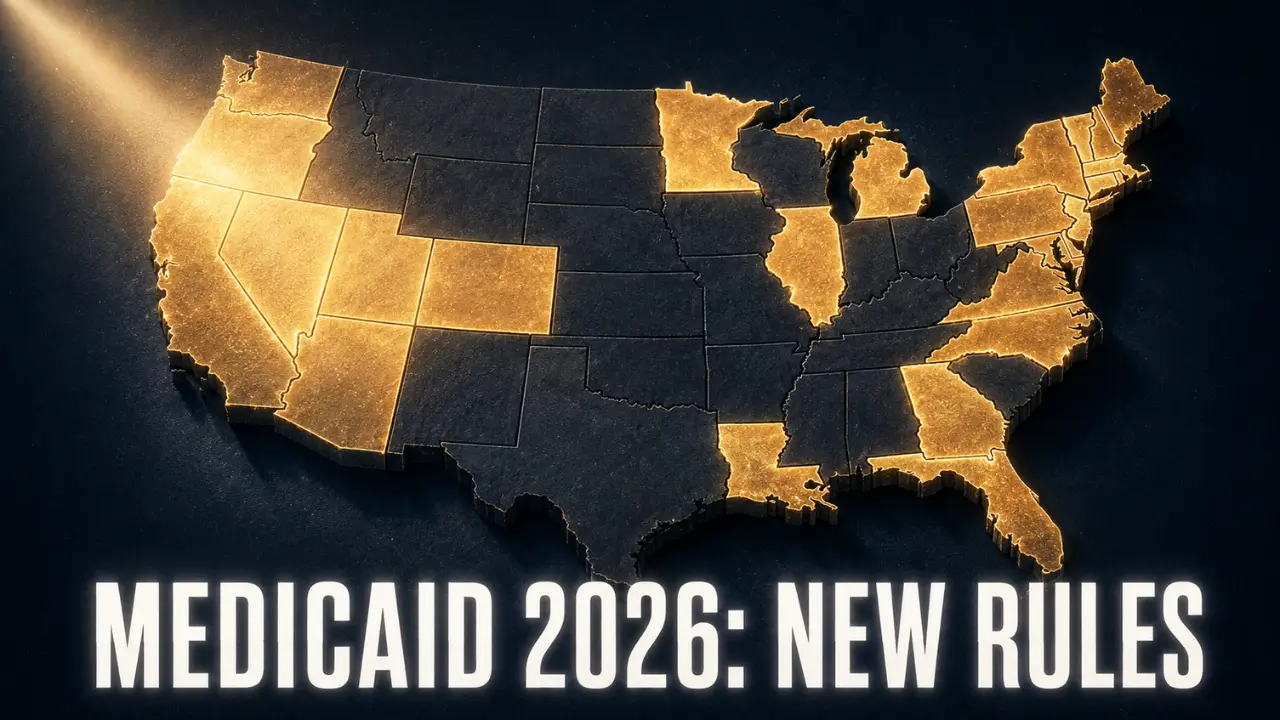
As of the most recent KFF tracking update in May 2026, 41 states plus D.C. have adopted expansion, and 10 states have not.
States that have not adopted full ACA expansion: Alabama, Florida, Georgia, Kansas, Mississippi, South Carolina, Tennessee, Texas, Wisconsin, and Wyoming.
Two of these states are partial exceptions:
- Wisconsin covers childless adults up to 100% of the FPL through its own state program, so — unlike the other nine non-expansion states — it has no full “coverage gap,” though it still doesn’t receive the enhanced federal match that comes with full ACA expansion.
- Georgia covers a limited group of adults up to 100% FPL through its Pathways to Coverage waiver, which requires a monthly work or activity requirement (more on this below).
In the other eight non-expansion states, adults without dependent children generally cannot qualify for Medicaid at any income level, and income limits for parents are often far below the poverty line.
For a full state-by-state breakdown of dollar amounts, see our guide to Medicaid Income Limits by State in 2026.
2026 Income Limits for Expansion-State Adults
| Household size | 100% FPL (monthly) | 138% FPL (monthly) | 138% FPL (annual) |
|---|---|---|---|
| 1 | $1,330 | $1,835 | $22,025 |
| 2 | $1,803 | $2,489 | $29,863 |
| 3 | $2,277 | $3,142 | $37,702 |
| 4 | $2,750 | $3,795 | $45,540 |
| 5 | $3,223 | $4,448 | $53,378 |
| 6 | $3,697 | $5,101 | $61,217 |
| 7 | $4,170 | $5,755 | $69,055 |
| 8 | $4,643 | $6,408 | $76,894 |
Alaska and Hawaii use higher, state-specific FPL bases, so their dollar thresholds are correspondingly higher. Figures are based on the 2026 FPL for the 48 contiguous states and D.C.
Not sure where your household falls? Our Medicaid Eligibility Calculator lets you enter your state, income, and household size to get an instant estimate.
Eligibility for Children, Pregnant Women, Parents, and CHIP
Income limits vary significantly depending on who is applying, not just which state they live in. According to the 24th annual national Medicaid and CHIP eligibility survey conducted by KFF and the Georgetown University Center for Children and Families, based on state data as of January 2026:
| Category | Typical 2026 income range | Notes |
|---|---|---|
| Children (Medicaid + CHIP combined) | Median 255% FPL | Ranges widely by state; some states extend coverage well above 300% FPL |
| Pregnant individuals | Mandatory floor of 138% FPL nationwide; median upper limit 213% FPL | Most states (38) set an upper limit at or above 200% FPL across Medicaid, CHIP, and pregnancy-specific coverage options |
| Parents/caretakers in non-expansion states | Median 40% FPL | Some non-expansion states set limits well below this median |
| Parents in expansion states (mandatory Section 1931 pathway) | Median 36% FPL | Parents above this level in expansion states may still qualify through the separate ACA expansion pathway, up to 138% FPL |
| Adults without dependent children (expansion states) | 138% FPL | Not available at any income in most non-expansion states |
CHIP (the Children’s Health Insurance Program) fills the gap for kids in families that earn too much for Medicaid but still need affordable coverage, generally extending eligibility well above standard Medicaid limits.
Because CHIP and Medicaid rules are easy to confuse, always check whether a specific income limit applies to Medicaid, CHIP, or both.
State Spotlight: Georgia’s Pathways to Coverage
Georgia is the only state that conditions ongoing Medicaid eligibility on a documented monthly work or activity requirement. Under Pathways to Coverage, adults ages 19–64 with income up to 100% of the FPL (about $1,330/month for one person, or $2,277/month for a household of three in 2026) must complete and report at least 80 hours per month of qualifying activity — employment, job training, education, or community service — to keep coverage.
As of October 1, 2025, reporting was simplified to just application and annual renewal rather than monthly submissions.
The Centers for Medicare & Medicaid Services has approved a temporary extension of the program through December 31, 2026, while Georgia seeks a longer-term renewal.
Enrollment has run well below original projections, with only a small fraction of the roughly 240,000 potentially eligible adults actually enrolled — a pattern advocates attribute to the administrative burden of the activity-reporting requirement.
Medicaid for Seniors and People with Disabilities (2026)
Long-term care and disability-related Medicaid — sometimes called Aged, Blind, and Disabled (ABD) or non-MAGI Medicaid — uses different, generally higher income standards than the FPL-based rules above.
The following federal standards took effect January 1, 2026, per CMS’s Spousal Impoverishment and SSI bulletin:
| Standard | 2026 amount |
|---|---|
| SSI Federal Benefit Rate (individual) | $994/month |
| SSI Federal Benefit Rate (couple) | $1,491/month |
| SSI resource (asset) limit | $2,000 individual / $3,000 couple |
| Institutional/”special income level” cap (300% of SSI FBR) | $2,982/month |
| Minimum Monthly Maintenance Needs Allowance (community spouse) | $2,643.75 (higher in Alaska and Hawaii) |
| Maximum Monthly Maintenance Needs Allowance | $4,066.50 |
| Community Spouse Resource Allowance | $32,532 minimum – $162,660 maximum |
| Home equity limit for long-term care eligibility | $752,000 minimum – $1,130,000 maximum |
These figures are federal floors and ceilings — exact rules for nursing home Medicaid and Home and Community-Based Services (HCBS) waivers vary by state, so always confirm specifics with your state Medicaid agency.
What’s Changing for 2027: The One Big Beautiful Bill Act
Signed into law on July 4, 2025, the One Big Beautiful Bill Act (Public Law 119-21) makes the largest changes to Medicaid eligibility rules in years. Some provisions are already in effect; others are scheduled but not yet active.
The Congressional Budget Office estimates the law’s health provisions will cause 11.8 million people to lose coverage by 2034, with additional coverage losses tied to separate policy changes such as the expiration of enhanced ACA marketplace tax credits.
| Provision | Effective date | What it means |
|---|---|---|
| Immigrant eligibility restrictions | October 1, 2026 | Limits Medicaid/CHIP eligibility to U.S. citizens, lawful permanent residents, certain Cuban and Haitian entrants, and COFA migrants; ends eligibility for refugees, asylees, and certain other previously eligible immigrants (states may still cover lawfully residing children and pregnant immigrants) |
| Work/community engagement requirements | January 1, 2027 (Nebraska began early, May 1, 2026; Georgia has required this since 2023) | 80 hours/month of work, education, training, or community service for non-exempt adults ages 19–64 in the 41 ACA expansion states plus Georgia and Wisconsin’s waiver populations |
| Six-month eligibility redeterminations | January 1, 2027 | Expansion adults must be redetermined every 6 months instead of annually |
| Updated address-verification requirements | January 1, 2027 | States must regularly check the USPS National Change of Address database and managed care data |
| Deceased-enrollee and duplicate-enrollment reviews | 2027–2028 | Quarterly reviews of the Social Security Death Master File and new cross-state duplicate enrollment checks |
| Cost-sharing up to $35/service for expansion adults over 100% FPL | October 2028 | Applies to non-exempt services for enrollees with income 100–138% FPL |
| Home equity cap for long-term care eligibility | January 1, 2028 | $1 million cap, not adjusted for inflation, cannot be waived by states |
| Temporary 2.5% increase to the Medicaid physician fee schedule conversion factor | January 1, 2026 – January 1, 2027 | A one-year bump to provider payment rates; see our Medicaid Fee Schedule guide for state-by-state provider rate details |
CMS issued an interim final rule on the work-requirement details in June 2026, and individual state implementation timelines — including possible extensions for some states to as late as December 31, 2028 — were still being finalized as of mid-2026.
If you’re currently covered through Medicaid expansion, watch for official notices from your state agency rather than relying on informal information about exact dates.
State Developments to Watch
- Wisconsin extended postpartum Medicaid coverage from 60 days to a full 12 months, effective July 1, 2026, becoming the 49th state to do so. Arkansas is now the only state that has not adopted the extension.
- Nebraska became the first state to begin enforcing the new federal work requirements early, starting May 1, 2026, ahead of the January 2027 nationwide deadline.
- Georgia continues to operate its Pathways to Coverage work-requirement program, extended through the end of 2026 while state officials pursue a longer renewal.
How to Apply
You can apply for Medicaid at any time of year — there’s no limited enrollment period.
Most states let you apply online through your state Medicaid agency or the Health Insurance Marketplace at HealthCare.gov, by phone, by mail, or in person at a local office.
You’ll generally need proof of income, household size, immigration or citizenship status (where applicable), and state residency.
Processing typically takes up to 45 days for most applications, or up to 90 days if a disability determination is involved.
Frequently Asked Questions
Is the Medicaid income limit the same in every state in 2026?
No. The federal government sets minimum rules, but each state decides its own income limits for many categories, especially for parents and adults without children. The 138% FPL limit generally applies only in the 41 expansion states plus D.C.
What is 138% of the federal poverty level in 2026?
For a single adult in the 48 contiguous states, 138% FPL is about $1,835/month, or $22,025/year. The amount increases with household size and is higher in Alaska and Hawaii.
Which states have not expanded Medicaid in 2026?
Alabama, Florida, Georgia, Kansas, Mississippi, South Carolina, Tennessee, Texas, Wisconsin, and Wyoming have not adopted full ACA Medicaid expansion, though Georgia and Wisconsin each offer limited coverage to some adults through their own programs.
Will Medicaid work requirements affect me in 2026?
Nationwide work requirements don’t take effect until January 1, 2027 for most states (Nebraska started earlier). Georgia has required work activity for its Pathways program since 2023. Once nationwide requirements begin, exemptions are expected for groups such as pregnant individuals, people receiving disability benefits, students, and caregivers of young children — but final federal guidance was still being finalized as of mid-2026.
How will Medicaid eligibility change for immigrants?
Starting October 1, 2026, federal Medicaid/CHIP funding will be limited to U.S. citizens, lawful permanent residents, certain Cuban and Haitian entrants, and COFA migrants. Refugees, asylees, and some other previously eligible immigrants will lose eligibility for federally funded coverage, though states can still choose to cover lawfully residing immigrant children and pregnant individuals.
Are Medicaid rules different for seniors and people with disabilities?
Yes. Long-term care and disability-based Medicaid use separate, generally higher income and asset standards tied to SSI benefit levels rather than the standard FPL-based limits used for children, parents, and other adults.
Where can I check my exact state’s income limits?
Because rules vary so much by state and category, always confirm current numbers with your state Medicaid agency or use our Medicaid Eligibility Calculator for a quick estimate before applying.
The Bottom Line
Medicaid eligibility in 2026 still comes down to your state, your income relative to the FPL, and which coverage category you fall into — expansion states cover most adults up to 138% FPL, while non-expansion states leave significant gaps for people without children. Layered on top of that is a wave of federal changes from the One Big Beautiful Bill Act that will restrict immigrant eligibility starting in October 2026 and bring work requirements and more frequent eligibility checks starting in January 2027. If you’re currently enrolled or planning to apply, the most important thing you can do is confirm your specific state’s current rules and watch for official notices about the changes ahead.
Last Updated: August 22, 2026
Sources:
- U.S. Department of Health and Human Services / ASPE, “Annual Update of the HHS Poverty Guidelines,” Federal Register, January 15, 2026 (effective January 13, 2026)
- Centers for Medicare & Medicaid Services, “2026 SSI, Spousal Impoverishment, and Medicare Savings Program Resource Standards,” CMCS Informational Bulletin, December 9, 2025
- KFF, “Status of State Medicaid Expansion Decisions,” updated May 21, 2026
- KFF and Georgetown University Center for Children and Families, “Medicaid and CHIP Eligibility, Enrollment, and Renewal Policies as States Prepare for Major Medicaid Policy Changes,” April 30, 2026
- Georgia Department of Community Health, “Eligibility Criteria – Georgia Pathways to Coverage”
- American Medical Association, “Changes to Medicaid, the ACA and Other Key Provisions of the One Big Beautiful Bill Act” (updated 2026)
- Association of State and Territorial Health Officials, “One Big Beautiful Bill Law Summary”
- Wisconsin Department of Health Services, “12-Month Postpartum Coverage for BadgerCare Plus,” DHS Memo, June 12, 2026
- Social Security Administration, “Understanding Supplemental Security Income (SSI Benefits)”
Disclaimer: CheckMedicaid.com is not affiliated with any government agency. This content is for educational purposes only. For an official eligibility decision, contact your state Medicaid agency.
About the Author
Akash Biswas holds a Master’s in Social Work and previously trained caseworkers on SNAP and Medicaid eligibility rules. He personally writes and verifies every article on CheckMedicaid.com against primary government sources. Read more about our editorial process →
Last verified: August 21, 2026, against the West Virginia Bureau for Medical Services and current HHS Federal Poverty Guidelines.
Spotted an error? Let us know — we correct confirmed mistakes promptly.