Written & Reviewed by Akash Biswas, MSW | Former Medicaid Caseworker Trainer Verified against official Medicaid.gov, CMS, and Federal Register guidance | Last Updated: July 2026
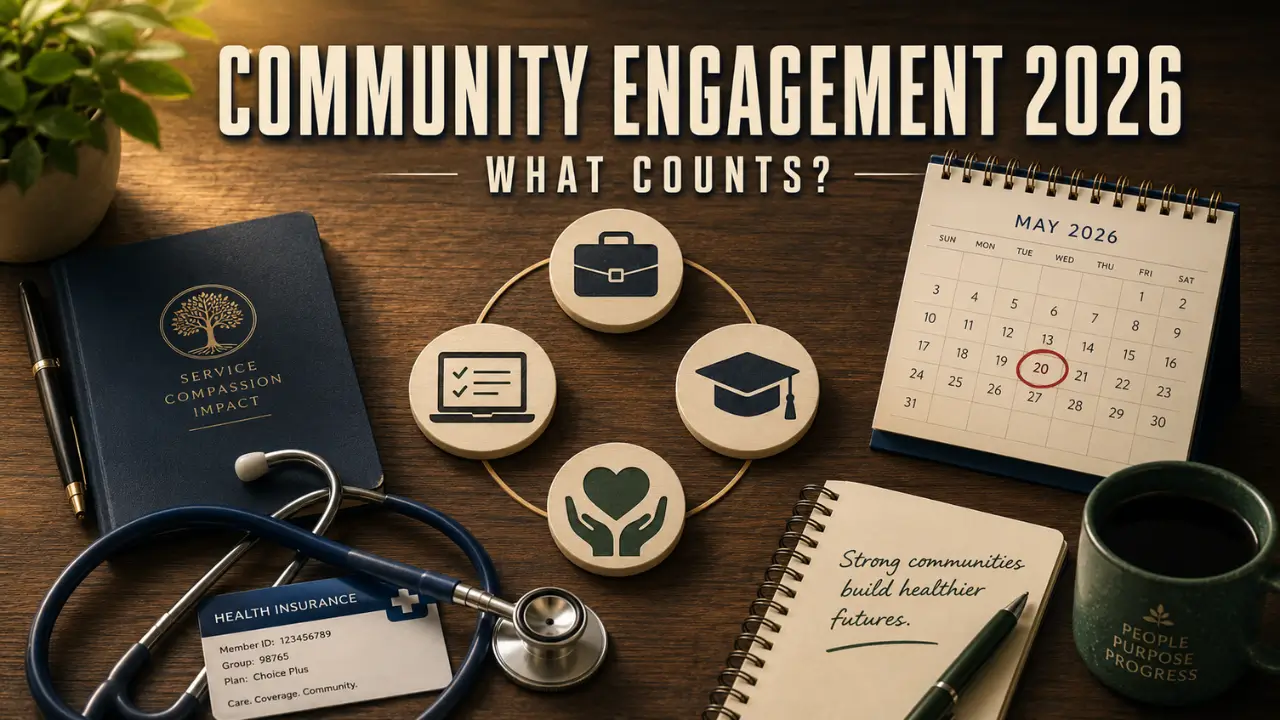
Community engagement is a new Medicaid rule for 2026. It means some adults must complete 80 hours a month of work, school, job training, or volunteering to keep their coverage.
You can also meet the rule by earning at least $580 a month in 2026, which equals 80 hours at the federal minimum wage.
This guide breaks down exactly what counts, who is exempt, and the key 2026 dates.
Quick Summary:
- You may need to report 80 hours a month of work, school, training, or community service
- The rule applies to non-pregnant adults ages 19–64 who are not on Medicare
- Pregnant people, caregivers of young children, and disabled adults are usually exempt
- States must have this rule in place by January 1, 2027, though some started earlier
- Not sure if this applies to you? Use our Medicaid Eligibility Calculator in 2026 to check your status
What Is Medicaid Community Engagement?
Community engagement is another name for Medicaid’s work requirement. It comes from the One Big Beautiful Bill Act, a federal law signed in July 2025. On June 1, 2026, CMS released the rule that tells states how to run this requirement.
Your next step is simple: find out if you fall into the group this rule affects. If you do, you’ll need to log your hours or confirm you qualify for an exemption.
Who Has to Follow This Rule?
The rule applies to adults ages 19 to 64 who are not pregnant and not enrolled in Medicare. It mainly affects people covered under Medicaid expansion. This is part of a bigger set of rules — see our Medicaid Eligibility in 2026 guide for the full picture of who qualifies for coverage.
Which States Are Affected?
As of mid-2026, 43 states and Washington, D.C. offer coverage to this group and must add the new requirement. States that never expanded Medicaid — including Texas, Florida, Alabama, Mississippi, South Carolina, Kansas, and Wyoming — are not required to add this specific rule, since they don’t have this coverage group.
What Counts as Community Engagement?
CMS lists several activities that count toward your 80 hours. You can combine employment, education, community service, or a work program to reach the total, and some states also count job search or job training. You can mix and match activities during the month.
Employment and Work Programs
Paid work counts, whether it’s full-time, part-time, or seasonal. Self-employed people can qualify by earning at least $580 a month in 2026, which equals the federal minimum wage times 80 hours. Participation in a state-approved job or training program also counts.
Education and Job Training
Being enrolled in school, vocational training, or a similar program counts toward your hours. Most states require at least half-time enrollment for school to count on its own.
Community Service and Volunteering
Volunteer service and community service both count toward your monthly total. Your service should be with a real organization you can document, not informal help for a neighbor or family member.
| Qualifying Activity | Examples | Counts Toward 80 Hours? |
|---|---|---|
| Employment | Full-time, part-time, seasonal, self-employment | Yes |
| Education | School, GED programs, half-time or more | Yes |
| Community Service | Volunteering with a documented organization | Yes |
| Work Program | State-approved job training or workforce program | Yes |
| Income Equivalent | Earning $580+ per month in 2026 | Yes (no hour log needed) |
Who Is Exempt From the Requirement?
You may not need to report any hours at all. Exemptions include pregnant or postpartum people, caregivers of a child age 13 or younger or of a family member with a disability, veterans with a total disability rating, medically frail or disabled individuals, and people already meeting SNAP or TANF work rules. Former foster youth, Tribal members, and people in drug or alcohol treatment are also exempt. States can also grant short-term hardship exemptions.
Here’s what this means for you: if you think you fit one of these groups, contact your state Medicaid office. You’ll likely need to confirm your exemption, even if you don’t have to log hours.
Key Dates for the 2026 Rule
CMS released the interim final rule on June 1, 2026, with public comments due by July 31, 2026. States must contact everyone affected by August 31, 2026, to explain the rule and how to report. States must have the requirement fully running no later than January 1, 2027.
States Starting Early
Some states didn’t wait for 2027. Georgia has run its own work requirement since July 2023 under a separate state waiver. Nebraska became the first state to enforce the new federal rule, starting May 1, 2026, and Montana followed on July 1, 2026. Arkansas began a “soft launch” on July 1, 2026, but won’t remove anyone from coverage until January 1, 2027. If you live in one of these states, check with your state Medicaid agency now.
How to Report Your Hours
Most states want you to log hours every month. Your next step is usually one of these:
- Log in to your state’s Medicaid portal and enter your hours or upload proof
- Call your state Medicaid office if you don’t have online access
- Mail a paper form if your state offers one
- Check for automatic verification — some states can confirm your work status using existing payroll records, so you may not need to report manually
If your income already places you close to your state’s cutoff, it helps to know where you stand. Check the Medicaid Income Limits by State in 2026 chart to see your household’s limit.
What Happens If You Don’t Report?
If your state can’t confirm you met the requirement, it must send you a notice and give you 30 days to prove compliance or claim an exemption before your coverage is denied or ends. This is why keeping your contact information updated with your state Medicaid office matters so much.
This rule affects eligibility, not your benefits. If you stay compliant, the care you receive and how your provider gets paid does not change — providers continue billing under your state’s Medicaid Fee Schedule in 2026.
FAQ
Q: What are the Medicaid work requirement hours for 2026?
A: Most affected adults must complete 80 hours a month. You can meet this through work, school, job training, community service, or a combination. You can also qualify by earning at least $580 a month in 2026, without logging hours separately.
Q: Who is exempt from the community engagement rule?
A: Pregnant and postpartum people, caregivers of young children, medically frail or disabled adults, veterans with a total disability rating, and Tribal members are usually exempt. Contact your state Medicaid office to confirm your exemption status.
Q: Does volunteering count toward Medicaid community engagement hours?
A: Yes. Volunteering with a documented nonprofit or public organization counts toward your 80-hour total. Informal help, like watching a neighbor’s home, typically does not count because it can’t be verified.
Q: When do Medicaid work requirements start in my state?
A: Most states must start by January 1, 2027. Georgia, Nebraska, Montana, and Arkansas have already begun. Check your state Medicaid agency’s website for your exact start date and reporting method.
Q: What happens if I don’t report my hours?
A: Your state must send you a notice and give you 30 days to prove compliance or an exemption. If you don’t respond, your coverage may be denied or end. Update your contact information to avoid missing this notice.
Q: Does this rule change what Medicaid covers?
A: No. Community engagement affects whether you keep your eligibility, not what services Medicaid covers. Your benefits and provider payments stay the same as long as you stay enrolled and compliant.
Sources & Disclaimer
Last Updated: July 2026
Sources:
- CMS Fact Sheet: Medicaid Community Engagement Requirement (CMS-2454-IFC)
- Medicaid.gov: Community Engagement
- Healthcare.gov: Medicaid & CHIP
- Federal Register: Medicaid Program; Community Engagement Requirement
CheckMedicaid.com is not affiliated with any government agency. This content is for educational purposes only. For official eligibility, contact your state Medicaid office or visit Medicaid.gov.