Last Updated: February 15, 2026
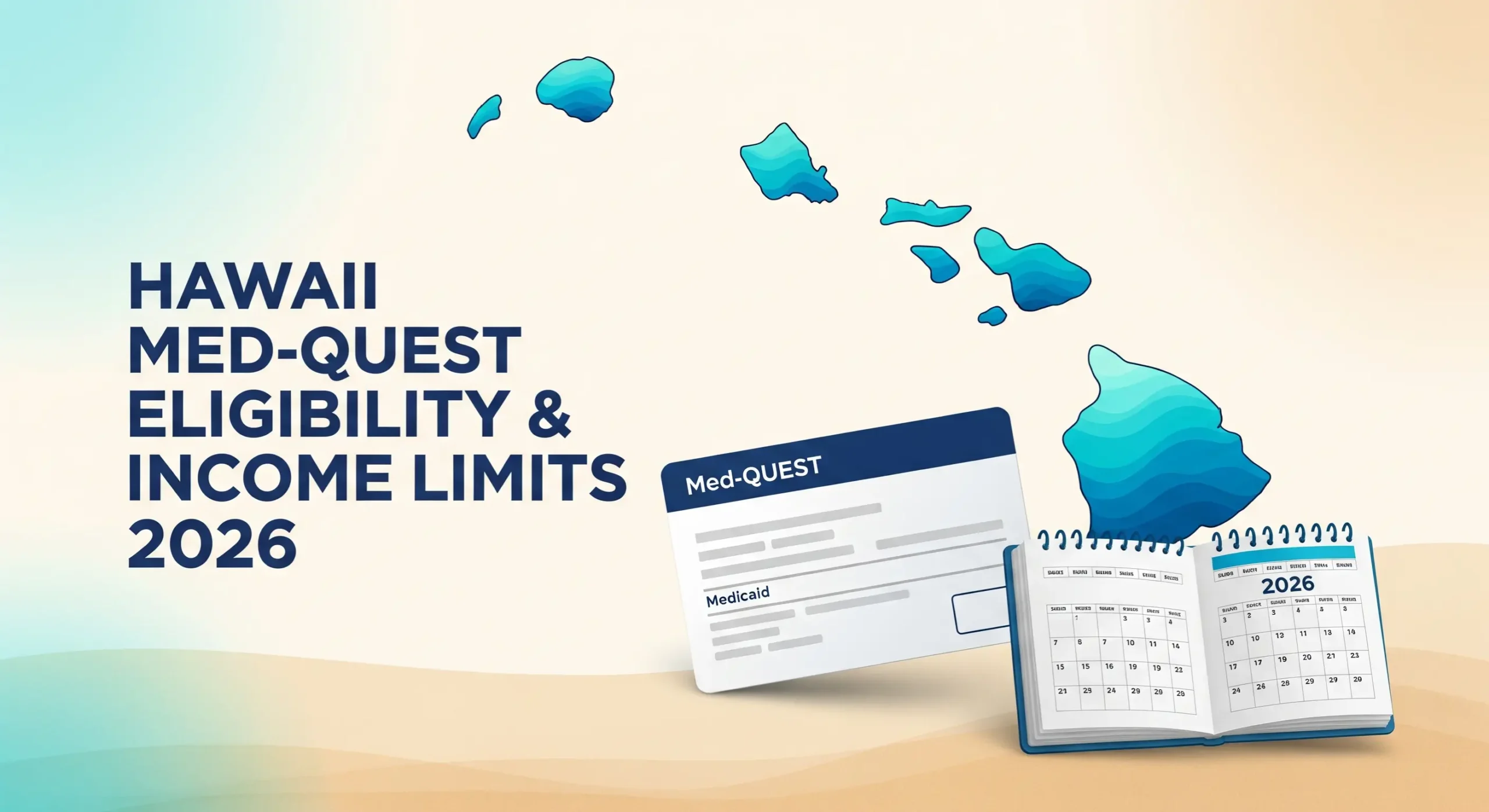
Hawaii Medicaid, called Med-QUEST, helps low-income residents get free or low-cost health coverage.
In 2026, income limits increased by about 2% to 3% due to the updated Federal Poverty Level (FPL).
Hawaii’s limits are higher than most states because of its higher cost of living.
Quick Summary:
- Hawaii Medicaid (Med-QUEST) income limits in 2026 range from $1,632 to $3,260/month, depending on your category and household size
- Hawaii uses a higher FPL of $18,360/year for a single person — more than the mainland U.S. standard
- Expansion adults (ages 19–64) qualify with income up to $2,163/month (138% FPL)
- Children and pregnant women can earn up to $3,260/month (200% FPL) for a household of one
- Most applicants — including adults, children, and pregnant women — have no asset test to worry about
- New 2026 rules give children under age 6 continuous coverage and extend postpartum coverage to 12 months
What Are the 2026 Hawaii Medicaid Income Limits?
Hawaii’s 2026 Medicaid income limits are set by the Federal Poverty Level.
The individual FPL in Hawaii is $18,360 per year (about $1,530 per month). This is higher than the mainland U.S. standard due to Hawaii’s cost of living.
To see how Hawaii stacks up against other states, check out the full guide on Medicaid income limits by state in 2026.
Monthly Income Limits by Category and Household Size
| Eligibility Category | Household of 1 | Household of 2 | Household of 3 |
|---|---|---|---|
| Expansion Adults (Ages 19–64) | $2,163 (138% FPL) | $2,862 (138% FPL) | $3,612 (138% FPL) |
| Children (Ages 0–18) | $3,260 (200% FPL) | $4,407 (200% FPL) | $5,554 (200% FPL) |
| Pregnant Women | $3,260 (200% FPL) | $4,407 (200% FPL) | $5,554 (200% FPL) |
| Aged, Blind, or Disabled (ABD) | $1,632 (100% FPL) | $2,209 (100% FPL) | $2,786 (100% FPL) |
| Long-Term Care (LTC/Nursing Home) | $2,901 (300% FBR) | N/A | N/A |
Note: For each additional person beyond 3, add about $577 per month to the household limit.
How 2026 Limits Compare to 2025
Income limits rose modestly from 2025 to 2026. Here’s a quick look at the change for a single individual:
| Category | 2025 Limit | 2026 Limit | Change |
|---|---|---|---|
| Expansion Adults (138% FPL) | $2,069 | $2,111 | +$42 |
| Children (313% FPL) | $4,693 | $4,789 | +$96 |
| Pregnant Women (196% FPL) | $2,939 | $2,999 | +$60 |
| Aged/Blind/Disabled (100% FPL) | $1,500 | $1,530 | +$30 |
Note: These figures include the standard 5% income disregard used in MAGI-based Medicaid calculations.
Asset Limits and Special Rules for 2026
Most Hawaii Medicaid applicants do not have an asset test. But some categories do have limits. Here is what you need to know.
Use the Hawaii Medicaid eligibility calculator to quickly check if you qualify based on your income and household size.
Who Has No Asset Test?
- Expansion adults (ages 19–64)
- Parents and caretakers
- Children (ages 0–18)
- Pregnant women
ABD and Long-Term Care Asset Limits
If you are aged, blind, or disabled, asset limits apply:
- Individual: $2,000
- Couple: $3,000
For Long-Term Care (LTC) or Home and Community-Based Services (HCBS), your primary home is exempt if its equity value is at or below $1,130,000 as of 2026.
Medically Needy Spend-Down Option
If your income is slightly above the limit, you may still qualify. Hawaii’s medically needy spend-down pathway lets you deduct medical expenses from your income to meet the limit.
- Individual spend-down limit: $469/month
- Couple spend-down limit: $632/month
Medicare Savings Programs (Dual Eligibility)
If you have both Medicare and Medicaid, you may qualify for extra help through Medicare Savings Programs. These programs help pay for Medicare premiums and out-of-pocket costs.
For full details on what services are covered and how much providers are paid, see the Medicaid Fee Schedule 2026.
| Program | Individual Limit | Couple Limit |
|---|---|---|
| Qualified Medicare Beneficiary (QMB) | $1,550/month | $2,095/month |
| Specified Low-Income Medicare Beneficiary (SLMB) | $1,856/month | $2,509/month |
Important: Starting January 1, 2026, dual eligibles face new restrictions on which Special Needs Plans (SNPs) they can enroll in. New rules align SNP enrollment with existing Med-QUEST health plans.
Key 2026 Policy Updates in Hawaii Medicaid
Hawaii made several important changes to Medicaid in 2026. These updates affect children, pregnant women, and those with both Medicare and Medicaid.
For a full breakdown of who qualifies under each rule, visit our guide on Hawaii Medicaid eligibility in 2026.
Continuous Coverage for Children
Under a new federal rule:
- Children under age 6 keep their Medicaid coverage until their 6th birthday — no income redetermination required
- Children ages 6 to 19 now only need redetermination every two years (previously every year)
This change helps families avoid coverage gaps due to minor income changes.
Extended Postpartum Coverage
Pregnant women now receive 12 months of postpartum Medicaid coverage after giving birth. This is now a permanent rule in Hawaii, not a temporary benefit.
FPL Adjustment
The 2026 FPL for Hawaii increased by about 3% over 2025 levels. This small bump expands eligibility slightly for many residents. The new individual FPL is $18,360 per year.
How to Apply for Hawaii Medicaid in 2026
Applying for Med-QUEST is free and takes just a few steps. You can apply in three easy ways:
- Online: Visit My Medical Benefits on Hawaii.gov
- By Phone: Call 1-800-316-8005 or 1-877-628-5076
- In Person: Visit your local Med-QUEST Division office
Have these items ready when you apply:
- Proof of Hawaii residency
- Social Security numbers for all household members
- Proof of income (pay stubs, tax returns)
- Citizenship or immigration status documents
Frequently Asked Questions (FAQs)
1. What is the Hawaii Medicaid income limit for a single adult in 2026?
A single adult (ages 19–64) can earn up to $2,163 per month (138% FPL) to qualify. This limit rose by about $42 compared to 2025. Hawaii’s limits are higher than the mainland U.S. due to its higher cost of living.
2. Does Hawaii Medicaid have an asset limit in 2026?
Most applicants — including adults, children, and pregnant women — have no asset test. Only aged, blind, or disabled individuals face a limit: $2,000 for one person, $3,000 for a couple.
3. Can my child keep Medicaid coverage even if my income changes?
Yes. In 2026, children under age 6 keep coverage until their 6th birthday regardless of income changes. Children ages 6–19 only need redetermination every two years, reducing coverage gaps.
4. What is the Hawaii Medicaid income limit for pregnant women in 2026?
Pregnant women can earn up to $3,260 per month for a household of one (200% FPL). Coverage also continues for 12 months postpartum after birth, which is now a permanent rule.
5. What if my income is slightly over the Medicaid limit in Hawaii?
You may still qualify through the medically needy spend-down program. Hawaii allows you to subtract medical expenses from your income. The spend-down limit is $469/month for an individual.
6. How do I apply for Hawaii Medicaid online in 2026?
Apply online at mybenefits.hawaii.gov, call 1-800-316-8005, or visit a local Med-QUEST office in person. The application is free and available in multiple languages.
Official Sources: