Last Updated: February 2026 | Source: HCA 19-0096 (01/26) — Washington State Health Care Authority
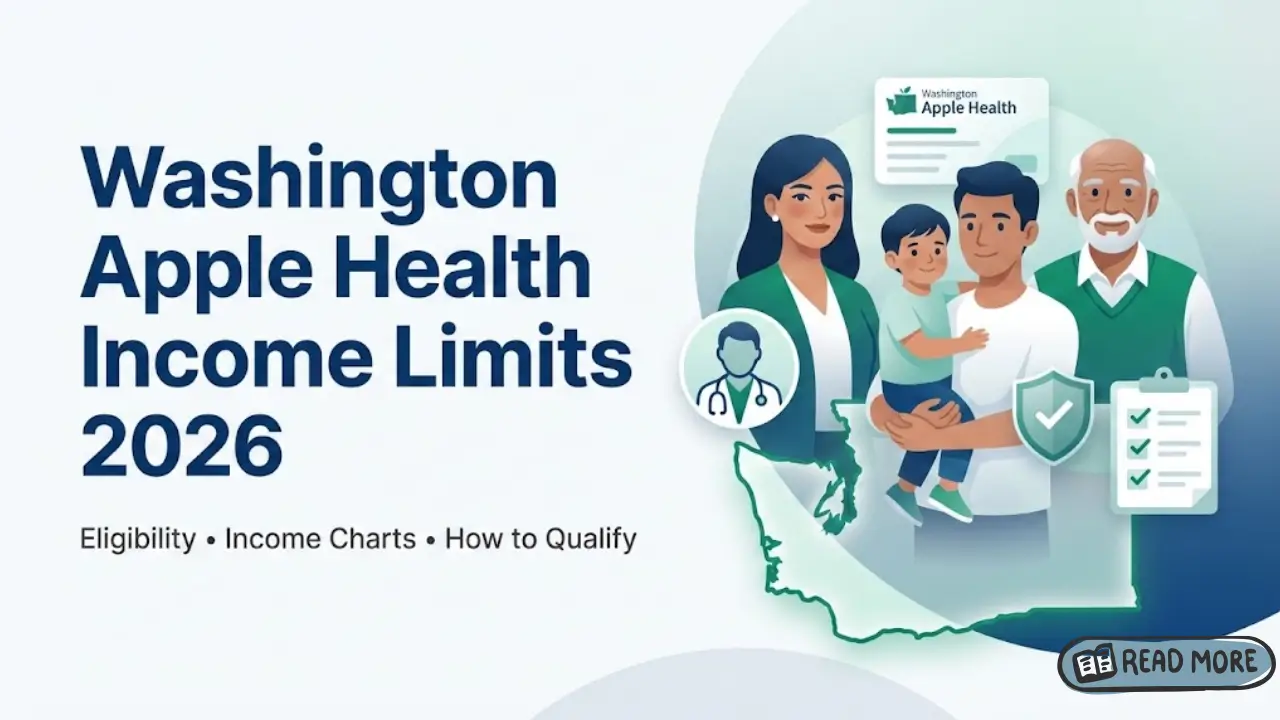
In Washington State, Apple Health is the free or low-cost health insurance program for residents with low income. It is Washington’s Medicaid program. Most people pay zero premiums and zero copays.
For 2026, a single adult qualifies with income up to $1,800/month. Children can qualify with family income of up to $4,134/month for a family of one. Seniors and people with disabilities use different rules based on SSI rates.
Quick Answer Summary:
- 💰 Adults (ages 19–64): You qualify with income up to $1,800/month for a single person — no savings limit applies.
- 👶 Children (under 19): Income limits go up to $4,134/month for one child — even higher-income families qualify through CHIP.
- 🤰 Pregnant women: You qualify up to $2,804/month — plus you get 12 months of free coverage after birth.
- 👴 Seniors & disabled (65+): Income limit is $994/month — a $2,000 asset limit also applies.
- 🏥 Long-term care: You can earn up to $2,982/month and still qualify for nursing home or home care coverage.
- 📋 Savings rules: Adults, children, and pregnant women face zero asset test — only seniors and long-term care applicants have a savings limit.
Note: There are two update cycles in 2026. MAGI programs (adults, children, families) will update again on April 1, 2026, when the new federal poverty level takes effect. Non-MAGI programs (aged, blind, disabled, long-term care) updated January 1, 2026.
Washington Apple Health MAGI Income Limits (2026)
MAGI stands for Modified Adjusted Gross Income. These programs cover most adults, children, pregnant individuals, and families. There is no asset or resource test for any MAGI program — only your income matters.
The limits below are currently in effect and will update again on April 1, 2026. To see how Washington compares nationally, you can check Medicaid income limits by state in 2026.
Adults — 138% Federal Poverty Level (FPL)
Most adults ages 19–64 qualify if their household income falls at or below 138% FPL.
| Household Size | Monthly Income Limit |
|---|---|
| 1 person | $1,800 |
| 2 people | $2,433 |
| 3 people | $3,065 |
| 4 people | $3,697 |
| 5 people | $4,330 |
| 6 people | $4,962 |
| 7 people | $5,595 |
| 8 people | $6,228 |
| Each additional person | +$632 |
All MAGI limits include the mandatory 5% income disregard, except for the Family Classic (N01) program.
Children & Pregnant Individuals — 215% FPL
Children and pregnant individuals qualify at a higher income threshold — up to 215% FPL. Unborn children count toward household size for these programs.
| Household Size | Monthly Income Limit |
|---|---|
| 1 person | $2,804 |
| 2 people | $3,790 |
| 3 people | $4,775 |
| 4 people | $5,760 |
| 5 people | $6,747 |
| 6 people | $7,731 |
| 7 people | $8,716 |
| 8 people | $9,703 |
| Each additional person | +$985 |
After-pregnancy coverage (postpartum Medicaid) follows the same 215% FPL limits above.
Family Classic (N01) Program
The Family Classic program has lower income thresholds than the standard Adult program.
| Household Size | Monthly Income Limit |
|---|---|
| 1 person | $511 |
| 2 people | $658 |
| 3 people | $820 |
| 4 people | $972 |
| 5 people | $1,127 |
| 6 people | $1,284 |
| 7 people | $1,471 |
| 8 people | $1,631 |
Family Planning Only — 265% FPL
Individuals who need family planning services only can qualify at up to 265% FPL, even if they don’t qualify for full Medicaid coverage.
| Household Size | Monthly Income Limit |
|---|---|
| 1 person | $3,456 |
| 2 people | $4,672 |
| 3 people | $5,886 |
| 4 people | $7,099 |
| Each additional person | +$1,214 |
CHIP Income Limits (Children’s Health Insurance Program)
Washington’s CHIP program has two premium tiers for children in households above 215% FPL.
| CHIP Tier | Income Threshold | Monthly Premium | 1-Person Limit |
|---|---|---|---|
| Tier 1 (N13/N33) | 265% FPL | $20/month | $3,456 |
| Tier 2 (N13/N33) | 317% FPL | $30/month | $4,134 |
CHIP Tier 2 income limits by household size:
| Household Size | Monthly Income Limit |
|---|---|
| 1 person | $4,134 |
| 2 people | $5,589 |
| 3 people | $7,041 |
| 4 people | $8,492 |
| 5 people | $9,947 |
| 6 people | $11,399 |
| 7 people | $12,851 |
| 8 people | $14,306 |
| Each additional person | +$1,452 |
SSI and CNIL Standards for 2026
The federal Social Security Administration issued a 2.8% Cost-of-Living Adjustment (COLA) for 2026. Washington’s SSI-related Medicaid standards have been updated to reflect this change, effective January 1, 2026.
These limits apply to the Aged, Blind, and Disabled (ABD) Medicaid programs. To understand more about how billing works under these programs, see the Medicaid Fee Schedule 2026.
2026 SSI / CNIL Income Standards
| Standard | Single Individual | Eligible Couple |
|---|---|---|
| Federal Benefit Rate (FBR) | $994/month | $1,491/month |
| CNIL Income Standard | $994/month | $1,491/month |
| ½ FBR | $497 | N/A |
| Shared Living FBR | $663 | $994 |
| SSI Resource Limit | $2,000 | $3,000 |
| Non-Blind SGA | $1,690/month | — |
| Blind SGA | $2,830/month | — |
SGA = Substantial Gainful Activity. This is the income level at which SSA considers a person “able to work.” The 2026 figures reflect the federal COLA increase.
Washington Medically Needy (MN) Program — 2026 Limits
The Medically Needy program helps people whose income is too high for standard Medicaid but who have high medical bills. Washington uses a spend-down process to determine eligibility.
These limits were also updated on January 1, 2026, using the same COLA figures.
2026 Medically Needy Income Limits (MNIL)
| Household Size | Monthly Income Standard |
|---|---|
| 1–6 people | $994/month |
| 7 people | $1,125/month |
| 8 people | $1,242/month |
| 9 people | $1,358/month |
| 10 people | $1,483/month |
| 11+ people | $1,483/month |
2026 Medically Needy Resource Limits
| Household Size | Resource Limit |
|---|---|
| 1 person | $2,000 |
| 2 people | $3,000 |
| 3 people | $3,050 |
| 4 people | $3,100 |
| 5 people | $3,150 |
| 6 people | $3,200 |
| 7 people | $3,250 |
| 8 people | $3,300 |
| Each additional person | +$50 |
Long-Term Care (LTSS) Medicaid Income Limits — 2026
Washington’s Long-Term Services and Supports (LTSS) Medicaid covers nursing home care, home and community-based waiver services, and assisted living facilities.
These limits updated January 1, 2026, and are some of the most important numbers for elderly or disabled residents planning for care.
For a complete breakdown of Washington Apple Health eligibility rules and how to apply, visit our guide on Washington Medicaid eligibility in 2026.
2026 LTSS Key Income and Resource Standards
| Standard | 2026 Amount |
|---|---|
| Medicaid Special Income Level (SIL) | $2,982/month |
| DDA & HCS HCBS Waiver PNA (at home) | $2,982/month |
| HCS Waivers PNA with Community Spouse | $994/month |
| Personal Needs Allowance — Nursing Home | $108.74/month |
| DDA & HCS Waivers / CFC / MPC PNA in ALF | $108.74/month |
| Room & Board in ALF | $885.26/month |
| Home Equity Limit | $1,130,000 |
| Community Spouse Maintenance Allowance (Max) | $4,066.50/month |
| TSOA Income Limit | $3,976/month |
| TSOA Resources (individual) | $84,354 |
| TSOA Resources (with Community Spouse) | $156,883 |
| Federal Spousal Resource Maximum (CSRA) | $162,660 |
| State Spousal Resource Allowance (Minimum) | $72,529 (updates odd years) |
| PNA State Veterans Home Maximum | $160/month |
PNA = Personal Needs Allowance. This is the amount a nursing home resident keeps each month for personal expenses. The Community Spouse Resource Allowance (CSRA) protects assets for the spouse living at home.
Medicare Savings Programs — 2026 Income Limits
Medicare Savings Programs (MSPs) help low-income Medicare beneficiaries pay for Part A and Part B costs. Washington eliminated the asset test for MSPs in 2026, meaning only income is checked — no savings or bank account limits apply.
The figures below are effective April 1, 2025 through March 31, 2026. New figures will publish April 1, 2026.
Current Medicare Savings Program Income Limits
| Program | What It Pays | 1-Person | 2-Person | 3-Person | 4-Person | Per Add’l |
|---|---|---|---|---|---|---|
| QMB — 110% FPL | Part A & B premiums, deductibles, copays | $1,454 | $1,959 | $2,463 | $2,967 | +$504 |
| SLMB — 120% FPL | Part B premium only | $1,585 | $2,136 | $2,685 | $3,235 | +$550 |
| QI-1 — 138% FPL | Part B premium only | $1,820 | $2,453 | $3,085 | $3,717 | +$632 |
| QDWI — 200% FPL | Part A premium only | $2,628 | $3,546 | $4,462 | $5,378 | +$916 |
All figures include a $20 general income disregard. No asset test applies in Washington for any MSP in 2026.
Medicare Cost-Sharing Standards (2026)
These are the standard Medicare cost-sharing figures relevant to Washington Apple Health members who are also enrolled in Medicare.
Knowing these numbers helps you understand what Apple Health may cover on your behalf.
| Medicare Item | 2026 Cost |
|---|---|
| Part A Premium (40+ work quarters) | Free |
| Part A Premium (30–39 quarters) | $311/month |
| Part A Premium (under 30 quarters) | $565/month |
| Part A Inpatient Deductible | $1,736 per benefit period |
| Part A Coinsurance (Days 61–90) | $434/day |
| Part A Coinsurance (over 90 days) | $868/day |
| Part A Coinsurance NF (Days 21–100) | $217/day |
| Part B Premium | $203/month |
| Part B Deductible | $283 |
| Low Income Subsidy (LIS) Resources — Single | $16,590 |
| Low Income Subsidy (LIS) Resources — Couple | $33,100 |
Key 2026 Policy Changes — What’s New
Washington Apple Health saw several important policy shifts in 2026. Every current and prospective enrollee should know these changes before applying.
Changes Already in Effect (January 1, 2026)
- 🔴 ABD/SSI income limit rose to $994/month for singles — up from 2025 levels due to the 2.8% federal COLA.
- 🔴 Washington eliminated asset limits for all Medicare Savings Programs — only income is tested now.
- 🔴 Apple Health Expansion for undocumented adults closed enrollment in December 2025. Current enrollees keep their coverage, but no new applications are accepted.
Coming in 2026 (Not Yet in Effect)
- 📅 April 1, 2026: MAGI income limits (adults, children, pregnancy, family planning) will rise again when the 2026 federal poverty level ($15,960/year for 1 person) is applied.
- 📅 April 1, 2026: Medicare Savings Program dollar thresholds will refresh with the new FPL.
- 📅 December 31, 2026: Apple Health Expansion adults must renew eligibility every 6 months per federal law (H.R. 1).
How to Apply for Washington Apple Health in 2026
Applying for Apple Health is free and can be done any time of year — there is no open enrollment window for Medicaid. Here is how to get started:
- Online: Apply at Washington Healthplanfinder — the fastest option.
- By phone: Call 1-855-923-4633 (Washington Health Benefit Exchange).
- In person: Visit your local HCA Community Services Office.
- By mail: Download and mail a paper application to the Health Care Authority.
What you’ll need to apply:
- Proof of identity (driver’s license, passport, or state ID)
- Proof of Washington State residency
- Social Security Number (for eligible applicants)
- Recent income information (pay stubs, tax returns, or benefit letters)
- Immigration documents (if applicable)
Frequently Asked Questions — Washington Medicaid 2026
1. What is the Apple Health income limit for a single adult in 2026?
A single adult can earn up to $1,800 per month (138% FPL, including the 5% disregard) to qualify for Washington Apple Health under the standard adult program. This figure is currently in effect and will update again on April 1, 2026.
2. Do you have to have resources or savings to qualify for Apple Health?
For MAGI-based Apple Health programs (adults, children, families, pregnancy), there is no asset or resource test. Only your income matters. However, non-MAGI programs like SSI-linked Medicaid do have resource limits ($2,000 for a single person).
3. What is the income limit for a family of 4 on Washington Medicaid in 2026?
A family of 4 can earn up to $3,697 per month under the standard adult Apple Health program (138% FPL). Children in the same household may qualify up to $5,760 per month at 215% FPL.
4. What is the nursing home Medicaid income limit in Washington for 2026?
The Medicaid Special Income Level (SIL) for long-term care in Washington is $2,982 per month in 2026. Residents in nursing facilities keep only $108.74 per month as a personal needs allowance.
5. Did Washington eliminate the asset test for Medicare Savings Programs in 2026?
Yes. Washington State eliminated the asset/resource test for all Medicare Savings Programs (QMB, SLMB, QI-1, QDWI) effective 2026. Only the income limits listed above apply — there is no longer a savings or bank account limit.
6. When will the 2026 MAGI income limits update again?
MAGI program limits (adults, children, pregnancy, family planning) will update again on April 1, 2026, when the new federal poverty level is applied. The updated figures will be published by the Washington State Health Care Authority at that time.
Official Sources & References
- 📄 HCA 19-0096 (01/26) — WA Apple Health Income and Resource Standards — Washington State Health Care Authority
- 🏛️ Washington State Health Care Authority — Apple Health (Medicaid) — hca.wa.gov
Last Updated: February 2026 | Source: HCA 19-0096 (01/26), Washington State Health Care Authority. Income limits are subject to change. Always verify current figures at hca.wa.gov before applying.