Written & Reviewed by Akash Biswas, MSW | Former Medicaid Caseworker Trainer | Verified against official Medicaid.gov, CMS, and state agency guidelines | Last Updated: July 2026
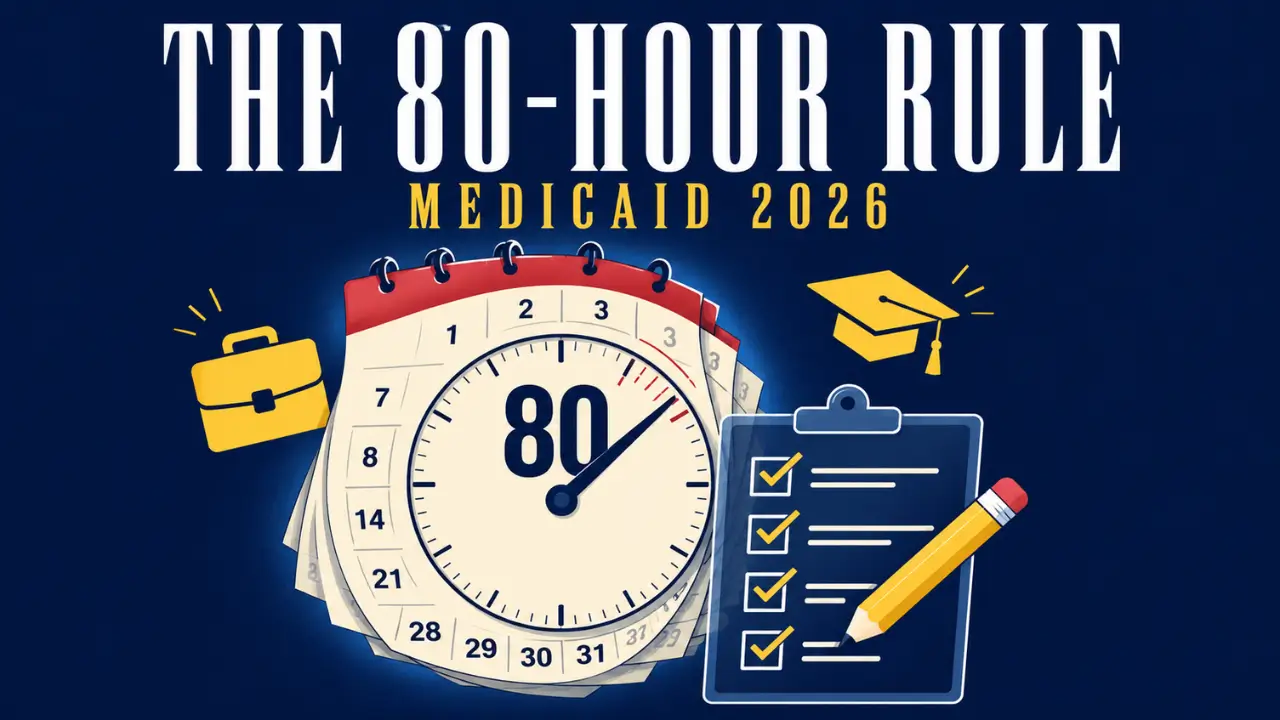
Starting in 2026, most adults on Medicaid expansion coverage must report 80 hours a month of work, school, or volunteering to keep their benefits. This comes from a new federal rule.
States must fully turn it on by January 1, 2027. This guide explains who it affects, how to report your hours, and what happens if you miss a deadline.
Quick Summary
- The rule applies to most expansion adults ages 19–64.
- You need 80 hours a month of work, school, training, or volunteering.
- Earning at least $580 a month also meets the rule, no hours log needed.
- You report through your state’s Medicaid portal, not Medicaid.gov.
- Many people qualify for an exemption and don’t have to report at all.
What Is the 80-Hour Rule?
The 80-Hour Rule is a new part of Medicaid law. It says many adults must show they are working, studying, or volunteering to keep their coverage.
Where It Came From
Congress passed a big budget law in 2025. It told Medicaid to add a work rule for certain adults. The Centers for Medicare & Medicaid Services, known as CMS, wrote the official rule in June 2026.
Who the Rule Applies To
This rule affects adults ages 19 to 64 in the Medicaid “expansion group.” That means people who qualify for Medicaid mainly because their income is low, not because of age or disability. If you’re not sure which group you’re in, our guide to Medicaid Eligibility in 2026 breaks down each category.
The 80-Hour Standard Explained
Each month, you must show 80 hours of qualifying activity. There are two main ways to meet this.
Option 1: Log 80 Hours
You can add up hours from work, school, job training, or volunteering. You can mix activities. They just need to total 80 hours in the month.
Option 2: Meet the Income Amount
If you earn at least $580 in the month, you meet the rule automatically. This equals 80 hours times the federal minimum wage. You do not need to track hours if your pay stubs show this amount.
How to Report Your Work Hours
There is no single federal website for this. You must report through your own state’s Medicaid system. Here is how the process works.
Step 1: Find Your Reporting Deadline
Most states must have reporting fully running by January 1, 2027. You may get a notice to set up your account as early as August 2026. Some states are moving faster than others.
A few states already have their own rules in place. Nebraska started May 1, 2026. Montana started July 1, 2026. Iowa’s rule begins December 1, 2026. Georgia has run a similar work requirement since 2023 under its own state program, called Pathways to Coverage, which works separately from this new federal rule.
Step 2: Log In to Your State Portal
You cannot report your hours on Medicaid.gov. Every state has its own online system. For example, North Carolina uses ePASS. Michigan uses MI Bridges. Texas uses YourTexasBenefits.
Once you log in, look for a tab called “Report Changes” or “Renewals.” Then choose “Work” or “Community Engagement” to enter your hours.
Step 3: Upload Your Proof
For most activities, you will need to upload proof. Keep records as you go so this step is easy.
- Paid work: Pay stubs showing hours or $580+ in gross pay.
- Self-employment: Invoices or a simple earnings ledger.
- Volunteering: A signed letter from your supervisor on official letterhead.
- School: A class schedule showing at least half-time enrollment.
What Counts as a Qualifying Activity?
You can mix and match activities to reach 80 hours. Here’s what counts toward your total.
Work and Training
Paid work counts, whether it’s private, public, subsidized, or unsubsidized. Job training programs and internships count too.
Education and Community Service
School counts if you’re enrolled half-time or more, including high school, GED programs, or college. Volunteering with a nonprofit or public agency also counts.
Other Qualifying Paths
Tribal work programs count for members of tribal communities. Compliance with substance use treatment or vocational rehab also satisfies the rule.
Who Is Exempt From Reporting?
Many people don’t have to report hours at all. If you fit one of these groups, you may still need to file a yearly exemption form.
Age and Health Exemptions
You’re exempt if you’re under 19 or over 64. Pregnant women and people up to 12 months postpartum are also exempt, though some states use a shorter 60-day minimum.
People who are medically frail don’t have to report either. This means a serious health condition or disability makes work impossible. A lawsuit filed in July 2026 is challenging how strictly this category is defined, so this rule may change.
Caregiver and Student Exemptions
You’re exempt if you’re the main caregiver for a child age 13 or younger. Caregivers of a disabled dependent are exempt too, with medical proof. Students enrolled at least half-time are also exempt.
Other Exemptions
People receiving unemployment benefits count as compliant in some states automatically. Always check your state’s exact rules, since categories can vary slightly.
What Happens If You Don’t Report?
Missing your hours has real consequences. Here’s what to expect.
Losing Coverage
If you don’t report your hours, or don’t meet the requirement, you lose Medicaid coverage. This is a full disenrollment, not a pause.
Getting Back On Medicaid
You can usually reapply right away. But you’ll need to prove you’re meeting the work rule for about 30 days before your coverage restarts. Exact rules depend on your state.
Key Dates to Remember
- June 3, 2026: CMS published the official rule.
- July 31, 2026: The federal rule takes effect. States begin finishing their portals.
- January 1, 2027: All states must have the work rule fully running.
Since income still matters even with the work rule in place, it helps to check the medicaid income limits by state in 2026 to see if you qualify in the first place. And if you’re comparing what your coverage pays for once you’re enrolled, our Medicaid Fee Schedule 2026 explains how the state pays providers for your care.
FAQ
Q: What is the 80-hour Medicaid rule?
A: It’s a new federal requirement for many Medicaid adults ages 19–64. You must show 80 hours a month of work, school, training, or volunteering to keep your coverage. Some people qualify for an exemption instead.
Q: When does the Medicaid work rule start?
A: The federal rule takes effect July 31, 2026. States must fully enforce it by January 1, 2027. Some states, like Nebraska and Montana, started earlier in 2026.
Q: Can I report my hours on Medicaid.gov?
A: No. You must report through your own state’s Medicaid portal. Each state has a different system, so check your state agency’s website for the correct login.
Q: What if I earn money but don’t track hours?
A: If you earn at least $580 a month, you automatically meet the rule. You don’t need to log specific hours if your pay stubs show this amount.
Q: Who is exempt from the work requirement?
A: Pregnant women, caregivers of young children, students, and people who are medically frail are commonly exempt. Age also matters — you’re exempt if you’re under 19 or over 64.
Q: What happens if I miss the reporting deadline?
A: You can lose your Medicaid coverage. To get it back, you’ll typically need to show about 30 days of meeting the work rule before coverage starts again.
Last Updated: July 2026
Sources:
- CMS Fact Sheet, Medicaid Community Engagement Requirement Interim Final Rule (CMS-2454-IFC), June 1, 2026 — cms.gov
- Federal Register, Medicaid Program: Community Engagement Requirement for Certain Individuals, June 3, 2026 — federalregister.gov
- Georgia Pathways to Coverage Program — pathways.georgia.gov
Disclaimer: CheckMedicaid.com is not affiliated with any government agency. For official eligibility, contact your state Medicaid office or visit Medicaid.gov.