Medicaid in Illinois provides health coverage for people with low income who meet set rules. It covers doctor visits, hospital stays, prescriptions, and other care.
The 2026 rules matter because income limits and details update each year with federal changes. Illinois has expanded Medicaid. This means more adults can qualify based just on income.
Eligibility depends on your group, income, and household size. Groups include children, pregnant women, and seniors. Bigger households often allow higher income. Age and disability play roles, too.
Illinois covers more people than non-expansion states. But not everyone gets in. Rules are strict. Coverage is not guaranteed.
You must apply and pass all checks. Check your facts with official sources.
Important: Some Medicaid income limits for Illinois will be updated in January 2026. Always check the official Illinois HFS website before applying to confirm the most current income rules.
Not sure if you qualify? Use our updated 2026 Medicaid eligibility calculator to check your eligibility based on your income, household size, and age in minutes.
What Is Medicaid in Illinois?
Medicaid is a state and federal program that helps pay for health care. In Illinois, the Department of Healthcare and Family Services (HFS) runs it. It serves over 3 million people.
The program covers check-ups, emergency care, mental health, dental for kids, and vision.
Illinois Medicaid helps children, pregnant women, families, low-income adults, seniors, and people with disabilities. It includes expanded coverage for adults without kids.
This makes it broader than in some states. The aim is to keep people healthy and lower costs. If you qualify, you pay little or nothing.
Most use managed care plans for better service.
Has Illinois Expanded Medicaid for 2026?
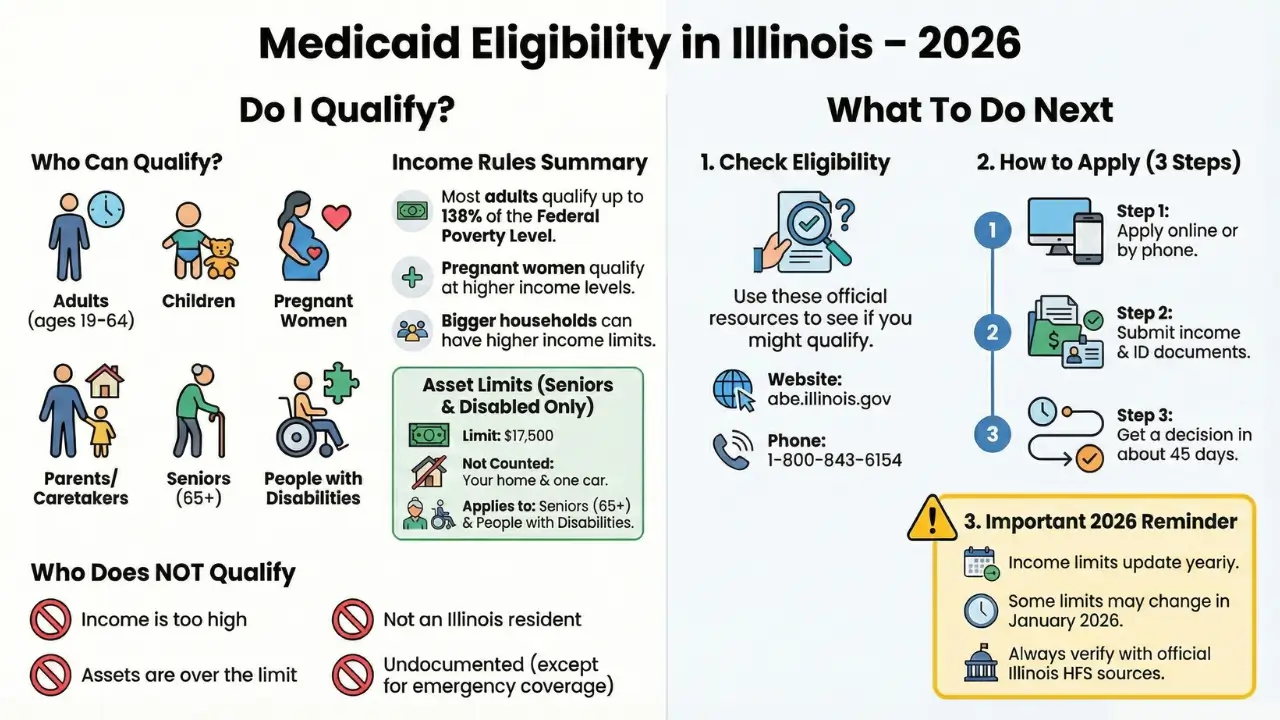
Yes, Illinois expanded Medicaid under the Affordable Care Act. It stays expanded in 2026. Expansion covers adults ages 19 to 64 with income up to 138 percent of the federal poverty level.
You do not need kids or a disability. This helps working people with low pay. Without it, fewer adults would qualify.
Over 688,000 adults use this coverage. If income is too high, check other plans.
Who Is Eligible for Medicaid in Illinois in 2026?
Illinois groups people for Medicaid. You must fit a group and meet income rules for your household. Each group has its own limits. Here are the main ones:
- Low-income adults (ages 19-64): Qualify with income up to 138 percent of the federal poverty level. This is from expansion. No kids needed.
- Children: Kids under 19 qualify with family income up to 142 percent of poverty level. Higher for younger ones sometimes.
- Pregnant women: Income up to 213 percent of poverty level. Coverage lasts through pregnancy and 12 months after.
- Parents and caretakers: Adults with kids under 19 qualify if family income is low, up to 138 percent for the household.
- Seniors (age 65+): Need low income, around $1,304 per month, and assets under $17,500.
- People with disabilities: Income and assets like seniors. Disability must be proven by Social Security or state.
Most groups use MAGI rules, based on tax income. Seniors and disabled use different counts. You must live in Illinois and be a citizen or qualified immigrant. Apply if close to limits.
How Household Size Affects Medicaid Eligibility in Illinois
Household size includes people on your tax return, like you, spouse, and dependents. For Medicaid, count kids under 19 or 21 if in school. Pregnant women add the unborn child.
For adults and families, MAGI rules use tax household. A single is size one. Add family to increase it. Bigger size raises income limit. A family of four can earn more than a single and qualify.
For seniors or disabled, size may count only for applicants. Common mistakes: Forgetting a dependent or adding non-family. Wrong size denies coverage. Use ABE tool to check. Report changes fast.
Medicaid Income Limits in Illinois (2026)
Income limits depend on group, household size, and federal poverty level. Illinois uses FPL guidelines. Limits update each year.
For adults, 138 percent FPL. Children up to 142 percent. Pregnant to 213 percent. Parents match adult limits. Seniors and disabled around $1,304 monthly.
Limits rise with household size. Use gross income minus deductions. Some income skips counting. Illinois has higher limits than non-expansion states. Check official charts. Verify on state sites.
Asset Limits for Illinois Medicaid (Seniors and Disabled)
Asset rules apply to seniors and people with disabilities. Kids, pregnant, and expansion adults skip them.
Countable assets: Cash, stocks, extra cars. Limit is $17,500 for the household. Exempt: Home, one car, personal items.
If over, spend down on care. Married couples protect more. Get help to plan.
Who Does NOT Qualify for Medicaid in Illinois?
Some do not qualify despite low income. If income exceeds your group’s limit, you are out. For seniors or disabled, assets over $17,500 block you.
Non-Illinois residents cannot join. Undocumented get only emergencies. Wrong info denies applications. Illinois covers many, but rules matter. Appeal if denied.
Special Medicaid Programs in Illinois
Illinois has added programs. HealthChoice Illinois is managed care for most. It coordinates care.
All Kids covers children with income too high for basic Medicaid.
ACA Adult Group is an expansion for low-income adults.
Long-term care helps seniors and the disabled at home or facilities. Includes spenddown.
These meet special needs. Ask during application.
How to Check Medicaid Eligibility in Illinois
Use the ABE website at abe.illinois.gov. Answer questions on income and household. It shows if you might qualify.
Call HFS at 1-800-843-6154. Visit local DHS offices. Bring proof.
Want to understand how your result was calculated? Read our full guide on Medicaid eligibility rules for 2026, including income limits and qualifying groups.
How to Apply for Medicaid in Illinois
Apply online at abe.illinois.gov. It’s quick. Or call 1-800-843-6154. In-person at DHS offices.
Gather ID, income proof, household details. Immigrants need papers. Review takes 45 days. Track online. Renew yearly.
What to Do If You Are Not Eligible
Try ACA Marketplace at getcovered.illinois.gov. Get subsidies. Community clinics offer low-cost care. Reapply if changes happen.
Frequently Asked Questions (FAQs)
How is household size counted for Medicaid in Illinois in 2026?
Household size is based on your tax household in 2026. This includes you, your spouse, and any dependents you claim, plus an unborn child if pregnant.
What are the Medicaid income limits in Illinois for 2026?
Income limits depend on your group and household size in 2026. Most adults qualify up to 138% of the federal poverty level, while children and pregnant women qualify at higher levels.
Can adults without children qualify for Medicaid in Illinois in 2026?
Yes, adults ages 19 to 64 without children can qualify in 2026. Income must be at or below 138% of the federal poverty level.
Does pregnancy affect Medicaid eligibility in Illinois in 2026?
Yes, pregnancy raises the income limit for Medicaid in Illinois in 2026. Coverage can last through pregnancy and up to 12 months after birth.
Do seniors have asset limits for Medicaid in Illinois in 2026?
Yes, seniors age 65 and older must meet asset limits in 2026. Countable assets usually must stay under $17,500, not counting a home or one car.
What is Medicaid expansion in Illinois for 2026?
Medicaid expansion covers low-income adults without children or disabilities in 2026. It allows more people to qualify based on income alone.
How often do Medicaid income limits change in Illinois?
Income limits change once each year. Illinois uses the updated federal poverty level rules for Medicaid eligibility in 2026.
Can immigrants qualify for Medicaid in Illinois in 2026?
Some lawfully present immigrants can qualify for full Medicaid coverage in 2026. Undocumented immigrants can receive emergency Medicaid only.
Key Takeaways
Illinois expanded Medicaid. This lets more adults qualify based on low income alone. Household size strongly affects eligibility. It raises income limits for bigger families. Income limits change each year with federal updates. Seniors and people with disabilities face asset rules too. Some income limits may change again in January 2026, so always verify the latest numbers on official Illinois Medicaid websites. Always apply through state site.