Medicaid Eligibility Illinois 2026 depends on more than just your income. Your household size, age, pregnancy status, disability, Medicare status, and the Medicaid program you apply for can all affect whether you qualify.depends on your age, household size, income, and the Medicaid program you may qualify for. Adults ages 19–64 may qualify through the ACA Adult group based on income, while seniors, people with disabilities, children, pregnant women, and parents or caretaker relatives may qualify under different Illinois Medicaid programs.
Illinois covers more people than non-expansion states. But not everyone gets in. Rules are strict. Coverage is not guaranteed.
You must apply and pass all checks. Check your facts with official sources.
Here’s what to know about Illinois Medicaid income limits, eligibility requirements, asset rules, and how to apply in 2026.
Important: Some Medicaid income limits for Illinois will be updated in January 2026. Always check the official Illinois HFS website before applying to confirm the most current income rules.
Not sure if you qualify? Use our updated 2026 Medicaid eligibility calculator to check your eligibility based on your income, household size, and age in minutes.
Table of Contents
What Is Medicaid in Illinois?
Illinois Medicaid is a state and federally funded health coverage program for eligible Illinois residents. Eligibility depends on factors such as your age, household, income, pregnancy or disability status, and the Medicaid coverage category that applies to you.
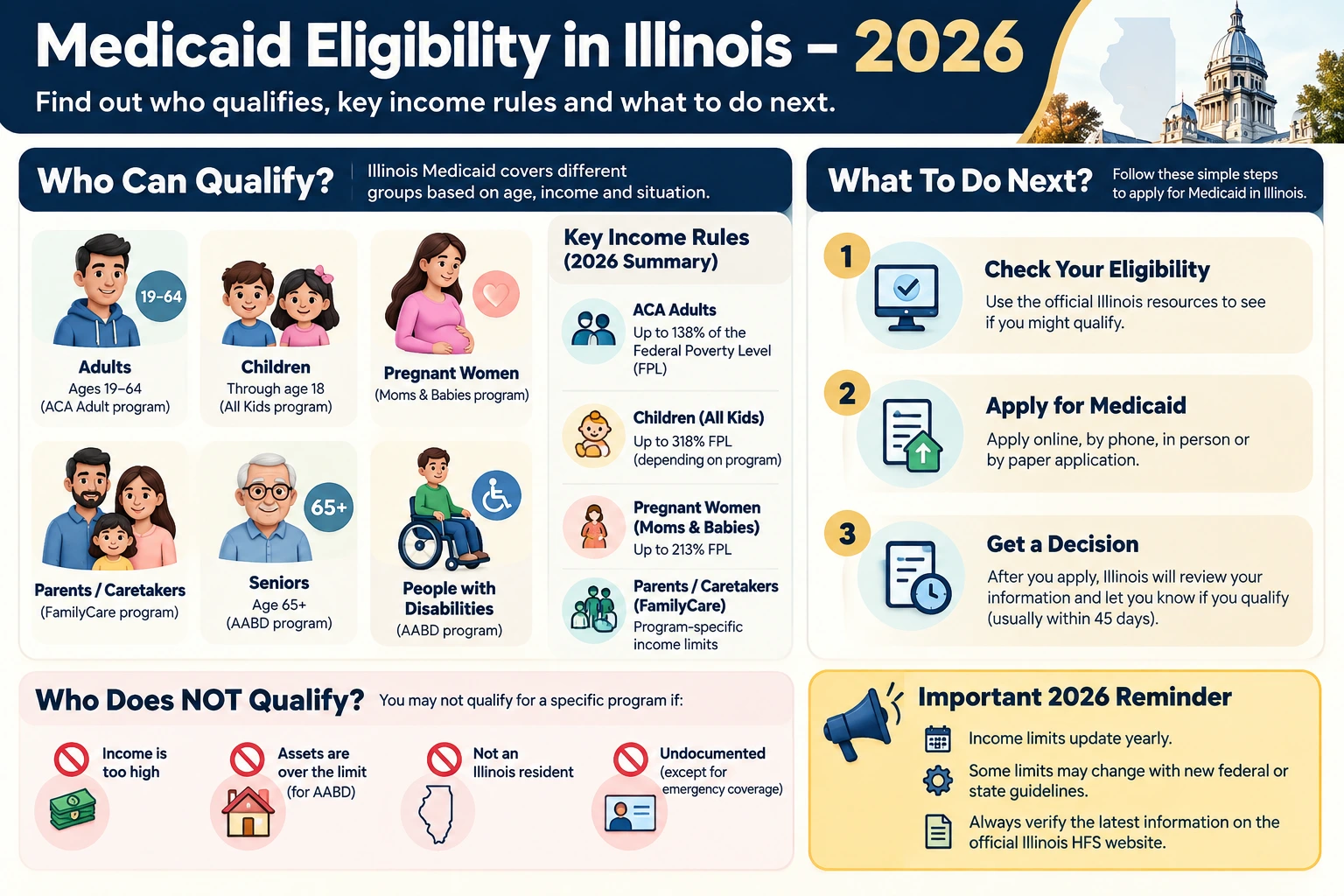
Illinois uses different programs, including ACA Adults, All Kids, FamilyCare, Moms & Babies, Former Foster Care and AABD Medical.
Medicaid Eligibility Illinois 2026: Who Qualifies?
Illinois groups people for Medicaid. You must fit a group and meet income rules for your household. Each group has its own limits. Here are the main ones:
ACA Adults
- Adults 19–64
- Generally no dependent child under 18 living with them
- Not already on Medicare
- Income pathway up to 138% FPL
All Kids
- Children through age 18
- Eligibility depends on household income and program rules
FamilyCare
- Parents or caretaker relatives living with dependent children under 18
Moms & Babies
- Pregnant women and eligible newborns
- Coverage can continue up to 12 months after birth under the program rules
AABD Medical
- People age 65+, blind, or with a qualifying disability
- Separate income/resource rules apply
Former Foster Care
- Young adults who aged out of Illinois DCFS foster care can qualify under this category.
Most groups use MAGI rules, based on tax income. Seniors and disabled use different counts. You must live in Illinois and be a citizen or qualified immigrant. Apply if close to limits.
ACA Adult Medicaid Income Limits
These figures apply to the ACA Adult 138% FPL pathway. Other Illinois Medicaid programs have different income limits.
ACA Adult — 138% FPL
| Household Size | Monthly Income |
|---|---|
| 1 | $1,835 |
| 2 | $2,489 |
| 3 | $3,141 |
| 4 | $3,795 |
| 5 | $4,448 |
| 6 | $5,101 |
Other 2026 Income Limits
Moms & Babies
Up to 213% FPL
All Kids
Up to 318% FPL, depending on the specific All Kids program/category. Illinois’ 2026 FPL chart lists Medicaid for children under 18 at up to 318% FPL.
FamilyCare
Parents/caretaker relatives have their own income guidelines rather than using the ACA Adult limit.
Asset Limits for Illinois Medicaid (Seniors and Disabled)
AABD Medical, which covers many seniors, blind individuals and people with disabilities, has separate income and resource rules. For 2026, the Illinois Medicaid income standards reference lists the AABD monthly income standard at $1,330 for one person and $1,803 for two people, with a $17,500 resource limit for AABD Medical.
Who Does NOT Qualify for Medicaid in Illinois?
Not everyone who applies for Medicaid in Illinois will qualify for the same coverage program. Eligibility can depend on your income, household size, age, pregnancy status, disability, Medicare status, immigration status, and available resources, depending on the Medicaid category.
You may not qualify for a particular Medicaid program if:
- Your income is above that program’s applicable limit.
- You do not meet the age or household requirements for the program.
- You exceed an applicable resource limit, such as the AABD resource limit.
- You do not meet Illinois residency or other eligibility requirements.
- You cannot provide information or documents needed to verify your eligibility.
However, being ineligible for one Medicaid category does not necessarily mean you cannot qualify under another program. For example, Illinois has separate coverage groups for children, pregnant individuals, parents and caretakers, ACA Adults, seniors and people with disabilities. (Illinois HFS)
Special Medicaid Programs in Illinois
Illinois Medicaid includes several programs designed for different groups of residents. The program that applies to you can affect the income limits and other eligibility requirements.
All Kids
Provides Medicaid and related health coverage for eligible children and teens.
FamilyCare
Provides coverage for eligible parents and caretaker relatives of dependent children.
ACA Adults
Covers eligible adults ages 19–64 who generally do not have a dependent child under 18 living with them and are not receiving Medicare.
Moms & Babies
Provides coverage for eligible pregnant individuals and newborns.
AABD Medical
Provides Medicaid coverage for eligible people who are 65 or older, blind, or have a qualifying disability. This category has separate income and resource rules.
Former Foster Care
Provides Medicaid coverage for certain young adults who aged out of Illinois DCFS foster care.
How to Check Medicaid Eligibility in Illinois
Use the ABE website at abe.illinois.gov. Answer questions on income and household. It shows if you might qualify.
Call HFS at 1-800-843-6154. Visit local DHS offices. Bring proof.
Want to understand how your result was calculated? Read our full guide on Medicaid eligibility rules for 2026, including income limits and qualifying groups.
How to Apply for Medicaid in Illinois
Apply online at abe.illinois.gov. It’s quick. Or call 1-800-843-6154. In-person at DHS offices.
Gather ID, income proof, household details. Immigrants need papers. Review takes 45 days. Track online. Renew yearly.
What to Do If You Are Not Eligible
Try ACA Marketplace at getcovered.illinois.gov. Get subsidies. Community clinics offer low-cost care. Reapply if changes happen.
What Medicaid Changes Are Coming in 2027?
Some Medicaid rules are scheduled to change in 2027, particularly for people enrolled as ACA Adults.
Beginning January 1, 2027, certain ACA Adult Medicaid recipients will be subject to new work, education or community-service requirements unless they qualify for an exemption. Illinois also expects ACA Medicaid expansion customers to have their eligibility reviewed every six months instead of every 12 months.
These changes do not apply in the same way to every Medicaid group. For example, many children, people age 65 and older, and people in other Medicaid categories are not subject to the ACA Adult work requirements.
If you are currently enrolled in Medicaid, keep your address and contact information updated through ABE so you do not miss important notices from Illinois HFS.
Check Your Illinois Medicaid Eligibility for 2026
Wondering whether you qualify for Medicaid in Illinois? Don’t rely on an outdated income number or assume you’re not eligible. Your household size, income, age, pregnancy, disability status and Medicaid category can all affect your eligibility.
The quickest way to know where you stand is to check your eligibility through Illinois ABE and submit an application if you may qualify. Even if you do not qualify for one Medicaid program, you may have another coverage option available.
Check your eligibility, review the current requirements, and take the next step toward getting the health coverage you may be eligible for.
Frequently Asked Questions (FAQs)
How is household size counted for Medicaid in Illinois in 2026?
Household size is based on your tax household in 2026. This includes you, your spouse, and any dependents you claim, plus an unborn child if pregnant.
What are the Medicaid income limits in Illinois for 2026?
For ACA Adult Medicaid, the 2026 income limit is $1,835 per month for one person and $2,489 for two people. Other Medicaid programs have different income limits.
Can adults without children qualify for Medicaid in Illinois in 2026?
Yes, adults ages 19 to 64 without children can qualify in 2026. Income must be at or below 138% of the federal poverty level.
Does pregnancy affect Medicaid eligibility in Illinois in 2026?
Yes, pregnancy raises the income limit for Medicaid in Illinois in 2026. Coverage can last through pregnancy and up to 12 months after birth.
Do seniors have asset limits for Medicaid in Illinois in 2026?
Yes. For AABD Medical, the 2026 resource limit is $17,500. The monthly income standard is $1,330 for one person and $1,803 for two people.
What is Medicaid expansion in Illinois for 2026?
Medicaid expansion covers low-income adults without children or disabilities in 2026. It allows more people to qualify based on income alone.
How often do Medicaid income limits change in Illinois?
Income limits change once each year. Illinois uses the updated federal poverty level rules for Medicaid eligibility in 2026.
Can immigrants qualify for Medicaid in Illinois in 2026?
Some lawfully present immigrants can qualify for full Medicaid coverage in 2026. Undocumented immigrants can receive emergency Medicaid only.
Key Takeaways
Medicaid Eligibility Illinois 2026 depends on depends on your income, household size, age, and Medicaid category. Eligible adults ages 19–64 may qualify through the ACA Adult program based on income and other requirements. Larger households generally have higher income limits, but the exact limit depends on the Medicaid program. Seniors and people with disabilities may have separate income and resource requirements under AABD Medical. Medicaid income and eligibility rules can change when new federal or state guidelines take effect. If you are unsure whether you qualify, check your eligibility and apply through the official Illinois ABE system.