Last Updated: February 26, 2026.
MassHealth is Massachusetts’ Medicaid program. It provides free or low-cost health coverage to residents who meet income rules.
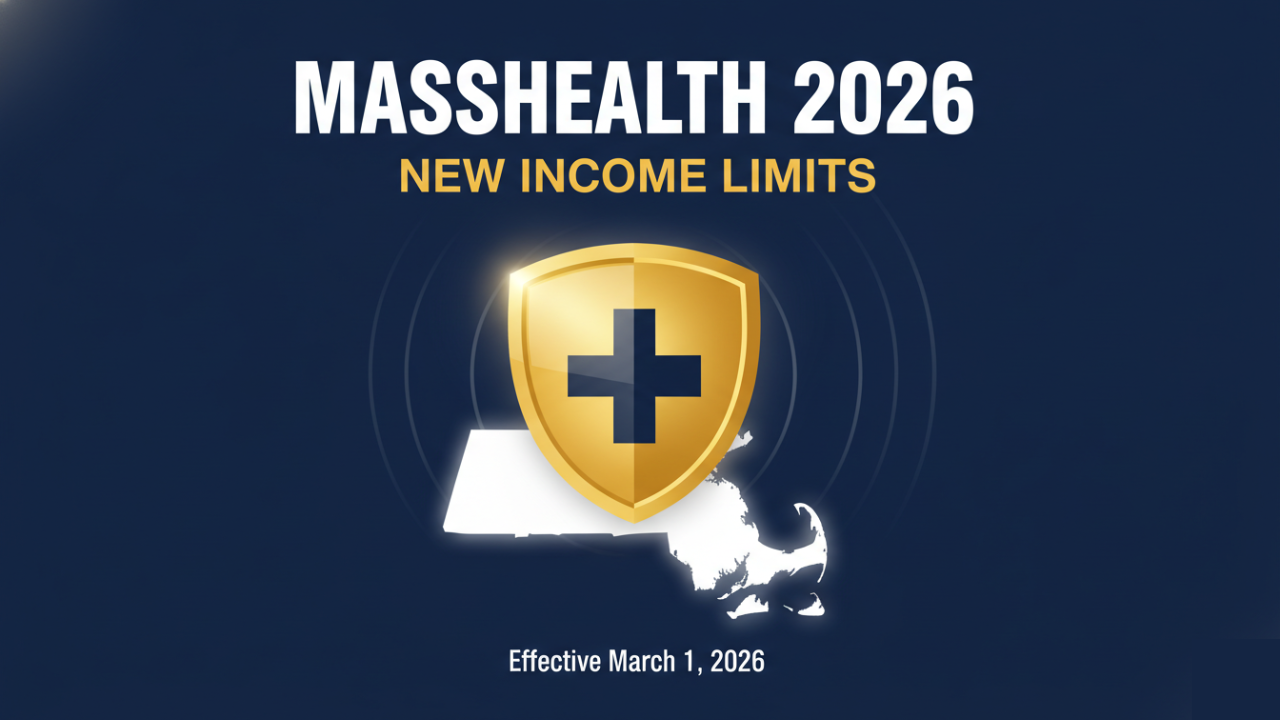
Starting March 1, 2026, MassHealth updates its income limits based on the new Federal Poverty Level (FPL).
Most adults qualify at 133% FPL (~$1,770/month). Seniors on Medicare can qualify up to 190% FPL (~$2,527/month).
Children can qualify up to 300% FPL (~$3,990/month).
Quick Answers — MassHealth Income Limits in 2026:
- Adults (19–64): Qualify at 133% FPL — about $1,770/month for one person
- Children (under 19): Qualify up to 300% FPL — about $3,990/month
- Pregnant women: Qualify at 200% FPL — about $2,608/month
- Seniors on Medicare (QMB): Qualify up to 190% FPL — about $2,527/month
- Disabled adults (CommonHealth): No income limit — any income qualifies
- New limits take effect March 1, 2026 — January/February applicants still use 2025 limits
- Biggest 2026 change: Senior long-term care limit rose +$81/month (from $2,901 → $2,982)
- No asset test for most programs, including Medicare Savings Programs
2026 MassHealth Income Limits at a Glance
Effective March 1, 2026, new income limits are in place across all MassHealth programs.
The table below shows limits for a single-person household. Limits are higher for larger families.
If you are researching Massachusetts Medicaid eligibility in 2026, these numbers are the starting point for every program.
| Program | Who It Covers | % FPL | Monthly Limit (1 Person) |
|---|---|---|---|
| Standard & CarePlus | Adults ages 19–64 | 133% | $1,770 |
| Senior Buy-In (QMB) | Seniors on Medicare | 190% | $2,527 |
| Buy-In (SLMB/QI) | Medicare seniors | 225% | $2,993 |
| Family Assistance | Children under 19 | 300% | $3,990 |
| CommonHealth | Disabled adults | None | No limit |
Note: These limits apply to a household of 1. Larger households have higher limits. Always verify current figures at mass.gov.
Why March 1 Matters
MassHealth does not update on January 1 like many other programs. It follows a March 1 cycle tied to federal poverty guidelines. Applications submitted in January or February 2026 still use 2025 limits. If you were denied in early 2026, re-apply after March 1 — new limits may make you eligible.
MassHealth Standard & CarePlus (Adults Ages 19–64)
Most working-age adults use the MAGI (Modified Adjusted Gross Income) method to determine eligibility.
There is no asset test for these programs — only income is counted.
MassHealth Standard
MassHealth Standard covers pregnant women, parents, caretakers, and disabled adults under 65.
- Income limit: 133% FPL for most adults (~$1,770/month)
- Income limit for pregnant women: 200% FPL (~$2,608/month)
- The fetus counts as an additional household member, which can raise the income limit further
MassHealth CarePlus
MassHealth CarePlus covers adults ages 21–64 who do not qualify for Standard.
- Income limit: Strictly 133% FPL (~$1,770/month individual)
- No asset test
- No premium for members at or below 150% FPL
Key tip: Your income is based on your Adjusted Gross Income (AGI) from your tax return — not your gross pay. Pre-tax deductions like 401(k) contributions or health insurance premiums can lower your AGI and help you qualify.
MassHealth Family Assistance (Children Under 19)
MassHealth Family Assistance covers children who do not qualify for Standard. It has one of the highest income limits in the country for a children’s Medicaid program.
- Income limit: Up to 300% FPL (~$3,990/month for a family of 1)
- Children from higher-income families may qualify for a small monthly premium
- Children’s Medical Security Plan (CMSP) also covers up to 405% FPL with a buy-in option
Senior & Medicare Programs (Age 65+)
Seniors have separate rules under MassHealth. Most senior programs use the Federal Benefit Rate (FBR) from SSI rather than the FPL.
This is the area where the biggest income limit increase happened in 2026.
For a full breakdown of how Massachusetts compares to other states, see our guide to Medicaid income limits by state in 2026.
Medicare Savings Programs (MSPs) — “Buy-In” Programs
These programs pay your Medicare premiums and sometimes your deductibles and copays.
Massachusetts has much higher income limits for these programs compared to the federal standard.
| Program | What It Pays | % FPL | Monthly Limit (1 Person) |
|---|---|---|---|
| Senior Buy-In (QMB) | Part A & B premiums, deductibles, coinsurance | 190% | $2,527 |
| Buy-In (SLMB/QI) | Part B premium only ($185/month in 2026) | 225% | $2,993 |
Important updates for 2026:
- No asset test — Massachusetts eliminated the asset test for Medicare Savings Programs in March 2024. You no longer need to worry about savings, a car, or a home when applying.
- If you have Medicare, these programs can save you thousands of dollars per year in premiums alone.
2025 vs. 2026: The Biggest Change for Seniors
The 300% FBR income limit — used for Home and Community-Based Services (HCBS) and long-term care programs — rose in 2026 due to the SSI cost-of-living adjustment.
| Limit | 2025 | 2026 | Change |
|---|---|---|---|
| SSI Federal Benefit Rate (FBR) | $967/month | $994/month | +$27 |
| 300% FBR Income Limit (LTC/HCBS) | $2,901/month | $2,982/month | +$81/month |
| Senior Asset Limit (Individual) | $2,000 | $2,000 | No change |
| Senior Asset Limit (Couple) | $3,000 | $3,000 | No change |
If you were just over the income limit in 2025, you may now qualify in 2026.
Long-Term Care & Nursing Home Coverage
Eligibility for nursing home coverage through MassHealth is strict. It involves a detailed financial review and a 5-year look-back period for any asset transfers.
Understanding what is covered — and what you pay — is essential.
You can also review the Medicaid Fee Schedule 2026 to see what MassHealth pays for specific nursing home and long-term care services.
Key Financial Rules for Long-Term Care
- Asset limit: $2,000 for a single individual
- Home equity exemption: Your primary home is exempt if equity is under approximately $1,100,000
- Income rule: You must pay nearly all monthly income to the facility
- Personal Needs Allowance (PNA): You keep only $72.80/month for personal items like clothing and haircuts — this amount did not increase for 2026
- Community Spouse protections: If your spouse remains at home, they can keep between $32,000 and approximately $161,000 in assets and up to ~$4,000/month in income
Spend-Down / Medically Needy Program
If your income is above the limit but you have high medical bills, you may still qualify through the spend-down pathway.
| Limit | 2025 | 2026 | Change |
|---|---|---|---|
| Monthly Income Limit — Individual | $522 | $522 | No change |
| Monthly Income Limit — Couple | $650 | $650 | No change |
| Asset Limit — Individual | $2,000 | $2,000 | No change |
Spend-down works over a 6-month period. Your unpaid medical bills reduce your countable income, potentially qualifying you for coverage.
MassHealth CommonHealth — Coverage for People with Disabilities
CommonHealth is one of the most flexible programs MassHealth offers. It allows working adults and children with disabilities to enroll regardless of income.
CommonHealth Eligibility Rules
- Income limit: None — you can earn any amount
- Premiums: Free at or below 150% FPL; sliding-scale premium above 150% FPL
- Example: Income between 150–200% FPL starts around $16.50/month
- Non-working disabled adults: May need to meet a one-time deductible before coverage begins
- Asset test: None
This program is especially valuable for people with disabilities who work and earn too much for standard Medicaid but cannot afford private insurance.
MassHealth Premiums in 2026
MassHealth is free for most low-income members. However, members with income above 150% FPL pay a monthly premium.
Premiums increased by 10% effective January 1, 2026.
| Income Level | 2025 Premium | 2026 Premium | Change |
|---|---|---|---|
| At or below 150% FPL | $0 | $0 | No change |
| Above 150% FPL | Base rate | Base rate +10% | ⬆️ Increase |
| Monthly range (all programs) | $0–~$90 | $0–~$100 | Small increase |
If you pay a MassHealth premium, contact MassHealth at 1-800-841-2900 to confirm your new amount.
2025 vs. 2026 Full Comparison Table
Here is a side-by-side view of all key income limits across both years.
| Program / Population | 2025 Limit | 2026 Limit | Change |
|---|---|---|---|
| Adults 19–64 (133% FPL), 1 person | ~$1,770/mo | ~$1,770/mo | ≈ Flat |
| Children under 19 (300% FPL) | ~$3,990/mo | ~$3,990/mo | ≈ Flat |
| Pregnant individuals (200% FPL) | ~$2,610/mo | ~$2,608/mo | ≈ Flat |
| Senior Buy-In QMB (190% FPL) | ~$2,527/mo | ~$2,527/mo | ≈ Flat |
| Seniors / LTC (300% FBR) | $2,901/mo | $2,982/mo | ✅ +$81/mo |
| Spend-Down MNIL — Individual | $522/mo | $522/mo | No change |
| Senior asset limit | $2,000 | $2,000 | No change |
| MSP asset test | None | None | No change |
| Premium (above 150% FPL) | Base rate | +10% | ⬆️ Increase |
Bottom line: Most income limits stayed flat because the 2026 Federal Poverty Level barely moved from 2025. The biggest change is the +$81/month increase for senior long-term care programs.
How to Apply for MassHealth in 2026
Applying is free and available year-round. There is no open enrollment period for MassHealth.
3 ways to apply:
- Online: Visit mahealthconnector.org and complete the application
- By phone: Call 1-800-841-2900 (TTY: 711), Monday–Friday, 8 AM–5 PM
- In person: Visit a local MassHealth enrollment center or a community health center near you
What you will need:
- Proof of Massachusetts residency
- Social Security number (for each applicant)
- Proof of income (pay stubs, tax return, or employer letter)
- Immigration documents (if applicable)
Coverage can start the first day of the month you apply in most cases. If you recently lost job-based coverage, you may qualify for expedited enrollment.
Frequently Asked Questions (FAQs)
Q: What are the MassHealth income limits for 2026?
Most adults (ages 19–64) qualify at 133% FPL, about $1,770/month for one person. Seniors on Medicare qualify up to 190% FPL (~$2,527/month). Children qualify up to 300% FPL (~$3,990/month). Limits updated March 1, 2026.
Q: When do the 2026 MassHealth income limits take effect?
MassHealth updates income limits on March 1, 2026 — not January 1. If you applied in January or February 2026 and were denied, re-apply after March 1. New limits may qualify you.
Q: Does MassHealth have an asset test in 2026?
Most programs do not. Adults under 65 on Standard, CarePlus, or Family Assistance have no asset test. Medicare Savings Programs (MSPs) also eliminated the asset test in 2024. Only long-term care and senior programs still require a $2,000 asset limit.
Q: What is the MassHealth income limit for seniors in 2026?
Seniors in community settings qualify at 100% FPL (~$1,304/month). For Medicare Savings Programs, the limit is 190%–225% FPL ($2,527–$2,993/month). For long-term care, the limit is 300% FBR, which is $2,982/month in 2026 — up from $2,901 in 2025.
Q: Can I get MassHealth if I work and have a disability?
Yes. MassHealth CommonHealth has no income limit for people with disabilities. You can earn any amount and still qualify. If your income exceeds 150% FPL, you pay a sliding-scale premium starting around $16.50/month.
Q: Did MassHealth premiums go up in 2026?
Yes. Members with income above 150% FPL saw a 10% premium increase effective January 1, 2026. Members at or below 150% FPL still pay $0 in premiums. Contact MassHealth at 1-800-841-2900 to confirm your current premium amount.
Official Sources
All income limits in this article come from official Massachusetts and federal government sources:
- MassHealth Program Financial Guidelines — mass.gov
- 2025 MassHealth Income Standards PDF — mass.gov
- MA Health Connector FPL Chart — mahealthconnector.org
- MassHealth Member Desk Guides — mass.gov
Last Updated: February 26, 2026. Income limits shown reflect March 1, 2026 standards where confirmed. Always verify the latest figures at mass.gov or by calling 1-800-841-2900.