Last Updated: March 3, 2026 –>
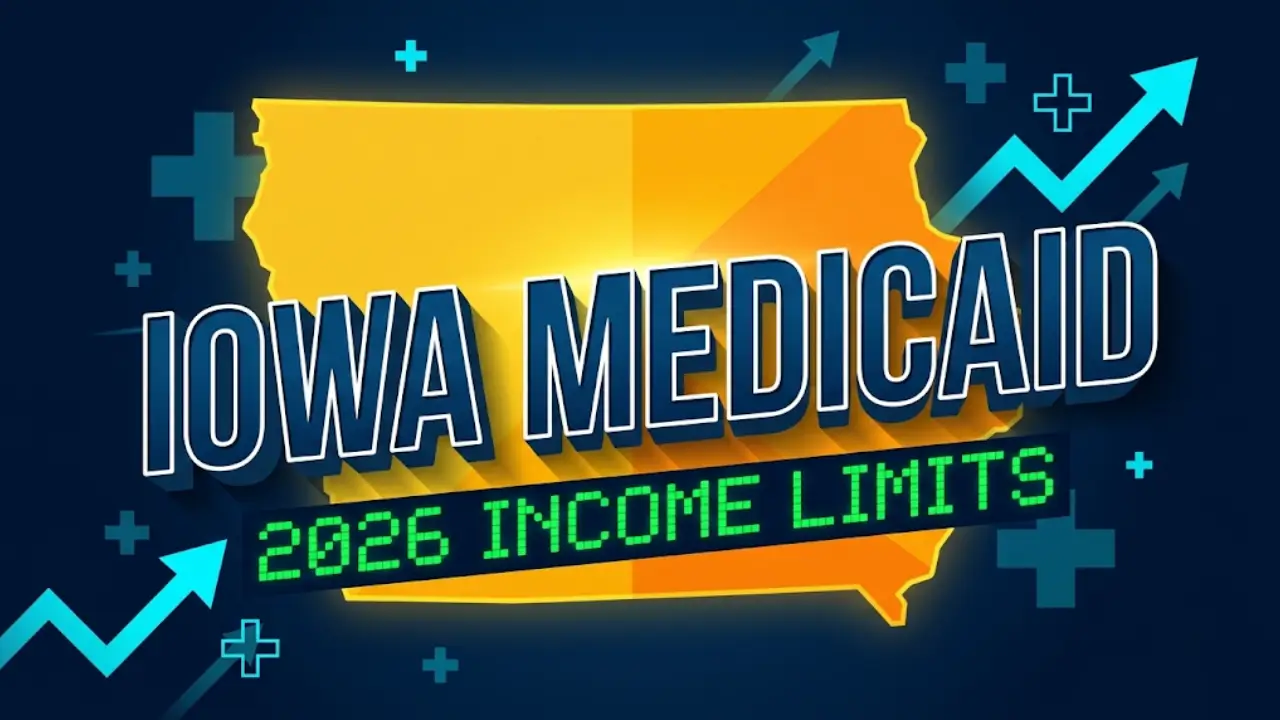
Iowa Medicaid income limits in 2026 set how much money you can earn and still get free or low-cost health coverage.
These limits are based on the Federal Poverty Level (FPL) and change every year.
Iowa uses different income rules for adults, children, pregnant women, and elderly or disabled residents.
Here is a quick look at what this guide covers:
- Adults ages 19–64: Income limit is 138% FPL ($22,025/year for one person)
- Children under 19: Free Medicaid up to 167% FPL; Hawki (CHIP) up to 302% FPL
- Pregnant women: Coverage up to 215% FPL with 12 months of postpartum care
- Elderly and disabled: Monthly limit of $994 (regular) or $2,982 (nursing home)
- Medically Needy spend-down: Target income of $483/month
- How to apply: Online at the Iowa HHS Benefits Portal or by phone
You can also compare these numbers with Medicaid income limits by state in 2026 to see how Iowa stacks up. If you are not sure where you fall, the Medicaid eligibility calculator for 2026 can help you check in minutes.
How Iowa Medicaid Income Limits Work in 2026
Iowa Medicaid uses two main ways to count your income. The method depends on which program you apply for.
MAGI-Based Income Rules
Most families, children, and non-disabled adults use Modified Adjusted Gross Income (MAGI).
This is your household income before taxes. It includes wages, salaries, and other taxable income.
Child support you receive does not count. There is no asset test for MAGI programs.
A 5% FPL income disregard also applies. This means the actual cutoff is slightly higher than the base percentage.
For example, the adult program lists 133% FPL but the effective limit is 138% FPL after the disregard.
Non-MAGI Income Rules
Elderly, blind, and disabled applicants use different counting rules. Iowa looks at “countable” income after certain deductions.
Most non-MAGI programs also have asset limits. A single person can usually have no more than $2,000 in countable assets.
A married couple can have up to $3,000.
2026 Federal Poverty Level (FPL) for Iowa
All MAGI-based limits start with the 2026 Federal Poverty Guidelines. Here are the base numbers for Iowa (and all 48 contiguous states):
| Household Size | 100% FPL (Annual) | 100% FPL (Monthly) |
|---|---|---|
| 1 | $15,960 | $1,330 |
| 2 | $21,640 | $1,803 |
| 3 | $27,320 | $2,277 |
| 4 | $33,000 | $2,750 |
| 5 | $38,680 | $3,223 |
| 6 | $44,360 | $3,697 |
| 7 | $50,040 | $4,170 |
| 8 | $55,720 | $4,643 |
| Each extra person | +$5,680 | +$473 |
Iowa multiplies these base numbers by set percentages for each Medicaid program. The sections below show the exact dollar limits.
Iowa Medicaid Income Limits for Adults (Ages 19–64)
Adults without Medicare can qualify through the Iowa Health and Wellness Plan.
This is Iowa’s Medicaid expansion program. The income limit is 138% FPL (133% base + 5% disregard).
Coverage is free through Iowa Health Link managed care.
If you do not complete “Healthy Behaviors” activities, you may owe a small monthly charge.
Adult Income Limit Chart (138% FPL) — 2026
| Household Size | Annual Income Limit | Monthly Income Limit |
|---|---|---|
| 1 | $22,025 | $1,835 |
| 2 | $29,863 | $2,489 |
| 3 | $37,702 | $3,142 |
| 4 | $45,540 | $3,795 |
| 5 | $53,378 | $4,448 |
| 6 | $61,217 | $5,101 |
| 7 | $69,055 | $5,755 |
| 8 | $76,894 | $6,408 |
| Each extra person | +$7,838 | +$653 |
If your income is above 138% FPL, you may still get help. Marketplace plans on HealthCare.gov offer subsidies for people above this limit.
Iowa Medicaid Income Limits for Children in 2026
Iowa provides broad health coverage for kids. Children can qualify for free Medicaid or the Hawki (CHIP) program based on family income.
Free Medicaid for Children (167% FPL)
Children ages 1–18 get free Medicaid if family income is at or below 167% FPL.
| Household Size | Annual Income Limit |
|---|---|
| 1 | $26,653 |
| 2 | $36,139 |
| 3 | $45,624 |
| 4 | $55,110 |
| 5 | $64,596 |
| 6 | $74,081 |
| 7 | $83,567 |
| 8 | $93,052 |
Hawki (CHIP) Income Limits for Children — 2026
Families that earn more than the Medicaid cutoff can still get Hawki coverage. Hawki covers medical and dental care for kids. Premiums are very low and capped per family.
| Hawki Tier | FPL % | Family of 2 | Family of 4 | Monthly Cost |
|---|---|---|---|---|
| Free medical | ~181% | $39,168 | $59,730 | $0 |
| Low premium | ~243% | $52,585 | $80,190 | $10/child (max $20/family) |
| Standard premium | ~302% | $65,353 | $99,660 | $20/child (max $40/family) |
Even families earning close to $100,000 a year (family of 4) may qualify for Hawki. Dental-only tiers are also available at small monthly costs.
Iowa Medicaid Income Limits for Pregnant Women in 2026
Iowa covers pregnant women at higher income levels than most other groups. This ensures moms and babies get the care they need.
Key Details for Pregnant Women
Starting in 2025, Iowa set the income limit for pregnant women at 215% FPL (with the 5% disregard making it effectively 220% FPL).
Postpartum coverage now lasts 12 months after the baby is born.
The household size for pregnant women includes the unborn child. So a pregnant woman with no other children counts as a household of 2.
Pregnant Women Income Limit Chart (215% FPL) — 2026
| Household Size | Annual Income Limit |
|---|---|
| 2 (pregnant individual) | $46,526 |
| 3 | $58,738 |
| 4 | $70,950 |
| 5 | $83,162 |
| 6 | $95,374 |
| 7 | $107,586 |
| 8 | $119,798 |
Coverage includes prenatal visits, labor and delivery, prescription drugs, and postpartum care for a full 12 months.
Iowa Medicaid Income Limits for Elderly and Disabled (2026)
Elderly and disabled Iowans use non-MAGI rules. Income limits are tied to the SSI Federal Benefit Rate (FBR), which is $994/month for individuals in 2026. Most programs also require an asset test.
Regular Medicaid (Aged, Blind & Disabled)
This covers basic healthcare for people 65 and older, or those who are blind or disabled.
| Status | Monthly Income Limit | Asset Limit |
|---|---|---|
| Individual | $994 | $2,000 |
| Couple | $1,491 | $3,000 |
Nursing Home Medicaid (Institutional Care)
Nursing home Medicaid has a higher income cap. It uses the “300% rule,” which is 300% of the SSI Federal Benefit Rate.
| Status | Monthly Income Limit | Asset Limit |
|---|---|---|
| Individual | $2,982 | $2,000 |
| Married (both applying) | $2,982 each ($5,964 combined) | $3,000 combined |
| Married (one applying) | $2,982 (applicant only) | $2,000 (applicant) |
The non-applicant spouse gets extra protections. In 2026, the Community Spouse Resource Allowance lets them keep up to $162,660 in assets.
They can also receive a Monthly Maintenance Needs Allowance of $4,066.50/month.
If income exceeds $2,982/month, a Miller Trust (also called a Qualified Income Trust) may help you qualify. This trust holds excess income for care costs.
Nursing home residents keep only $55/month as a personal needs allowance. The rest goes toward care costs.
Home and Community Based Services (HCBS) Waivers
HCBS waivers let people get long-term care at home instead of a nursing facility.
The income limit is the same as nursing home Medicaid: $2,982/month. Asset limits are also $2,000 for individuals.
To learn how Iowa pays healthcare providers, see the Iowa Medicaid fee schedule for 2026.
Medicaid for Employed People with Disabilities (MEPD) in 2026
Iowa’s MEPD program lets disabled residents work and keep Medicaid. The current income limit is 250% FPL.
MEPD Income Limits (250% FPL) — 2026
| Household Size | Annual Income Limit |
|---|---|
| 1 | $39,900 |
| 2 | $54,100 |
| 3 | $68,300 |
| 4 | $82,500 |
Premiums apply on a sliding scale for income above 150% FPL.
2026 Legislative Update
An Iowa Senate bill (SF 2315) is working to raise the MEPD income cap from 250% to 300% FPL.
If passed, a single person could earn up to about $47,880/year and still qualify.
Disability rights advocates support this change but want even higher limits and no asset tests.
Iowa Medically Needy Spend-Down Program
If your income is too high for other Medicaid programs, the Medically Needy program may still help. It works like a deductible.
How the Spend-Down Works
You must spend your “excess” income on medical bills each month. Once you hit the target income level, Medicaid kicks in for the rest of that period.
The Medically Needy Income Level (MNIL) is $483/month for individuals and couples. Iowa calculates spend-down in 2-month periods. The asset limit for this program is $10,000 per household.
Example: If you earn $1,483/month, your spend-down amount is $1,000. You must show $1,000 in medical expenses (like bills, premiums, or co-pays) to become eligible for that period.
Eligible medical expenses include unpaid medical bills, Medicare premiums, health insurance premiums, and costs not covered by other insurance.
Iowa Medicaid Income Limits: 2025 vs. 2026 Comparison
Income limits rise each year with inflation. Here is how 2026 compares to 2025 for key programs.
| Program | 2025 Limit (1 Person) | 2026 Limit (1 Person) | Change |
|---|---|---|---|
| Adults 19–64 (138% FPL) | ~$21,597/year | $22,025/year | +$428 |
| Children Medicaid (167% FPL) | ~$26,136/year | $26,653/year | +$517 |
| Nursing Home (300% SSI) | $2,901/month | $2,982/month | +$81 |
| Regular ABD (SSI rate) | ~$967/month | $994/month | +$27 |
These increases reflect a 2.63% rise in the Consumer Price Index. No major program expansions or cuts took effect in 2026 beyond these annual adjustments.
For a full breakdown across all states, visit the Medicaid fee schedule in 2026 page.
How to Apply for Iowa Medicaid in 2026
Applying for Iowa Medicaid is free. You can apply any time of year. There is no open enrollment period for Medicaid.
3 Ways to Apply
- Online: Visit the Iowa HHS Benefits Portal at hhsservices.iowa.gov. This is the fastest option and now works on mobile phones.
- By phone: Call 1-800-338-8366 during business hours.
- In person: Visit your local Iowa HHS office or county office.
What You Need to Apply
You will need these documents ready:
- Proof of identity (driver’s license, state ID, or birth certificate)
- Social Security numbers for all household members
- Proof of income (pay stubs, W-2s, tax returns, or benefit letters)
- Proof of Iowa residency (utility bill, lease, or mail)
- Medical records if applying for disability-based programs
MAGI-based applications (adults, children, pregnant women) usually get faster decisions. Non-MAGI programs (elderly, disabled) require a full financial review and may take longer.
Tips for a Smooth Application
- Use gross income (before taxes) for MAGI programs.
- Report all household members and their income.
- Report any changes in income or household size right away.
- Keep copies of everything you submit.
- If denied, you have the right to appeal.
Important Changes for Iowa Medicaid in 2026
Several policy updates affect Iowa Medicaid this year.
Postpartum Coverage Extension
Starting in 2025, new mothers keep Medicaid for 12 months after giving birth.
Before this change, coverage only lasted 60 days. This is a big improvement for maternal health in Iowa.
Income Limit Reduction for Infants and Pregnant Women
Iowa lowered the income limit for infants and pregnant women from 380% FPL to 220% FPL (215% + 5% disregard).
This means fewer women and infants will qualify compared to prior years.
However, the 12-month postpartum extension partially offsets this change.
Technology Upgrades
The Iowa HHS portal now has mobile-friendly forms and electronic document upload.
Automated renewal reminders go out 60 days before coverage expires.
Real-time eligibility checks for some programs can give answers in hours instead of weeks.
Federal Budget Impact
Federal budget changes through the “One Big Beautiful Bill” may bring work requirements of 80 hours/month for non-disabled adults ages 19–64 starting in 2027. Six-month eligibility checks are planned starting December 2026.
Frequently Asked Questions
What is the Iowa Medicaid income limit for a single person in 2026?
A single adult (ages 19–64) can earn up to $22,025 per year (138% FPL) and qualify. Elderly or disabled individuals have a monthly limit of $994. Nursing home applicants can earn up to $2,982/month.
Can I get Iowa Medicaid if I work full time in 2026?
Yes. Many full-time workers qualify. If you earn under $22,025/year as a single adult, you are eligible. Disabled workers can earn up to $39,900/year through the MEPD program.
What is the Hawki income limit for a family of 4 in Iowa?
A family of 4 can qualify for Hawki (CHIP) with income up to $99,660/year at the highest tier (302% FPL). Premiums are $20/child per month, capped at $40/family.
Does Iowa Medicaid have an asset limit in 2026?
MAGI programs (adults, children, pregnant women) have no asset test. Non-MAGI programs (elderly, disabled, nursing home) have a $2,000 asset limit for individuals and $3,000 for couples.
How do I renew my Iowa Medicaid coverage in 2026?
Iowa sends renewal notices before your coverage expires. You can renew online at the HHS portal, by phone, or by mail. Report any income or household changes right away to avoid gaps.
What if my income is just over the Iowa Medicaid limit?
You may qualify for the Medically Needy spend-down program. You could also get subsidized coverage through HealthCare.gov Marketplace plans. A Miller Trust can help nursing home applicants whose income exceeds $2,982/month.
Sources: Iowa HHS Medicaid Income Guidelines | ASPE 2026 Federal Poverty Guidelines