Last Updated: March 2026
Illinois SNAP income limits for 2026 help you know if you qualify for food benefits. These limits are based on your household size and monthly income.
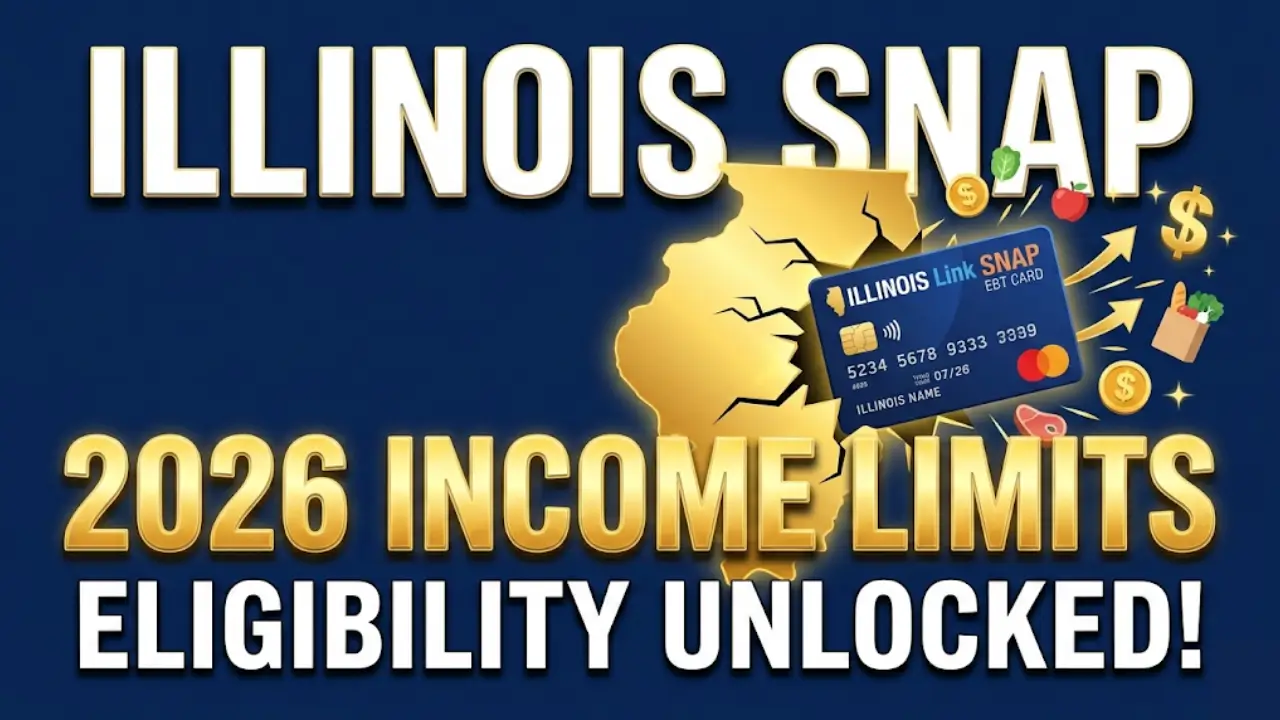
Illinois uses the Link EBT card to send SNAP benefits each month.
Here is what this article covers:
- 2026 gross income limits for Illinois SNAP (165% and 200% FPG)
- Net income limits for all households (100% FPG)
- Special rules for seniors and disabled members
- Illinois BBCE policy that removes the asset test
- Key deductions that lower your countable income
- How to apply for SNAP in Illinois
What Is SNAP in Illinois?
SNAP stands for Supplemental Nutrition Assistance Program. In Illinois, SNAP benefits go on a Link EBT card.
You use this card to buy food at approved stores. The Illinois Department of Human Services (IDHS) runs the program.
Who Can Get Illinois SNAP Benefits?
You may qualify based on your household size, income, and expenses. A “household” means people who live together and share meals.
You must also live in Illinois and meet basic identity and work rules.
SNAP is one of many aid programs in the U.S. You can also check SNAP income limits by state in 2026 to compare your state’s rules.
How Illinois SNAP Eligibility Works
Illinois follows federal SNAP rules but adds its own expanded access through a policy called Broad-Based Categorical Eligibility (BBCE).
This means more families can qualify compared to standard federal rules.
What Is Broad-Based Categorical Eligibility (BBCE)?
BBCE is an Illinois state policy linked to TANF. It raises the gross income limit and removes the asset test for most homes. Here is what BBCE does:
- Raises the gross income limit to 165% of the Federal Poverty Guidelines (FPG)
- Raises it to 200% of FPG for homes with a senior (age 60+) or disabled member
- Removes the asset/resource test for most households
- Lets more working families qualify for SNAP
Gross Income vs. Net Income
Illinois checks two types of income for SNAP:
- Gross income is your total income before any deductions. This includes wages, Social Security, pensions, child support, and unemployment.
- Net income is what remains after allowed deductions. This is used to figure out your benefit amount.
Most households must pass both the gross and net income tests.
2026 Gross Monthly Income Limits (Without Seniors or Disabled Members)
These limits apply to households where no one is age 60 or older and no one has a disability. The gross income cap is set at 165% of the Federal Poverty Guidelines.
| Household Size | Monthly Gross Income Limit |
|---|---|
| 1 | $2,152 |
| 2 | $2,909 |
| 3 | $3,665 |
| 4 | $4,421 |
| 5 | $5,177 |
| 6 | $5,934 |
| 7 | $6,690 |
| 8 | $7,446 |
| 9 | $8,203 |
| 10 | $8,960 |
| Each extra person | +$757 |
A family of four can earn up to $4,421 per month before taxes and still qualify.
2026 Gross Monthly Income Limits (With a Senior or Disabled Member)
If your household has at least one person age 60 or older or one disabled member, you get a higher limit. The gross income cap goes up to 200% of the Federal Poverty Guidelines.
| Household Size | Monthly Gross Income Limit |
|---|---|
| 1 | $2,608 |
| 2 | $3,525 |
| 3 | $4,441 |
| 4 | $5,358 |
| 5 | $6,275 |
| 6 | $7,191 |
| 7 | $8,108 |
| 8 | $9,025 |
| 9 | $9,941 |
| 10 | $10,858 |
| Each extra person | +$917 |
These higher limits help seniors and people with disabilities get food assistance even with slightly higher incomes. Households with elderly or disabled members are also exempt from the standard gross income test in many cases.
2026 Net Monthly Income Limits (All Households)
All households must meet the net income limit at 100% of the Federal Poverty Guidelines. Net income is your gross income minus allowed deductions.
| Household Size | Monthly Net Income Limit |
|---|---|
| 1 | $1,305 |
| 2 | $1,763 |
| 3 | $2,221 |
| 4 | $2,680 |
| 5 | $3,138 |
| 6 | $3,596 |
| 7 | $4,055 |
| 8 | $4,513 |
| Each extra person | +$459 |
Your net income decides if you qualify and how much you get each month. The lower your net income, the higher your SNAP benefit.
Asset and Resource Limits in Illinois
Illinois has no asset or resource limit for most SNAP households. This is because of the BBCE policy. You do not need to worry about your savings, car value, or bank balance in most cases.
When Do Asset Limits Apply?
Federal asset rules only kick in for rare situations, such as:
- Intentional program violations
- Lottery or gambling winnings over $4,500
For most families, the asset test does not apply. This makes it easier to qualify in Illinois than in many other states.
Key Deductions That Lower Your Net Income
Deductions reduce your gross income to net income. More deductions mean a lower net income and a better chance to qualify. Illinois allows these SNAP deductions:
- Standard deduction: About $209 per month for households of 1 to 3 people
- Earned income deduction: 20% of all wages and salary
- Dependent care costs: Child care or care for disabled adults
- Excess shelter costs: Rent, mortgage, utilities (capped at about $744 for most; uncapped for elderly/disabled households)
- Medical expenses: Costs over $35 per month for elderly or disabled members only
If you pay high rent or have large medical bills, these deductions can help you qualify.
Maximum SNAP Benefits in Illinois for 2026
Your monthly SNAP benefit depends on your net income and household size. Below are approximate maximum benefit amounts for fiscal year 2026.
| Household Size | Max Monthly Benefit |
|---|---|
| 1 | $298 |
| 3 | $785 |
| 5 | $1,183 |
Actual amounts vary. Households with very low net income get the maximum. Higher net income means a smaller benefit.
Work Requirements for Illinois SNAP in 2026
SNAP has work rules separate from income limits. Starting February 1, 2026, updated ABAWD (Able-Bodied Adults Without Dependents) rules apply in Illinois.
Who Must Meet Work Requirements?
Adults ages 18 to 64 without dependents must work, volunteer, or train at least 80 hours per month. If you do not meet this rule, you can only get SNAP for 3 months in a 36-month period.
Who Is Exempt?
Many people are exempt from work rules, including:
- Parents or caretakers of children
- Pregnant individuals
- People with a disability
- People already meeting other exemptions
If you qualify for health coverage, you may want to check Medicaid income limits by state in 2026 or learn about Medicaid fee schedule 2026 for provider payment rates.
How to Apply for Illinois SNAP
Applying for SNAP in Illinois is free and straightforward. You can apply in one of these ways:
- Online: Visit ABE.illinois.gov to submit your application
- By phone: Call 1-800-843-6154
- In person: Visit your local DHS office
Free Eligibility Screening Tool
Before you apply, use the free Illinois SNAP Eligibility Calculator at fscalc.dhs.illinois.gov to check if you qualify.
What Happens After You Apply?
IDHS will review your application. They may ask for proof of income, identity, and household details. Benefits are loaded each month onto your Illinois Link card.
You must recertify every 12 or 24 months. Senior and disabled households often get longer certification periods. Always report changes in income or household size right away.
Important Things to Know
Here are a few extra details about Illinois SNAP in 2026:
- These income limits are effective October 1, 2025 through September 30, 2026
- Only income from the last 30 days (or projected income) counts
- Some income is excluded, like certain tax credits
- Illinois did not make state-specific changes beyond standard federal cost-of-living adjustments
- Benefits are issued statewide on the Link EBT card
Frequently Asked Questions
What is the income limit for SNAP in Illinois in 2026?
For a household of one, the gross income limit is $2,152 per month (165% FPG). Households with a senior or disabled member can earn up to $2,608. Net income must be at or below $1,305.
Does Illinois have an asset limit for SNAP?
No. Illinois removes the asset test for most SNAP households through its BBCE policy. Your savings and vehicle values usually do not count against you.
How do I apply for SNAP in Illinois?
Apply online at ABE.illinois.gov, call 1-800-843-6154, or visit a local DHS office. You can also use the free eligibility calculator at fscalc.dhs.illinois.gov.
What is the maximum SNAP benefit in Illinois for 2026?
A single person can receive up to about $298 per month. A family of five may get up to $1,183. Your actual amount depends on your net income after deductions.
Do seniors get higher SNAP income limits in Illinois?
Yes. Households with a member age 60 or older qualify under the 200% FPG limit instead of 165%. They also get uncapped shelter deductions and medical expense deductions.
What are the SNAP work requirements in Illinois for 2026?
Adults ages 18 to 64 without dependents must work or train 80 hours per month. Exemptions apply for parents, pregnant individuals, and people with disabilities. These rules took effect February 1, 2026.
Last Updated: March 2026
Sources: Illinois Department of Human Services (IDHS) · USDA Food and Nutrition Service – SNAP Eligibility