Written & Reviewed by Akash Biswas, MSW | Former Medicaid Caseworker Trainer | Verified against official Medicaid.gov and Illinois HFS guidelines | Last Updated: March 2026
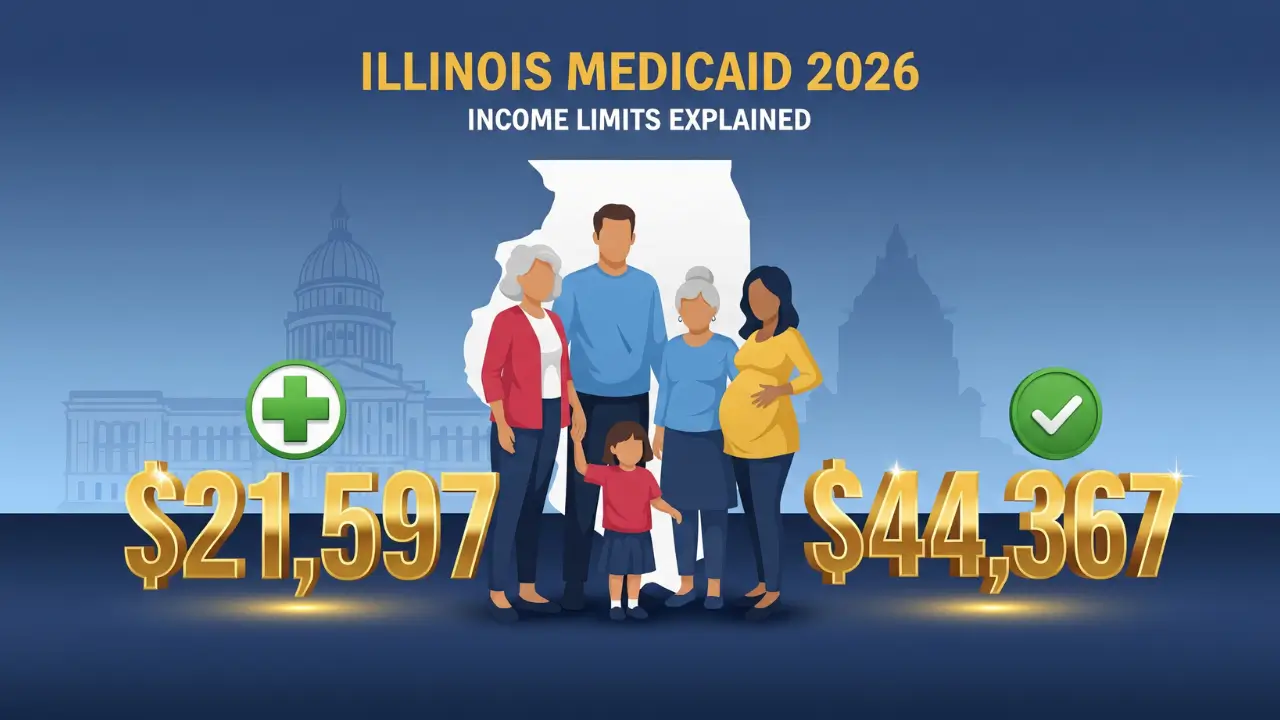
In 2026, a single adult in Illinois can earn up to $1,835 per month ($22,022 per year) and still qualify for Medicaid.
A married couple (household of 2) can earn up to $2,489 per month. A family of four can earn up to $44,367 per year.
These limits come from the Federal Poverty Level (FPL) guidelines released January 15, 2026. Illinois uses a percentage of FPL to set each program’s income cutoff.
Need a quick answer? Use our free Medicaid Calculator to check if you qualify in 60 seconds.
How Illinois Medicaid Eligibility Works
Illinois runs Medicaid through two agencies:
- Illinois Department of Healthcare and Family Services (HFS) manages the medical programs.
- Illinois Department of Human Services (IDHS) processes applications and checks eligibility.
Your eligibility depends on your age, household size, income, and sometimes assets.
Illinois uses two methods to count income:
- MAGI (Modified Adjusted Gross Income) — for most people under 65
- Non-MAGI — for seniors (65+), blind, and disabled individuals
What Is MAGI?
MAGI is a way to count your income for Medicaid. It includes:
- Wages and salaries
- Self-employment income
- Unemployment benefits
- Taxable Social Security
- Alimony (for divorces before 2019)
MAGI does not count:
- Child support received
- SSI (Supplemental Security Income)
- Workers’ compensation
- Non-taxable Social Security
- Veterans’ benefits (in most cases)
Important: Illinois applies a 5% FPL income disregard on top of the base limit. This means you can earn slightly more than 133% FPL and still qualify. The effective limit is 138% FPL.
Source: Illinois DHS WAG 25-03-02 and HHS.gov 2026 Poverty Guidelines
Adults Ages 19–64 (ACA Adult Medicaid)
This is the most common Medicaid program in Illinois. It covers working-age adults with low income. Illinois expanded Medicaid in 2014 under the Affordable Care Act. You do not need children to qualify.
Income limit: 138% of the Federal Poverty Level
| Household Size | Monthly Income Limit | Annual Income Limit |
|---|---|---|
| 1 person | $1,835 | $22,022 |
| 2 people | $2,489 | $29,862 |
| 3 people | $3,142 | $37,703 |
| 4 people | $3,795 | $45,543 |
| 5 people | $4,449 | $53,384 |
| 6 people | $5,102 | $61,224 |
| 7 people | $5,756 | $69,064 |
| 8 people | $6,409 | $76,905 |
Add $654/month for each person beyond 8.
Key facts about this program:
- No asset test. Your savings, home, and car don’t matter.
- No dependent children needed. Single adults qualify.
- Covers over 688,000 Illinois adults as of 2025.
- Includes doctor visits, hospital stays, prescriptions, dental, and vision.
If your income is above these limits, you may qualify for subsidized Marketplace insurance at healthcare.gov.
Check now: Use our free Medicaid Calculator to see if you qualify.
Source: Illinois HFS Medical Programs and 2026 Federal Poverty Guidelines
Illinois Medicaid Income Limits for Married Couples 2026
If you’re married, your income limit depends on two things:
- Which Medicaid program you’re applying for
- Whether one or both spouses are applying
Here’s a full breakdown.
ACA Adult Medicaid for Married Couples (Ages 19–64)
For married couples under 65, your household size is at least 2. Your combined income must fall below the limit for a household of 2.
| Situation | Monthly Income Limit | Annual Income Limit |
|---|---|---|
| Married couple (household of 2) | $2,489 | $29,862 |
| Married couple + 1 child (household of 3) | $3,142 | $37,703 |
| Married couple + 2 children (household of 4) | $3,795 | $45,543 |
- No asset test. Your home, cars, and savings don’t count.
- Both spouses’ income is combined.
- Based on 138% of FPL.
AABD Medicaid for Married Couples (Age 65+ or Disabled)
If you or your spouse is 65 or older, blind, or disabled, different rules apply. This is called AABD (Aged, Blind, and Disabled) Medicaid.
| Situation | Monthly Income Limit |
|---|---|
| Single person | $1,330 |
| Married couple, both applying | $1,803 |
| Married couple, one spouse applying | $1,330 (applicant’s income only) |
Effective April 2026 – March 2027. Based on 100% FPL. Source: Illinois DHS WAG 25-03-02
How income is counted for married couples in AABD:
- If both spouses apply, their income is combined. The limit is $1,803/month.
- If only one spouse applies for Nursing Home Medicaid or a Medicaid Waiver, only the applicant’s income counts. The other spouse’s income is not counted.
- If only one spouse applies for regular AABD Medicaid, both spouses’ incomes are combined.
This is a key difference. Many couples don’t realize that for long-term care, only the applying spouse’s income matters.
Nursing Home Medicaid for Married Couples
| Situation | Monthly Income Limit | Asset Limit |
|---|---|---|
| Single applicant | $1,330 | $17,500 |
| Both spouses applying | $1,803 | $17,500 combined |
| One spouse applying | $1,330 (applicant only) | $17,500 (applicant) + up to $162,660 (non-applicant spouse) |
The non-applicant spouse gets to keep assets through the Community Spouse Resource Allowance (CSRA). More on this in the spousal protections section below.
Source: MedicaidPlanningAssistance.org – Illinois and IL Aging Medicaid Standards PDF
Income Limits for a Household of 2
Many people search for the exact limit for a 2-person household. Here it is for every program:
| Program | Monthly Limit (Household of 2) | Who Qualifies |
|---|---|---|
| ACA Adult (ages 19–64) | $2,489 | Low-income adults, 138% FPL |
| AABD (age 65+ or disabled) | $1,803 | Seniors, blind, disabled (both applying) |
| Pregnant Women (Moms & Babies) | $3,764 | Pregnant women, 213% FPL |
| Parents/Caretakers | $2,489 | Parents with children under 19, 138% FPL |
For ACA Adult Medicaid: A household of 2 can earn up to $2,489 per month or $29,862 per year.
For AABD Medicaid: A married couple where both apply can earn up to $1,803 per month combined.
No matter which program you apply for, Illinois checks your eligibility for every program you may qualify for — not just the one you choose. So always apply.
Not sure? Try our free calculator — it checks all programs for you.
Single Adult Income Limits 2026
If you’re a single adult (ages 19–64) with no dependents, here’s your limit:
| Monthly | Annual | |
|---|---|---|
| ACA Adult Medicaid | $1,835 | $22,022 |
| AABD Medicaid (65+ or disabled) | $1,330 | $15,960 |
For ACA Adult Medicaid, there is no asset test. Your bank account, home, and car don’t affect eligibility. You only need to meet the income limit and be an Illinois resident.
For AABD Medicaid, there is an asset limit of $17,500. Your primary home and one vehicle are exempt.
Children Under 19 (All Kids Program)
Illinois has one of the best children’s health programs in the country. It’s called All Kids. Even middle-income families often qualify.
All Kids Income Limits 2026
| Program Level | Income Limit (Family of 4) | What You Pay |
|---|---|---|
| All Kids Assist (free) | Up to ~$102,237/year (318% FPL) | Nothing — fully free |
| All Kids Share | $102,237 – $150,000/year | Small monthly premiums |
| All Kids Premium | Above $150,000/year | Higher monthly premiums |
All Kids Assist Income Limits by Family Size
| Family Size | Monthly Income | Annual Income |
|---|---|---|
| 2 | $4,750 | $56,994 |
| 3 | $5,987 | $71,835 |
| 4 | $7,224 | $86,676 |
| 5 | $8,461 | $101,517 |
Based on 318% FPL. Source: Illinois HFS All Kids Program
What All Kids covers:
- Doctor visits and hospital care
- Dental cleanings and fillings
- Vision exams and glasses
- Mental health services
- Prescriptions
Good to know:
- No asset test for children.
- Unborn babies count toward your household size.
- American Indian and Alaska Native children pay nothing at any income level.
- Coverage continues even if a parent doesn’t qualify.
Pregnant Women (Moms & Babies Program)
Pregnant women get the most generous income limits in Illinois. The state covers you at 213% of the Federal Poverty Level.
Moms & Babies Income Limits 2026
| Household Size | Monthly Income | Annual Income |
|---|---|---|
| 1 person (just you) | $2,787 | $33,444 |
| 2 people | $3,764 | $45,168 |
| 3 people | $4,742 | $56,904 |
| 4 people | $5,719 | $68,628 |
| 5 people | $6,697 | $80,364 |
Your unborn baby counts as a household member. So if you’re pregnant and single, your household size is 2.
What makes this program special:
- Presumptive eligibility — You can get instant, temporary coverage while your full application processes. Ask at any hospital or clinic.
- No premiums or copays. Everything is free.
- Baby is automatically covered for the first year after birth.
- 12 months postpartum coverage. Illinois extended this from 60 days. You stay covered for a full year after delivery.
- No asset test.
Source: Illinois HFS Moms & Babies
Parents and Caretaker Relatives
If you have a child under 19 living with you, you may qualify as a parent or caretaker relative.
The income limits are the same as ACA Adult Medicaid: 138% FPL.
| Household Size | Monthly Income | Annual Income |
|---|---|---|
| 2 (you + 1 child) | $2,489 | $29,862 |
| 3 (you + 2 children) | $3,142 | $37,703 |
| 4 (you + 3 children) | $3,795 | $45,543 |
| 5 | $4,449 | $53,384 |
Requirements:
- You must have a dependent child under 19 in your home.
- You can be a parent, grandparent, aunt, uncle, or other caretaker.
- No asset test.
Seniors and People with Disabilities (AABD)
AABD stands for Aged, Blind, and Disabled. This program has stricter rules than ACA Adult Medicaid. It uses non-MAGI income counting.
AABD Income Limits 2026
| Household Size | Monthly Income Limit |
|---|---|
| 1 person | $1,330 |
| Married couple (both applying) | $1,803 |
Effective April 2026 – March 2027. Based on 100% FPL.
Note: Illinois also applies a $25 income disregard on top of these limits. So the effective limits are slightly higher.
Who Qualifies for AABD?
- Adults age 65 or older
- People who are legally blind
- People with disabilities (as defined by Social Security standards)
- People receiving SSI automatically qualify
Medicare Savings Programs (MSP)
If you’re on Medicare, Illinois also offers help paying your Medicare costs. These have different income limits:
| Program | Income Limit (Single) | Income Limit (Couple) | What It Covers |
|---|---|---|---|
| QMB (Qualified Medicare Beneficiary) | $1,330/mo | $1,803/mo | Medicare Part A & B premiums, deductibles, copays |
| SLMB (Specified Low-Income) | $1,331 – $1,596/mo | $1,804 – $2,164/mo | Medicare Part B premium only |
| QI-1 (Qualifying Individual) | $1,597 – $1,796/mo | $2,165 – $2,435/mo | Medicare Part B premium only |
Source: IL Aging Medicaid Income Standards 2026
If you qualify for QMB, SLMB, or QI-1, Illinois pays some or all of your Medicare costs. This saves you hundreds of dollars per month.
2026 Asset Limits: What Counts and What Doesn’t
ACA Adult Medicaid, children’s programs, and pregnant women have NO asset test. Your savings, home, and car don’t matter. Only your income counts.
AABD Medicaid (seniors, blind, disabled) DOES have an asset test.
AABD Asset Limits 2026
| Situation | Asset Limit |
|---|---|
| Single person | $17,500 |
| Married couple (both applying) | $17,500 combined |
| Married couple (one applying for nursing home/waiver) | $17,500 (applicant) + up to $162,660 (spouse) |
Illinois raised this limit from $2,000 to $17,500 — a major increase that helps thousands more people qualify.
What Counts as an Asset?
These are countable assets:
- Cash and checking/savings accounts
- Stocks, bonds, and mutual funds
- Certificates of deposit (CDs)
- IRAs and retirement accounts (Note: Illinois counts IRAs, unlike some states)
- Cryptocurrency
- Real estate you don’t live in
- Additional vehicles beyond your first one
What Does NOT Count?
These assets are exempt (they don’t count against the limit):
- Your primary home (equity up to $752,000)
- One vehicle (any value)
- Personal belongings and household items
- Irrevocable prepaid funeral/burial contracts (up to $8,434; no limit if funded by life insurance)
- Life insurance with face value under $1,500
- Burial plot and related items
The 60-Month Look-Back Period
If you’re applying for Nursing Home Medicaid or a Medicaid Waiver, Illinois looks back 60 months (5 years) at your financial history.
The state checks whether you gave away assets or sold them below fair market value. If you did, you may face a penalty period where Medicaid won’t pay for your care.
This does NOT apply to regular AABD Medicaid. The look-back rule only applies to long-term care programs.
Source: Illinois HFS and MedicaidPlanningAssistance.org
Spousal Impoverishment Protections 2026
When one spouse needs nursing home care, Illinois protects the other spouse from poverty. These rules ensure the community spouse (the spouse staying at home) can keep enough income and assets to live.
Community Spouse Income Protection
| Protection | 2026 Amount |
|---|---|
| Community Spouse Maintenance Needs Allowance (CSMNA) | Up to $4,066.50/month |
| Minimum CSMNA | $2,643.75/month |
How this works: If the community spouse earns less than $4,066.50 per month, the nursing home spouse can transfer income to them — up to that amount. This protects the at-home spouse from losing all household income.
Community Spouse Asset Protection
| Protection | 2026 Amount |
|---|---|
| Community Spouse Resource Allowance (CSRA) | Up to $162,660 |
| Home equity limit | $752,000 (primary residence) |
How this works: When one spouse enters a nursing home, all assets are considered jointly owned. But the community spouse can keep up to $162,660 of the couple’s total assets. The applicant spouse must spend down to $17,500.
The family home is exempt as long as the community spouse lives in it or the applicant intends to return.
Source: CMS Spousal Impoverishment Standards 2026
Health Benefits for Workers with Disabilities (HBWD)
Illinois offers a special program for people with disabilities who work. It has higher income limits than regular AABD Medicaid.
| Situation | Monthly Income Limit |
|---|---|
| Single person | $4,655 |
| Married couple | $6,312 |
Asset limit: $25,000
This program lets you earn more and still keep Medicaid coverage while you work.
Source: Illinois HFS HBWD Program
Special Eligibility Categories
Some groups qualify under special rules with different (or no) income limits.
Former Foster Youth
If you were in foster care at age 18 or older, you qualify for Medicaid automatically until age 26. There is no income limit and no asset test for this group.
Immigration Status
Illinois provides some coverage regardless of immigration status:
- Emergency Medicaid — Available for undocumented immigrants for childbirth and urgent medical emergencies.
- Health Benefits for Immigrant Seniors — Covers immigrants age 65+ who don’t qualify for regular Medicaid.
- Health Benefits for Immigrant Adults (ages 42–64) — This program ended July 1, 2025.
Benefit Access Program
Illinois seniors (65+) and people with disabilities (ages 16+) may qualify for the Benefit Access Program for transit and license plate discounts. Income limits differ from Medicaid. Visit Illinois Secretary of State for details.
What If Your Income Is Too High?
Don’t give up if you’re slightly over the limit. Illinois offers several programs to help.
Spend-Down Program (Medically Needy)
The spend-down works like an insurance deductible. Illinois sets a medically needy income limit (MNIL):
| Situation | MNIL (Effective April 2026 – March 2027) |
|---|---|
| Single person | $1,330/month |
| Couple | $1,803/month |
How it works:
Your income minus the MNIL = your spend-down amount.
Example: You earn $1,630/month. The limit is $1,330. Your spend-down is $300. Once you have $300 in medical bills in a month, Medicaid covers everything else.
You can meet your spend-down two ways:
- Submit medical bills (doctor visits, prescriptions, Medicare premiums) that total your spend-down amount.
- Pay the spend-down directly to Illinois DHS like a monthly premium.
Qualified Income Trusts (Miller Trusts)
If you need nursing home care and your income is too high, a Miller Trust may help. You deposit your excess income into the trust. This brings your countable income below the limit.
An attorney must set up the trust. The trust funds go toward your care costs.
Marketplace Insurance
If you earn too much for Medicaid but not enough to afford insurance, check healthcare.gov. You may qualify for premium tax credits that reduce your monthly cost by 50–90%.
How Illinois Compares to Other States
Illinois has generous Medicaid income limits compared to most states. Here’s why:
- Illinois expanded Medicaid under the ACA in 2014. Ten states still have not expanded.
- In non-expansion states, childless adults often get no Medicaid at all.
- Non-expansion states may limit parents to 50% FPL or less — just $7,825/year for an individual in 2026.
- Illinois eliminated the “coverage gap” so no one falls between Medicaid and Marketplace subsidies.
See how all 50 states compare: Medicaid Income Limits by State 2026
How to Apply for Illinois Medicaid
Applying is free. You have several options.
Online (Fastest)
Go to abe.illinois.gov. You can:
- Complete the application online
- Upload documents
- Save your progress and come back later
- Check your application status
By Phone
Call the IDHS Help Line: 1-800-843-6154
- Available Monday through Friday
- Interpreters available for non-English speakers
- TTY: 1-800-447-6404
In Person
Visit your local Family Community Resource Center. Staff can help you fill out the application. Find your nearest office here.
Documents You’ll Need
Gather these before you start:
- Photo ID or birth certificate
- Social Security numbers for all household members
- Proof of income (pay stubs, tax returns, benefit letters)
- Proof of Illinois residency (utility bill, lease)
- Immigration documents (if applicable)
Tip: Don’t wait to gather every document. Apply first. The agency will tell you exactly what they need.
Processing Times
- Regular applications: 45 days
- Disability applications: Up to 90 days
- Pregnant women: Can get presumptive eligibility (instant temporary coverage) at any hospital or clinic
- Retroactive coverage: Medicaid can cover bills from up to 3 months before your application date
Recent Changes for 2026
Illinois made several important updates this year:
Income limits increased ~3%. All FPL-based limits rose when the 2026 Federal Poverty Guidelines took effect on January 15, 2026.
AABD asset limit jumped to $17,500. This was previously $2,000 for decades. The increase helps thousands of seniors and disabled adults who were just over the old limit.
Home equity limit raised to $752,000. Up from $730,000 in 2025.
Spousal resource allowance: $162,660. Up from $157,920 in 2025.
CSMNA: $4,066.50/month. Up from $3,948 in 2025.
Postpartum coverage: 12 months. Illinois now covers new mothers for a full year after birth (previously 60 days).
Program ended: Health Benefits for Immigrant Adults (ages 42–64) ended July 1, 2025.
Federal update: The One Big Beautiful Bill Act may affect future Medicaid funding. Work requirements for ACA expansion adults may begin in 2027. Check our blog for updates.
Illinois HFS MAGI Income Limits — Official Reference
For those looking for the official HFS MAGI income standards used by caseworkers, here is the complete reference table:
ACA Adult (138% FPL) — Monthly Gross Income
| Household Size | Monthly Income Limit |
|---|---|
| 1 | $1,835 |
| 2 | $2,489 |
| 3 | $3,142 |
| 4 | $3,795 |
| 5 | $4,449 |
| 6 | $5,102 |
| 7 | $5,756 |
| 8 | $6,409 |
AABD / QMB (100% FPL) — Monthly Gross Income
| Household Size | Monthly Income Limit |
|---|---|
| 1 | $1,330 |
| 2 | $1,803 |
Does not include the $25 income disregard applied to each category.
Official source: Illinois DHS WAG 25-03-02 Medical FPLs and IL Aging 2026 Medicaid Income Standards
Frequently Asked Questions
What is the maximum income for Illinois Medicaid as a single adult in 2026?
A single adult (ages 19–64) can earn up to $1,835 per month ($22,022/year) under ACA Adult Medicaid. This is based on 138% of the Federal Poverty Level. There is no asset test for this group. If you earn less than this, you likely qualify for free coverage.
What are the Illinois Medicaid income limits for a married couple in 2026?
For ACA Adult Medicaid (ages 19–64), a married couple with no children can earn up to $2,489 per month ($29,862/year). For AABD Medicaid (age 65+ or disabled), the limit is $1,803/month if both spouses apply. If only one spouse applies for long-term care, only that spouse’s income counts ($1,330/month limit).
What are the income limits for a household of 2?
A household of 2 in Illinois can earn up to $2,489/month ($29,862/year) for ACA Adult Medicaid, or $1,803/month for AABD Medicaid (both applying). For pregnant women, it’s $3,764/month.
What are the Illinois Medicaid income limits for a family of 4 in 2026?
For parents and adults, the limit is $3,795 per month ($45,543/year). Children in the same family may qualify at much higher limits — up to $7,224/month (~$86,676/year) through the All Kids Assist program. Always apply for the whole family.
What are the Illinois Medicaid income limits for a family of 3?
A family of 3 can earn up to $3,142/month ($37,703/year) under ACA Adult Medicaid (138% FPL).
What are the Illinois Medicaid income limits for a family of 5?
A family of 5 can earn up to $4,449/month ($53,384/year) under ACA Adult Medicaid (138% FPL).
What is the asset limit for seniors (AABD) in 2026?
The asset limit is $17,500 for a single person or a couple (both applying). This was raised from $2,000 in previous years. Your primary home (equity up to $752,000), one vehicle, and personal belongings are typically exempt.
Does my car count against the Medicaid asset limit?
No. One vehicle is exempt regardless of value. If you own more than one vehicle, only the additional vehicles count toward the $17,500 limit. Adults under 65 on ACA Medicaid have no asset test at all.
Does Illinois Medicaid cover dental and vision for adults?
Yes. Illinois Medicaid covers dental care (cleanings, fillings, root canals, dentures) and vision services (annual eye exams, glasses) for adults. You pay nothing extra for these benefits.
What if my income is slightly over the limit?
You may still qualify through the Spend-Down Program. It works like a monthly deductible. You pay the difference between your income and the limit in medical expenses each month. After that, Medicaid covers the rest. You can also pay the amount directly to DHS.
How do I complete my Medicaid renewal in 2026?
You must renew every year. Watch your mail for a notice from HFS. Renew online at abe.illinois.gov under “Manage My Case.” Missing the deadline will cause you to lose coverage. Act promptly when you receive the notice.
What is the FamilyCare income limit in Illinois?
FamilyCare covers parents and caretaker relatives of children under 19. The income limit is the same as ACA Adult Medicaid: 138% FPL ($2,489/month for a household of 2).
What is the All Kids income limit for 2026?
For fully free coverage (All Kids Assist), a family of 4 can earn up to about $86,676/year (318% FPL). Families earning more can still get coverage with low premiums through All Kids Share or All Kids Premium.
How does Medicaid know my income?
Illinois checks your income through electronic data matching. The system pulls wage data from employers, tax records, unemployment benefits, and Social Security. You must also provide pay stubs and tax returns with your application.
Is All Kids the same as Medicaid?
All Kids is Illinois’s children’s health insurance program. All Kids Assist is the free level — this IS Medicaid (Title XIX). All Kids Share and Premium levels are the CHIP (Children’s Health Insurance Program) component and charge small premiums.
Can I get Medicaid if I’m unemployed?
Yes. If you have no income or very low income and live in Illinois, you likely qualify for ACA Adult Medicaid. Being unemployed does not disqualify you. Apply at abe.illinois.gov.
Official Resources
Always verify information with these official sources:
- Illinois Department of Healthcare and Family Services: hfs.illinois.gov
- Apply Online: abe.illinois.gov
- IDHS Help Line: 1-800-843-6154 (TTY: 1-800-447-6404)
- Official Income Standards: DHS WAG 25-03-02
- 2026 Medicaid Income Standards PDF: IL Aging Document
- Illinois Legal Aid: illinoislegalaid.org
- Federal Poverty Guidelines: HHS ASPE
Bottom Line: Illinois offers many paths to Medicaid coverage. Most adults qualify with income under $1,835/month. Married couples qualify at $2,489/month (ACA) or $1,803/month (AABD). Children qualify at much higher limits. Even if you’re over the limit, spend-down and special programs can help. Don’t assume you won’t qualify — check with our free calculator or apply to find out.
CheckMedicaid.com is not affiliated with any government agency. This content is for educational purposes only. Always verify eligibility with your state Medicaid agency before making coverage decisions.
© 2026 CheckMedicaid.com — Free calculators & guides for benefits eligibility.