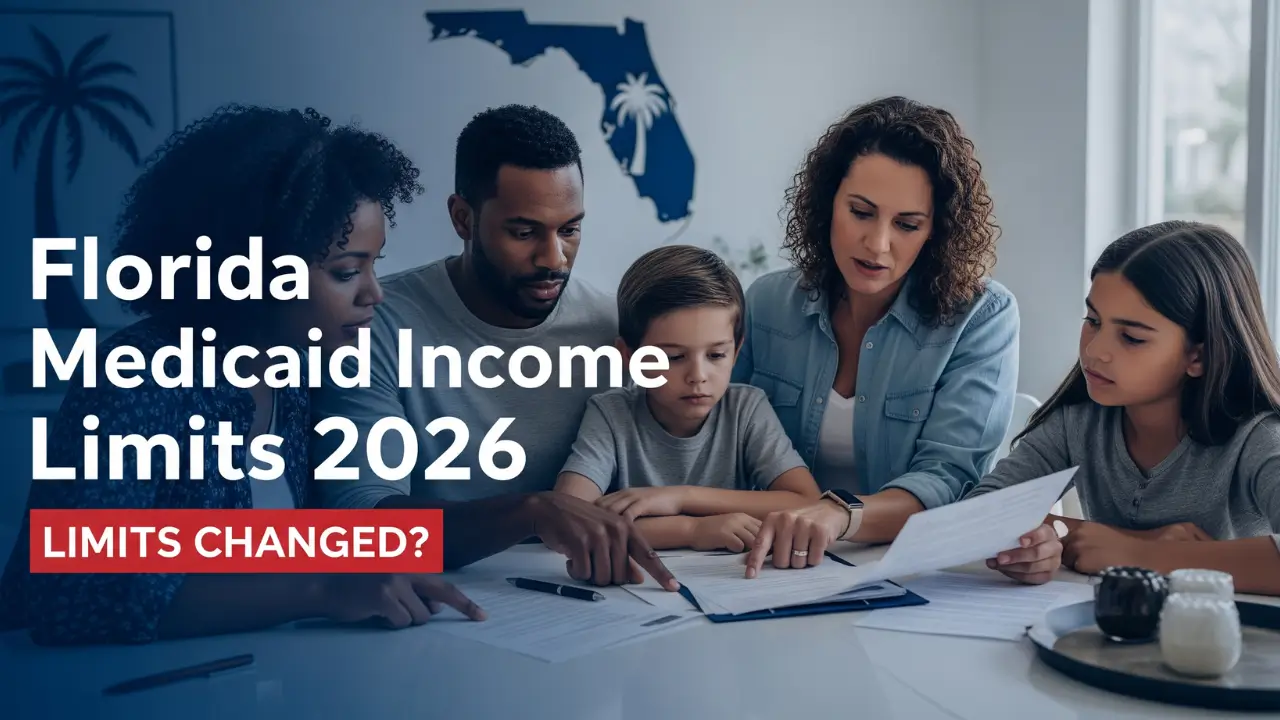
Florida Medicaid income limits changed in 2026. Knowing these limits helps you see if you qualify. The limits vary by age, family size, and program type.
Quick Summary:
- Long-term care income cap rose to $2,982/month for singles
- Family Medicaid uses 2026 Federal Poverty Level percentages
- Florida has not expanded Medicaid to childless adults
- Asset limits remain at $2,000 for individuals in nursing care
- Miller Trusts help people over the income cap still qualify
- Pregnant women and children have higher income limits
Understanding Florida Medicaid Income Limits in 2026
Florida uses different income limits for different programs. Your age, disability status, and family size matter.
The state follows federal rules but has not expanded coverage.
Last Updated: February 2026
Who Can Get Florida Medicaid?
Medicaid covers several groups in Florida. Seniors, disabled individuals, children, and pregnant women qualify. Parents with very low income may also qualify.
Childless adults without disabilities rarely qualify. Florida did not expand Medicaid under the Affordable Care Act. This creates a coverage gap for many working adults.
Long-Term Care Medicaid Income Limits 2026
These limits apply to seniors aged 65 and older. They also cover blind or disabled individuals. Nursing home care and home services use these limits.
The income cap increased in January 2026. It now follows the Federal Benefit Rate (FBR). Understanding Florida Medicaid eligibility 2026 helps you prepare your application.
Institutional Care (Nursing Home)
| Category | Individual | Couple (Both Apply) | Asset Limit |
|---|---|---|---|
| Nursing Home | $2,982/month | $5,964/month | $2,000 (Individual), $3,000 (Couple) |
If you live in a nursing home, this limit applies. Income includes Social Security, pensions, and retirement accounts. Most of your income goes to the facility.
Home & Community Based Services (HCBS)
| Category | Individual | Couple (Both Apply) | Asset Limit |
|---|---|---|---|
| HCBS | $2,982/month | $5,964/month | $2,000 (Individual), $3,000 (Couple) |
HCBS helps you stay home instead of entering a facility. You receive personal care, meal delivery, and other supports. The same income cap applies as nursing homes.
Regular Medicaid (Aged/Blind/Disabled)
| Category | Individual | Couple | Asset Limit |
|---|---|---|---|
| Regular Medicaid | $994/month | $1,491/month | $5,000 (Individual), $6,000 (Couple) |
This program covers regular healthcare without long-term care. Doctor visits, prescriptions, and hospital stays are included. Income limits are much lower than institutional care.
Income Cap Rules and Miller Trusts
Florida is an “Income Cap” state. This means strict monthly income limits apply. If you earn $2,983 or more monthly, you exceed the cap.
What Happens If You’re Over the Income Limit?
You must create a Qualified Income Trust (QIT). This is also called a Miller Trust. You deposit your excess income into this special account.
How Miller Trusts Work:
- You set up an irrevocable trust with a bank
- All income goes into the trust each month
- The trust pays your medical expenses and care costs
- Florida Medicaid then covers remaining healthcare needs
- After death, Florida may recover funds from the trust
Miller Trusts are mandatory for anyone over $2,982/month. An elder law attorney can help you set one up. Most banks familiar with the Florida Medicaid Fee Schedule in 2026 offer these accounts.
Spousal Protection Rules for 2026
When one spouse needs nursing home care, the other can stay home. Florida protects the “Community Spouse” who stays home. These protections prevent spousal impoverishment.
Community Spouse Resource Allowance (CSRA)
The healthy spouse can keep up to $162,660 in assets. This increased from $157,920 in 2025. The sick spouse can only keep $2,000.
Community Spouse Income Allowance
The healthy spouse keeps all their own income. They may also receive part of the applicant’s income. This brings their monthly income to $2,644 to $4,067.
Example:
- Husband enters nursing home with $3,500/month income
- Wife stays home with $1,200/month income
- Wife can receive up to $1,444 from husband’s income
- This brings her total to $2,644/month minimum
Home Equity Protection
Your primary home is exempt if equity is $752,000 or less. The home must meet certain conditions:
- You intend to return home, OR
- Your spouse lives there, OR
- Your dependent child lives there
This protects your family home during long-term care. The equity limit applies only to the applicant, not the community spouse.
Source: Florida Agency for Health Care Administration
H2: Family Medicaid Income Limits 2026 (MAGI)
Family Medicaid uses Modified Adjusted Gross Income (MAGI). This program covers children, pregnant women, and some parents. Income limits are based on the Federal Poverty Level (FPL).
These limits do not have asset tests. Only income matters. Comparing Medicaid income limits by state in 2026 shows that Florida has stricter parent limits than those in expansion states.
Children’s Coverage by Age
| Household Size | Children 6-18 | Children 1-5 | Infants <1 |
|---|---|---|---|
| 2 people | $2,398/month | $2,525/month | $3,715/month |
| 3 people | $3,027/month | $3,187/month | $4,690/month |
| 4 people | $3,657/month | $3,850/month | $5,665/month |
| 5 people | $4,287/month | $4,513/month | $6,640/month |
Younger children have higher limits. Infants receive coverage up to 206% of poverty level. All dependent children should apply regardless of parent’s income.
Pregnant Women
| Household Size | Income Limit (196% FPL) |
|---|---|
| 2 people | $3,534/month |
| 3 people | $4,462/month |
| 4 people | $5,390/month |
| 5 people | $6,317/month |
Pregnant women have much higher limits. Coverage continues for 12 months after delivery. This includes postpartum care and mental health services.
Parents and Caretaker Relatives
| Household Size | Income Limit (approx. 27% FPL) |
|---|---|
| 2 people | $485/month |
| 3 people | $615/month |
| 4 people | $742/month |
| 5 people | $870/month |
Parent limits are extremely low in Florida. A family of three can only earn $615/month to qualify. This is about $7,380 per year for a family of three.
The Coverage Gap Problem
Florida did not expand Medicaid. This creates serious coverage problems. Many working parents earn too much for Medicaid but too little for Marketplace subsidies.
Example of the Gap:
- Family of 3 earns $800/month ($9,600/year)
- Too much for Florida Medicaid ($615/month limit)
- Too little for Marketplace help (requires 100% FPL = $2,272/month)
- Result: No affordable health insurance available
Medically Needy Program (Share of Cost)
This program works like a deductible. You pay medical bills until you meet your “share of cost.” Then Medicaid pays the rest that month.
This option helps people over income limits. It’s often the only choice for non-disabled adults without children.
How Share of Cost Works
Florida allows you to keep minimal income:
- $180/month for individuals
- $241/month for couples
Everything above this becomes your monthly share of cost.
Example:
- Your monthly income: $1,500
- Florida allows: $180
- Your share of cost: $1,320
You must incur $1,320 in medical bills that month. After you meet this amount, Medicaid covers additional bills. The cycle resets each month.
Who Uses This Program?
- Adults aged 19-64 without disabilities or children
- Seniors slightly over the income cap who don’t use Miller Trusts
- Anyone with high medical expenses relative to income
This program requires careful record-keeping. Save all medical bills and receipts. You can learn more about covered services through the medicaid fee schedule 2026.
Source: Centers for Medicare & Medicaid Services
Asset Limits for Florida Medicaid 2026
Asset limits differ by program. Cash, bank accounts, and investments count. Some assets are exempt and don’t count.
Countable Asset Limits
| Program | Individual | Couple |
|---|---|---|
| Nursing Home / HCBS | $2,000 | $3,000 |
| Regular Medicaid | $5,000 | $6,000 |
These are low limits. Many people must “spend down” assets to qualify. Spend down means using your assets on approved expenses.
Exempt Assets (Don’t Count)
- Primary home (up to $752,000 equity for singles)
- One vehicle of any value
- Personal belongings and household items
- Prepaid burial plans
- Life insurance under $2,500 face value
- IRAs in payout status
Your home and car usually don’t count. This protects basic necessities. The home protection has equity limits for single applicants only.
The 5-Year Look-Back Period
Florida reviews all asset transfers within 60 months (5 years). Giving away assets or selling below value creates penalties. The penalty period delays Medicaid coverage.
Important: Plan asset transfers carefully. Consult an elder law attorney before giving away property or money.
Florida KidCare (CHIP) for Children
If your child’s income is too high for Medicaid, try Florida KidCare. This is Florida’s Children’s Health Insurance Program (CHIP). It covers children up to age 19.
Income Limits
Income limits reach up to 215% of the poverty level. This is much higher than regular Medicaid. Small monthly premiums apply for some families.
What KidCare Covers
- Doctor and hospital visits
- Prescription medications
- Dental and vision care
- Mental health services
- Preventive care and vaccines
Apply through Florida KidCare’s website. You can apply even if you think you earn too much.
How to Apply for Florida Medicaid
Application processes vary by program. Long-term care applications require more documentation. Family Medicaid uses simpler online applications.
Application Methods
Online:
- ACCESS Florida website for family Medicaid
- MyFlorida.com for long-term care Medicaid
By Phone:
- Call 1-866-762-2237 (toll-free)
In Person:
- Visit your local Department of Children and Families office
- Meet with a Medicaid planner at Area Agency on Aging
Documents You’ll Need
- Social Security cards for all household members
- Proof of income (pay stubs, Social Security statements)
- Bank statements from last 3 months
- Property deeds or mortgage statements
- Life insurance policies
- Retirement account statements
- Medical bills (for the Medically Needy program)
FAQ: Florida Medicaid Income Limits 2026
Q: What is the income limit for nursing home Medicaid in Florida in 2026?
The income limit is $2,982 per month for individuals in 2026. This increased from $2,901 in 2025. If you earn more, you must set up a Miller Trust to qualify for coverage.
Q: Does Florida Medicaid have asset limits in 2026?
Yes. Nursing home applicants can keep $2,000 as an individual or $3,000 as a couple. Regular Medicaid allows $5,000 for individuals and $6,000 for couples. Your home and one car usually don’t count.
Q: Can my spouse keep our assets if I need nursing home care?
Yes. The community spouse can keep up to $162,660 in assets in 2026. Your home is also protected if your spouse lives there. They keep all their own income too.
Q: What is a Miller Trust and when do I need one?
A Miller Trust (Qualified Income Trust) is required when your income exceeds $2,982/month. You deposit your income into this trust. The trust pays medical expenses and helps you qualify for Medicaid coverage.
Q: Do pregnant women have higher Medicaid income limits in Florida?
Yes. Pregnant women can earn up to 196% of the poverty level and still qualify. For a family of three, this is about $4,462/month. Coverage continues for 12 months after delivery.
Q: What is the Medically Needy program in Florida?
Medically Needy works like a deductible. You pay your medical bills until you meet your share of cost. Then Medicaid covers remaining bills that month. It helps people slightly over income limits with high medical costs.
Conclusion
Florida Medicaid income limits for 2026 depend on your situation. Seniors and disabled individuals face different rules than families. The income cap for long-term care increased to $2,982 monthly.
Miller Trusts help people over the income limit qualify. Spousal protections prevent impoverishment when one spouse needs care. Children and pregnant women have much higher income limits than parents.
If you’re close to these limits, apply anyway. Rules can be complex and exceptions exist. Contact your local Department of Children and Families for help with your specific situation.
Need help determining your eligibility? Visit the Florida Agency for Health Care Administration or call 1-866-762-2237 for free application assistance.