
PeachCare for Kids is Georgia’s children’s health insurance program under CHIP. It helps provide coverage to children under age 19 who live in Georgia, do not have current health coverage, and meet the program’s eligibility rules.
For 2026, the PeachCare for Kids income limits 2026 are based on household income and family size. Georgia’s policy sets the PeachCare income limit at 247% of the federal poverty level for countable income. Children who qualify for Medicaid are generally screened into Medicaid instead of PeachCare.
This guide explains PeachCare eligibility 2026, Georgia PeachCare income limits, possible costs, income verification, how to apply through Georgia Gateway, and what to expect during renewal.
Last reviewed: August 25, 2026
Sources checked: Georgia Department of Community Health, Georgia DFCS/PAMMS Policy Manual, Georgia.gov, HHS, and KFF.
Quick Answer
- PeachCare for Kids is Georgia’s CHIP program. It provides health coverage to eligible children under age 19 who meet Georgia’s program rules.
- The 2026 PeachCare income standard is 247% of the Federal Poverty Level (FPL). Georgia uses Modified Adjusted Gross Income (MAGI) rules when reviewing financial eligibility.
- Georgia also applies a 5% FPL income disregard as part of its MAGI eligibility methodology. This is why some websites may describe PeachCare as having an effective limit of roughly 252% FPL. The official Georgia table lists 247% PCK as the main standard and shows the Plus 5% amount separately.
- 2026 PeachCare income limits vary by household size. Examples of the published 247% PCK standards include:
- Family of 3: $5,624 per month, or about $67,488 per year
- Family of 4: $6,792 per month, or about $81,504 per year
- Family of 5: $7,963 per month, or about $95,556 per year
- Family of 6: $9,131 per month, or about $109,572 per year
- Income is only one part of eligibility. Georgia also considers the child’s age, Georgia residency, insurance status, citizenship or eligible immigration status, household information, and other program requirements.
- PeachCare is not Medicaid. PeachCare is CHIP. Georgia Medicaid is a separate program. The same Medical Assistance application can screen a child for both programs.
- You do not need to choose between Medicaid and PeachCare before applying. Georgia reviews the application and determines which program, if any, the child qualifies for.
- PeachCare may have a monthly premium and copays. Some children are exempt, including children under age 6, children in foster care, and American Indian and Alaska Native children.
- PeachCare covers a broad range of children’s health services. Benefits include doctor visits, hospital care, prescription drugs, dental care, vision care, preventive services, and mental health services.
- Apply through Georgia Gateway. Choose “Apply for Benefits” and select “Medical Assistance.” Georgia can use the application to evaluate Medicaid and PeachCare eligibility.
- You may apply in other ways. Georgia also accepts applications by phone, mail, in person, and through other approved methods.
- Have income information ready. Georgia may verify income electronically or ask for documents such as recent pay stubs, employer verification, benefit statements, or self-employment records.
- Citizenship and identity may be verified electronically. If Georgia cannot verify the information electronically, it may request documents from the family.
- PeachCare is generally renewed every 12 months. Georgia first tries to complete the renewal using available electronic information. If it cannot, the state sends a renewal notice or form explaining what is needed.
- A renewal notice gives families at least 30 calendar days to respond. A separate verification request may have a different deadline. Georgia’s PeachCare income-verification guidance generally gives 14 days for requested missing verification.
- Children under 19 generally receive 12 months of continuous eligibility. A later increase in household income usually does not end PeachCare during that coverage period, subject to limited exceptions.
- If a child loses PeachCare at renewal, Georgia reviews other Medicaid categories when applicable. Income above the PeachCare limit does not usually qualify a child for regular income-based Medicaid, but another Medicaid category may apply in some circumstances.
- Georgia Access may be another option if Medicaid and PeachCare are not available. Georgia Access has its own eligibility and enrollment rules. Losing PeachCare does not automatically mean that a Georgia Access plan can start immediately.
- Georgia’s official sources should be used for the final answer. Income limits, premiums, eligibility rules, and enrollment requirements can change. Georgia Gateway, official DFCS notices, and Georgia DCH/DFCS policy are the best sources for an individual case.
Official sources checked: Georgia Department of Community Health, Georgia DFCS/PAMMS Policy Manual, Georgia.gov, Georgia Gateway, and federal HHS guidance.
PeachCare for Kids Income Limits in Georgia for 2026
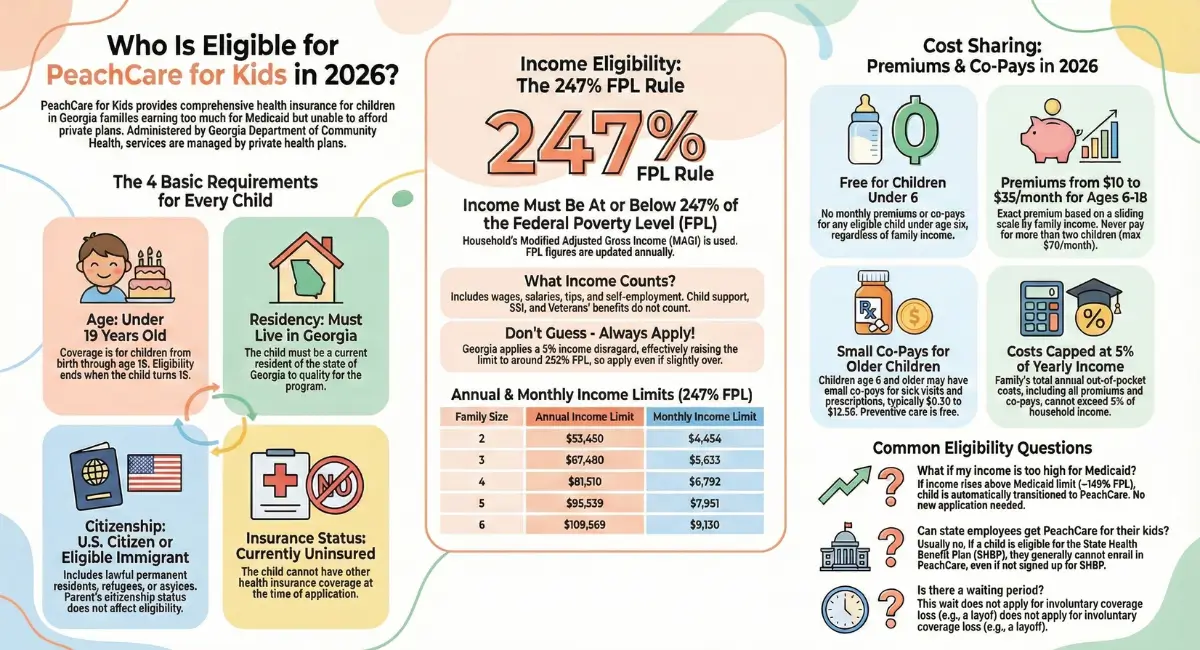
The PeachCare for Kids income limits for 2026 are based on 247% of the Federal Poverty Level (FPL). PeachCare for Kids covers uninsured children under age 19 who live in Georgia and meet the program’s other eligibility rules.
Georgia uses Modified Adjusted Gross Income (MAGI) to determine income eligibility. In simple terms, MAGI is an income calculation based largely on taxable income and household tax relationships.
Your household size matters. So does your monthly income. Georgia also lists corresponding annual income amounts. The Georgia Department of Community Health says these income limits are based on 247% FPL and are updated each year.
PeachCare for Kids income limits 2026
Here are the Georgia PeachCare income limits published by the Georgia Department of Community Health:
| Household size | Monthly income limit | Annual income limit |
|---|---|---|
| 1 | $3,100 | $37,200 |
| 2 | $4,208 | $50,496 |
| 3 | $5,315 | $63,780 |
| 4 | $6,422 | $77,064 |
| 5 | $7,530 | $90,360 |
| 6 | $8,637 | $103,644 |
| 7 | $9,745 | $116,940 |
| 8 | $10,852 | $130,224 |
| Each additional person | Add $1,108 per month | Add $13,284 per year |
These figures are the current income limits shown by Georgia DCH. For example, a household of four has a listed limit of $6,422 per month or $77,064 per year.
Keep in mind that being under the income limit does not automatically mean a child will qualify. Georgia also looks at the child’s age, Georgia residency, insurance status, citizenship or eligible immigration status, and whether the child qualifies for Medicaid instead.
How the 5% income disregard works
Georgia’s MAGI rules also include a 5% FPL income disregard. This can make the eligibility calculation different from simply comparing your income with the 247% FPL figure. Georgia’s 2026 Family Medicaid Financial Limits specifically shows a 247% PCK standard and a separate “Plus 5%” amount.
The important point is that the 5% disregard is not an extra income amount that every family automatically gets. Under federal MAGI rules, the disregard is used when it makes the difference between being eligible and ineligible. It applies only when the income calculation is within five percentage points above the applicable standard.
Because of this, you may see PeachCare described as having an effective income range of roughly 252% FPL in some explanations. The official PeachCare income limit remains 247% FPL. The 5% disregard is part of how Georgia calculates MAGI eligibility when the disregard is needed.
What income does Georgia review?
Georgia reviews income under MAGI rules. The state says income information must be verified when you apply and again during the annual renewal process.
Depending on your household, income can include sources such as:
- Wages, salary, and tips
- Net income from self-employment
- Unemployment income
- Social Security income
- Interest and dividends
- Some pensions and retirement income
- Rental income and royalties
- Other taxable or countable income
Georgia DCH lists a broader set of earned and unearned income sources that may need to be reported and verified.
You may be asked for recent pay stubs or other proof of income. Georgia allows applicants and existing households to upload documents through Georgia Gateway.
Income is only one part of PeachCare eligibility
Meeting the PeachCare income limit in Georgia is only one part of the eligibility decision.
A child generally must also:
- Be under age 19
- Live in Georgia
- Be uninsured
- Be a U.S. citizen or meet an eligible immigration-status rule
- Not be eligible for Medicaid
Georgia says children who qualify for Medicaid are placed in the appropriate Medicaid program. Children who fall within the PeachCare income limits are placed in PeachCare for Kids. You do not need a separate application for each program.
Example: A family of three with monthly income of $5,100 is below the listed PeachCare limit of $5,315 per month. That means the household is within the published income range. It does not guarantee eligibility. Georgia will still review the child’s household information, insurance status, citizenship or immigration status, and countable income before making a final decision.
PeachCare Income Limits by Household Size
The PeachCare for Kids income limits 2026 are listed in Georgia’s Family Medicaid Financial Limits as a 247% PCK standard. The state also lists a separate Plus 5% amount. These figures are effective March 1, 2026.
For the household sizes most families search for, the official Georgia figures are:
| Household size | Monthly income | Annual income* | Eligibility context |
|---|---|---|---|
| 2 | $4,455 | $53,460 | 247% PCK income standard |
| 3 | $5,624 | $67,488 | 247% PCK income standard |
| 4 | $6,792 | $81,504 | 247% PCK income standard |
| 5 | $7,963 | $95,556 | 247% PCK income standard |
| 6 | $9,131 | $109,572 | 247% PCK income standard |
*Annual amounts are shown here by multiplying the official monthly figure by 12. Georgia’s source publishes the monthly limits in its 2026 Family Medicaid Financial Limits table.
Georgia’s official table also shows a Plus 5% figure for PeachCare. For example, the 247% PCK amount for a household of four is $6,792 per month, while the listed Plus 5% amount is $6,929. The Plus 5% column should not be treated as a separate standard that every family automatically receives. It is part of the state’s eligibility methodology.
The Georgia policy manual identifies this table as “Family Medicaid Financial Limits 2026” and gives an effective date of March 1, 2026.
Looking for your family size? See the sections below for PeachCare income limits for a family of 3, 4, 5, and 6.
PeachCare Income Limit for a Family of 3
For a family of 3, Georgia’s 2026 247% PCK income standard is $5,624 per month. That is about $67,488 per year when the monthly amount is multiplied by 12. The official Georgia table also lists a Plus 5% amount of $5,737 per month.
For example, a three-person household with monthly income of about $5,500 is below the published 247% PCK amount. That means the household is within the main income range shown in Georgia’s table.
Income alone does not guarantee PeachCare coverage. Georgia makes the final eligibility determination after reviewing the household’s complete information.
PeachCare Income Limit for a Family of 4
For a family of 4, the 2026 PeachCare 247% PCK income standard is $6,792 per month, or about $81,504 per year based on 12 months of the monthly figure. Georgia lists $6,929 per month under the Plus 5% column.
For example, if a four-person household earns approximately $6,500 per month, that amount is below the published 247% PCK threshold.
That does not mean the child is automatically approved. Georgia reviews the household under its Medicaid and PeachCare eligibility rules before making a final decision.
PeachCare Income Limit for a Family of 5
For a family of 5, the 2026 PeachCare 247% PCK income standard is $7,963 per month, or about $95,556 per year using the monthly figure multiplied by 12. The Plus 5% amount listed by Georgia is $8,124 per month.
For example, a five-person household earning about $7,800 per month is below the published 247% PCK amount.
The final eligibility decision depends on the child and household meeting all applicable program rules, not income alone.
PeachCare Income Limit for a Family of 6
For a family of 6, the 2026 PeachCare 247% PCK income standard is $9,131 per month, or about $109,572 per year based on 12 months of income. Georgia lists $9,315 per month under the Plus 5% column.
For example, a six-person household with monthly income of $9,000 is below the published 247% PCK income amount.
As with other household sizes, being below the income figure does not by itself guarantee coverage. Georgia reviews the full application and makes the final determination.
Why PeachCare Uses 247% of the Federal Poverty Guidelines
The 247% FPL PeachCare figure comes directly from Georgia’s current eligibility policy. Georgia DFCS says PeachCare for Kids is for uninsured children under age 19 in families with countable income at or below 247% of the Federal Poverty Level (FPL). Georgia uses Modified Adjusted Gross Income (MAGI) rules when reviewing financial eligibility.
The 2026 Georgia financial limits table lists a 247% PCK standard and a separate Plus 5% amount. The table is effective March 1, 2026.
What does 247% FPL mean?
The Federal Poverty Guidelines are issued by the U.S. Department of Health and Human Services (HHS) and are updated each year. States use these guidelines when setting income standards for programs such as Medicaid and CHIP.
Georgia applies the 247% standard to PeachCare for Kids. For example, the 2026 Georgia table lists a 247% PCK monthly income standard of $6,792 for a household of four. That figure is the state’s published PeachCare financial standard for that household size.
How the PeachCare income disregard works
You may also see references to a PeachCare income disregard or a 5% FPL disregard. This is a separate part of MAGI eligibility rules.
Federal Medicaid guidance says the 5% disregard is used only when it is needed to determine eligibility. In other words, it can help a person qualify when MAGI is above the main income standard but within five percentage points of the FPL above that standard. It is not an additional income amount that every applicant simply adds to the published limit.
Georgia shows this distinction directly in its 2026 financial limits table. For a household of four, for example, the table lists $6,792 at 247% PCK and $6,929 under Plus 5%.
Why some websites say PeachCare is 252% FPL
You may find websites that describe PeachCare 252% FPL as the income limit. This usually comes from adding the five-percentage-point MAGI disregard to the 247% standard.
That can be useful shorthand, but it can also be misleading. The official Georgia table identifies 247% PCK as the main income standard and lists the Plus 5% amount separately. The federal rule also says the disregard is applied only when it makes a difference to eligibility.
For that reason, a family should not assume that every household can automatically earn up to a full 252% of the federal poverty guidelines and still qualify.
Why different websites show different dollar amounts
Different PeachCare income figures can appear online for several reasons.
First, the federal poverty guidelines change each year. HHS publishes new guidelines annually, and Georgia updates its financial limits accordingly.
Second, some websites may be showing an older year’s limits. Georgia’s 2025 table, for example, has lower 247% PCK amounts than the current 2026 table.
Third, a website may be showing the 247% PCK figure while another shows the Plus 5% figure. Those are not necessarily conflicting sources. They can represent different parts of the same MAGI methodology.
A calculator can also produce a different result if it uses a different year, household definition, or income methodology. For that reason, an online calculator should be treated as an estimate rather than the final authority.
For current PeachCare 247 percent FPL limits, the best starting point is Georgia’s own 2026 financial limits and PeachCare policy. Georgia DFCS makes the final eligibility determination after reviewing the household’s information and verifying income.
How Georgia Determines PeachCare Eligibility
PeachCare eligibility 2026 depends on more than household income. Georgia reviews the child’s age, residence, insurance status, citizenship or immigration status, income, and other applicable program rules.
The state uses the Medical Assistance application process to determine which coverage program is appropriate. A child who qualifies for Medicaid is placed in Medicaid rather than PeachCare for Kids. A separate PeachCare application is not required.
Age Requirement
The PeachCare age limit is under 19. Georgia’s policy says coverage is available from birth through the last day of the month of a child’s 19th birthday.
Georgia Residency
The child must live in Georgia to qualify for PeachCare for Kids. Georgia DCH identifies Georgia residency as an eligibility requirement for the program.
Income Eligibility
PeachCare income eligibility is determined using MAGI rules. Georgia’s current policy states that countable income must be at or below 247% of FPL for PeachCare for Kids. The state also publishes a separate Plus 5% amount as part of its financial eligibility methodology.
Georgia verifies income when a family applies. Income is also verified during the annual renewal process. Verification may include recent pay stubs and information about other income sources.
Health Coverage Status
PeachCare is designed for an uninsured child. Georgia DCH says the child must not have current health coverage and must not be eligible for Medicaid.
This means having private health insurance can affect eligibility. The important question is whether the child has current coverage when Georgia reviews the application.
Citizenship and Immigration Eligibility
The child must be a U.S. citizen or fall within an eligible legal immigrant category. Georgia verifies the child’s citizenship or immigration status as part of the eligibility process.
Georgia DCH also states that parents do not have to verify their own citizenship or immigration status for a child’s PeachCare application. The status requirement applies to the child seeking coverage.
Immigration eligibility can depend on the child’s specific status and other federal rules. Families with questions about a particular immigration category should rely on Georgia’s eligibility determination rather than assume that one general rule applies to every situation.
Other Eligibility Requirements
Georgia also applies other Medical Assistance rules when reviewing an application. In particular, a child who is eligible for Medicaid is not eligible for PeachCare for Kids. Georgia’s policy also requires income and citizenship or immigration information to be verified.
The safest way to determine who qualifies for PeachCare is to submit the Medical Assistance application through Georgia’s system. Georgia reviews the child’s household, income, coverage, and other eligibility information and determines whether Medicaid or PeachCare is the appropriate program.
PeachCare for Kids vs Medicaid for Children
PeachCare for Kids is Georgia’s CHIP program. It is not the same program as Medicaid, although the same medical-assistance application can determine which program a child qualifies for.
Georgia says its single Medical Assistance application reviews household circumstances and determines the most appropriate coverage. Children who meet Medicaid requirements are placed in Medicaid, while children who meet PeachCare requirements are placed in PeachCare for Kids. (dch.georgia.gov)
This can make PeachCare vs Medicaid confusing for parents. You generally do not have to decide which program to apply for before submitting an application. Georgia evaluates the information you provide and determines whether Medicaid or PeachCare is appropriate. (dch.georgia.gov)
| Question | Medicaid | PeachCare for Kids |
|---|---|---|
| Program type | Medicaid | CHIP |
| Income range | Depends on the child’s Medicaid category and applicable income rules | Generally covers children in families above the applicable Medicaid income level and within PeachCare’s income limits |
| Child eligibility | Yes | Yes |
| Premiums | Program and eligibility category dependent | Premiums may apply |
| Application | Georgia Gateway | Georgia Gateway |
| Final decision | Georgia | Georgia |
Georgia’s Department of Community Health administers both Medicaid and CHIP in the state. Georgia refers to its CHIP program as PeachCare for Kids. (dch.georgia.gov)
Is PeachCare Medicaid?
No. PeachCare is not Medicaid. PeachCare for Kids is Georgia’s CHIP program, created under Title XXI of the Social Security Act. Medicaid is a separate federal-state health coverage program. Georgia administers both programs as part of its Medical Assistance system. (dch.georgia.gov)
The programs can look similar from a family’s perspective because both provide health coverage for children and both can be accessed through the same Georgia Gateway Medical Assistance application. (georgia.gov)
PeachCare or Medicaid: Which one does a child get?
You generally do not need to choose between them yourself.
When you submit a Medical Assistance application, Georgia reviews your household composition, income, and other circumstances. Children who fall under the applicable Medicaid income rules are placed in the appropriate Medicaid program. Children who fall within the PeachCare for Kids income limits are placed in PeachCare. Georgia says no separate application is needed for PeachCare. (dch.georgia.gov)
This means there is no single income cutoff that applies to every child in Medicaid. Medicaid eligibility can vary by the child’s eligibility category and household circumstances. It is better to let Georgia evaluate the complete application rather than assume that a particular income level automatically means Medicaid or PeachCare.
How costs can differ
Cost is another important difference.
PeachCare for Kids can have monthly premiums and copayments, depending on the child’s circumstances and household income. Georgia DCH says PeachCare premiums resumed as applications and renewals were completed, and Georgia.gov notes that some enrolled families may be required to pay premiums or copayments. (dch.georgia.gov; georgia.gov)
Medicaid cost-sharing works under different program rules. The amount, if any, depends on the Medicaid category and applicable requirements. Because of this, families should not assume that the cost of Medicaid and PeachCare will be the same.
Where do you apply?
Both programs are part of Georgia’s Medical Assistance application process. You can use Georgia Gateway to apply for Medicaid or PeachCare for Kids. Georgia Gateway also lets families renew coverage, report changes, upload documents, view notices, and check an application status. (georgia.gov)
The key point is simple: you do not need to file one application for Medicaid and another for PeachCare. Submit the Medical Assistance application and let Georgia determine which children’s coverage program applies. (dch.georgia.gov)
PeachCare Premiums and Copays in 2026
PeachCare for Kids may have monthly premiums and copays. The amount can depend on household income, the number of children enrolled, the child’s age, and Georgia’s current program rules. Georgia resumed applicable PeachCare premiums and copays on October 1, 2024.[dch.georgia]
PeachCare Premiums by Income Level
Georgia uses income-based premiums for some PeachCare households. The premium amount may vary by the family’s assigned income tier and the number of children enrolled.
Publicly available Georgia materials do not all list the same premium amounts. Some Georgia DCH materials list a monthly premium of $10 to $35 for one child, with a maximum of $70 for two or more children in the same household. A historical Georgia CHIP cost-sharing table lists premiums from $11 to $36 for one child and family maximums from $16 to $72.[dch.georgia][nashp]
Because these public sources differ, do not rely on an older online premium chart to determine what you will owe. Georgia assigns the applicable premium after reviewing the child’s eligibility. Check the premium amount shown in your PeachCare approval notice, renewal notice, or billing notice.
Does PeachCare Cost Money?
It can. Some families pay a monthly premium and may owe copays for certain services.
Georgia does not charge premiums or copays for:
- Children under age 6
- Children in foster care
- American Indian and Alaska Native children[dch.georgia]
If your child is not in one of these groups, Georgia will tell you whether a premium applies and how much you must pay.
Are There Copays?
Copays may apply to some services for PeachCare members who are not exempt. The amount varies by service and the child’s current health plan.
Current Georgia managed-care materials list examples ranging from $0.50 to $3 for certain prescription drugs and office-based services, $2 for some community health-center or rural health-clinic visits, $3 for certain outpatient services, and $12.50 for inpatient hospital services.[pshpgeorgia]
Emergency services and some preventive services have copay protections or exemptions. Before receiving non-emergency care, check your child’s current health-plan handbook or call the plan to confirm the copay that applies.[dch.georgia]
What Does PeachCare for Kids Cover?
PeachCare for Kids provides broad health coverage for eligible children in Georgia. PeachCare benefits include routine care, treatment when a child is sick, hospital services, dental and vision care, prescriptions, and mental health services.
Doctor Visits
Coverage includes primary care when your child is sick, regular checkups, preventive services, and specialist care.
Hospital Care
PeachCare covers hospitalization and emergency room services when medically needed.
Prescription Drugs
Prescription medications are included as a covered benefit.
Dental Care
PeachCare includes dental care for enrolled children.
Vision Care
Vision coverage includes vision screenings and eyeglasses.
Preventive Care
Preventive benefits include services such as immunizations and regular checkups.
Mental Health Services
PeachCare also covers mental health care. The child’s Georgia Families Care Management Organization helps coordinate covered care.
How to Apply for PeachCare for Kids in Georgia
You can apply for PeachCare through Georgia’s regular Medical Assistance application. You do not need a separate PeachCare application. Georgia reviews the application for both Medicaid and PeachCare eligibility.
Apply Online Through Georgia Gateway
The easiest way to apply is through Georgia Gateway:
- Go to Georgia Gateway.
- Select “Apply for Benefits.”
- Choose “Medical Assistance” as the type of application.
- Follow the prompts and provide your household and income information.
Before applying, Georgia recommends having information such as Social Security numbers or immigration document numbers, employer and income information, and details about current health insurance available to your household.
Apply by Phone
You can apply or get application help by calling:
PeachCare for Kids: 1-877-427-3224
Georgia DFCS: 1-877-423-4746
Follow the prompts when calling.
Apply in Person or by Other Methods
Georgia currently allows you to submit a Medical Assistance application in person at a local DFCS office or Right from the Start Medical Assistance (RSM) Group office. Georgia recommends calling before visiting to confirm that in-person service is available.
You can also mail a completed and signed application. Georgia’s current application instructions list this mailing address:
Division of Family and Children Services
Customer Contact Center
P.O. Box 4190
Albany, GA 31706
Georgia says applications generally take about 45 days to process, although processing can take longer if additional information is needed. You will receive a letter explaining whether your child is eligible and what to do next.
What Documents Do You Need for PeachCare?
The PeachCare documents needed depend on what Georgia can verify electronically and what information is needed to complete your application. Georgia verifies the household’s income and the child’s citizenship or eligible immigration status. The state may verify some information electronically, but it can ask for documents when additional proof is needed.
Proof of Income
For PeachCare income verification, Georgia requires all applicant income to be verified electronically or manually. Depending on your situation, the state may ask for recent pay stubs, employer information, benefit statements, tax records, or other proof of income.
Examples can include:
- Recent pay stubs
- An employer statement or verification form
- Social Security or retirement benefit statements
- Unemployment documentation
- Self-employment income records
- Documentation of other income Georgia asks you to report
You can upload requested documents through Georgia Gateway.
Identity and Citizenship Documents
Georgia verifies the citizenship and identity of the child applying for PeachCare. The state may be able to confirm this information electronically using the child’s Social Security number. That means you may not need to send paper documents when electronic verification is successful.
When electronic verification does not provide enough proof, Georgia may ask for documents.
If one document proves both citizenship and identity, such as a U.S. passport, Certificate of Naturalization, or Certificate of Citizenship, that document can satisfy both requirements.
Otherwise, Georgia generally needs one document proving citizenship and one document proving identity. A birth certificate by itself proves citizenship but may not satisfy the separate identity requirement.
Other Documents Georgia May Request
Georgia may ask for additional documents when information cannot be verified electronically or when more information is needed to determine eligibility. The request depends on the details of your application.
Check your Georgia Gateway account and notices carefully. Send requested information by the stated deadline to avoid delays in processing.
What If Your Income Changes?
Report changes to your household and income information through Georgia Gateway. Updated income can affect eligibility or the premium assigned to your household.
Georgia also reviews income during renewal and may ask for current proof. Keep recent pay stubs and other income records available in case the state requests them.
When Does PeachCare Coverage Start?
The PeachCare effective date is not simply the day you submit an application. Under Georgia’s current policy, a new enrollment generally begins on the first day of the month in which the completed application, required verifications, and initial premium payment have been received, when a premium is due. PeachCare does not provide coverage for prior months.
There are also important payment deadlines:
- New applicant: You have 45 days to pay the initial premium.
- Renewal: You have 30 days to pay the initial premium.
This means approval does not necessarily mean your child’s coverage is already active. When an initial premium is required, Georgia must receive that payment before enrollment can begin under the applicable rules.
What Happens After the Initial Premium?
The initial premium is different from regular monthly payments during the enrollment period. Under Georgia’s current continuous eligibility policy, once the required initial payment for a new enrollment period has been received, a child generally does not lose PeachCare coverage during that enrollment period simply because a later regular premium is not paid. Premiums can still accrue, and Georgia sends quarterly statements.
Because individual cases can differ, check your Georgia Gateway notices and PeachCare account for the payment amount, due dates, and effective date assigned to your child.
How PeachCare Renewal and Redetermination Work
PeachCare renewal happens every 12 months. Georgia first checks whether it can renew coverage using available electronic information. If it cannot complete the renewal that way, Georgia sends a renewal notice or form and explains what information is needed. (pamms.dhs.ga.gov)
When Does PeachCare Need to Be Renewed?
PeachCare must be renewed annually, and Georgia generally cannot require a renewal more often than every 12 months. You can renew through Georgia Gateway, by phone, mail, fax or email, in person, or through an authorized representative. (pamms.dhs.ga.gov)
Georgia gives families at least 30 calendar days to respond to an alternate renewal notice. If Georgia later requests specific missing verification, follow the deadline in that request; the PeachCare income-verification page says requested information should generally be provided within 14 days. (pamms.dhs.ga.gov; dch.georgia.gov)
What Happens If Your Income Changes?
Children under 19 generally receive 12 months of continuous eligibility. This means a later income increase usually does not end PeachCare before the 12-month period ends. Limited exceptions can apply, such as turning 19, moving out of Georgia, requesting closure, certain eligibility errors involving fraud or perjury, or death. (pamms.dhs.ga.gov)
What If You Lose Eligibility?
At renewal, Georgia performs a continuing Medicaid determination when a child is no longer eligible under the current category. In plain language, Georgia checks whether another Medicaid category applies before ending Medical Assistance when appropriate. (pamms.dhs.ga.gov)
A child who loses PeachCare because of income will not usually qualify for regular income-based Medicaid. However, another Medicaid category may apply based on the child’s individual circumstances.
How to Avoid Losing Coverage Because of Missing Information
Watch your Georgia Gateway account and notices during renewal. Respond by the deadline and upload any requested documents.
Keeping your income and household information current can also help prevent delays during renewal.
What Happens If My Child Is Over the PeachCare Income Limit?
Being over the PeachCare income limit does not automatically mean that another program will cover your child. Georgia reviews the child’s complete circumstances and applies the eligibility rules for each available program.
Could My Child Qualify for Medicaid?
Georgia reviews a child for other Medicaid coverage categories when the child is no longer eligible for PeachCare. Income above the PeachCare limit will not usually qualify a child for regular income-based Medicaid, but another Medicaid category may apply based on the child’s individual circumstances. (pamms.dhs.ga.gov)
Could PeachCare Still Apply?
Do not assume that being slightly above one published dollar amount automatically ends eligibility. Georgia uses its MAGI methodology, including applicable income-disregard rules, when making the final determination. (pamms.dhs.ga.gov)
What About Georgia Access?
Georgia Access may be another option if a child does not qualify for Medicaid or PeachCare. Georgia Access has separate eligibility rules, including Georgia residency and qualifying citizenship, nationality, or lawful-presence requirements. Enrollment is generally limited to Open Enrollment unless the child qualifies for a Special Enrollment Period. (georgiaaccess.gov)
Losing PeachCare can create a qualifying event, but Georgia Access deadlines and eligibility depend on the circumstances. Check Georgia Access for the applicable Special Enrollment Period before assuming coverage can start immediately.
What About Employer or Private Coverage?
Employer-sponsored or other private health insurance may also be an option. Availability and cost depend on the family.
Children with other public or private health insurance generally are not eligible for PeachCare, although Georgia has exceptions for coverage such as dental-only or vision-only insurance. (pamms.dhs.ga.gov)
The main point is simple: being over the PeachCare income limit does not automatically determine what coverage comes next. Georgia must review the child’s circumstances under the rules for Medicaid, PeachCare, Georgia Access, or other available coverage.
PeachCare for Kids Frequently Asked Questions
What is the income limit for PeachCare for Kids in 2026?
Georgia’s published PeachCare for Kids income limit is 247% of the Federal Poverty Level (FPL). Georgia uses MAGI, or Modified Adjusted Gross Income, to determine income eligibility. The state also applies the applicable 5% FPL income disregard during its MAGI calculation, which is why some websites may refer to an effective limit of about 252% FPL. Georgia Gateway and DFCS make the final eligibility decision.[pamms.dhs.ga][pamms.dhs.ga]
What is the PeachCare income limit for a family of 4?
For a four-person household, Georgia’s 2026 DFCS financial-limits table lists a PeachCare limit of $6,792 per month, or $81,504 per year, at 247% FPL. The policy table also shows a separate 5% FPL MAGI disregard amount, which Georgia uses in its eligibility calculation.[pamms.dhs.ga][pamms.dhs.ga]
What is the PeachCare income limit for a family of 3?
For a three-person household, Georgia’s 2026 PeachCare income limit is $5,624 per month, or $67,488 per year, at 247% FPL. This is a starting point, not a guarantee. Georgia reviews MAGI income, household composition, available health coverage, and the child’s other eligibility details.[pamms.dhs.ga][pamms.dhs.ga]
What is the PeachCare income limit for a family of 5?
For a five-person household, Georgia’s 2026 PeachCare income limit is $7,963 per month, or $95,556 per year, at 247% FPL. Georgia calculates eligibility using current household income and the state’s MAGI rules.[pamms.dhs.ga][pamms.dhs.ga]
Is PeachCare for Kids Medicaid?
No. PeachCare for Kids is Georgia’s CHIP program, not Medicaid. CHIP is health coverage for uninsured children who may have household income above the applicable Medicaid range but within PeachCare’s limits.
Georgia uses one Medical Assistance application to review children for both programs. If a child qualifies for Georgia Medicaid, Georgia enrolls the child in Medicaid rather than PeachCare.[dch.georgia][georgia]
How much does PeachCare cost in 2026?
Some families may have a monthly PeachCare premium and copays for certain services. The amount depends on household income, the number of enrolled children, the child’s age, exemption status, and Georgia’s current rules.
Public Georgia materials available online list different historical premium amounts. For the most reliable current amount, use the child’s PeachCare approval, renewal, or billing notice. Georgia says children under age 6, children in foster care, and American Indian or Alaska Native children do not have PeachCare premiums or copays.[dch.georgia][dch.georgia]
Is PeachCare free?
It can be free for some children. Georgia does not charge premiums or copays for children under age 6, children in foster care, or American Indian and Alaska Native children.[dch.georgia]
Other eligible children may have a monthly premium and may pay copays for certain services. The child’s Georgia Families health plan and PeachCare notices provide the applicable amount.[dch.georgia][dch.georgia]
How do I apply for PeachCare in Georgia?
Apply through Georgia Gateway, Georgia’s online benefits portal. Choose “Apply for Benefits” and select “Medical Assistance.” Georgia uses this application to review a child for Medicaid and PeachCare for Kids.[georgia][georgia]
You can also apply:
By phone: PeachCare for Kids at 1-877-427-3224 or DFCS at 1-877-423-4746
In person: At a local DFCS office or Right from the Start Medical Assistance Group office
By mail: Using a completed and signed Medical Assistance application[georgia][medicaid.georgia]
What documents are needed for PeachCare?
Georgia may verify some information electronically, but it can request documents when more proof is needed. Families commonly need information about household members, income, current health coverage, and the child’s citizenship or eligible immigration status.[georgia][dch.georgia]
Income documents can include recent pay stubs, employer verification, benefit award letters, or self-employment records. A Social Security number is required for each child applying for PeachCare, and Georgia may use it to verify citizenship and identity electronically.[dch.georgia][dch.georgia]
What happens if my income changes?
Report household and income changes through Georgia Gateway. A higher income does not necessarily mean your child loses PeachCare immediately.
Children under age 19 generally receive 12 months of continuous eligibility. During that coverage period, Georgia generally cannot end PeachCare simply because the household income rises above the program limit. Georgia reviews eligibility at annual renewal, subject to limited exceptions such as moving out of Georgia, turning 19, voluntarily ending coverage, or certain findings involving fraud, abuse, or perjury.[pamms.dhs.ga]
Official Georgia PeachCare Sources
| Source | What it verifies |
|---|---|
| Georgia Department of Community Health (DCH) | PeachCare eligibility criteria, covered benefits, program costs, contacts, and member information |
| Georgia DCH applications page | How to apply for PeachCare, including Georgia Gateway, phone, mail, and in-person application options |
| Georgia DFCS/PAMMS Medicaid Policy Manual | Detailed PeachCare eligibility, MAGI income calculations, renewals, continuous eligibility, premiums, and third-party insurance rules |
| Georgia.gov | State application instructions, document checklist, eligibility overview, and Georgia Gateway access |
| U.S. Department of Health and Human Services (HHS) | Annual Federal Poverty Guidelines used to calculate income-based eligibility standards |
| KFF | Independent state-level context on Medicaid and CHIP income eligibility, enrollment, and renewal policy |
For the final decision on eligibility, coverage start dates, premiums, and required documents, rely on Georgia Gateway, official DFCS notices, and Georgia DCH or DFCS policy—not a general income calculator or third-party summary.[georgia][pamms.dhs.ga]
About This Guide
Reviewed August 25, 2026. This guide was researched and reviewed using current information from the Georgia Department of Community Health (DCH), Georgia Division of Family and Children Services (DFCS) policy manuals, Georgia.gov, Georgia Gateway, and relevant U.S. Department of Health and Human Services (HHS) guidance.
The review included Georgia’s 2026 Family Medicaid Financial Limits, PeachCare for Kids eligibility and income-verification policies, renewal and continuous-eligibility rules, coverage and cost information, and application guidance.
Because Medicaid and PeachCare rules, income limits, and costs can change, this guide should be checked against Georgia’s current information when you apply or renew coverage. Georgia Gateway and Georgia’s official eligibility determination are the final sources for an individual family’s eligibility.
Next review: This guide should be reviewed whenever Georgia publishes new annual income limits or makes a substantive change to PeachCare eligibility, premiums, renewal, or coverage rules.