Written & Reviewed by Akash Biswas, MSW | Former Medicaid Caseworker Trainer | Verified against NCDHHS and Medicaid.gov official guidelines | Last Updated: March 2026
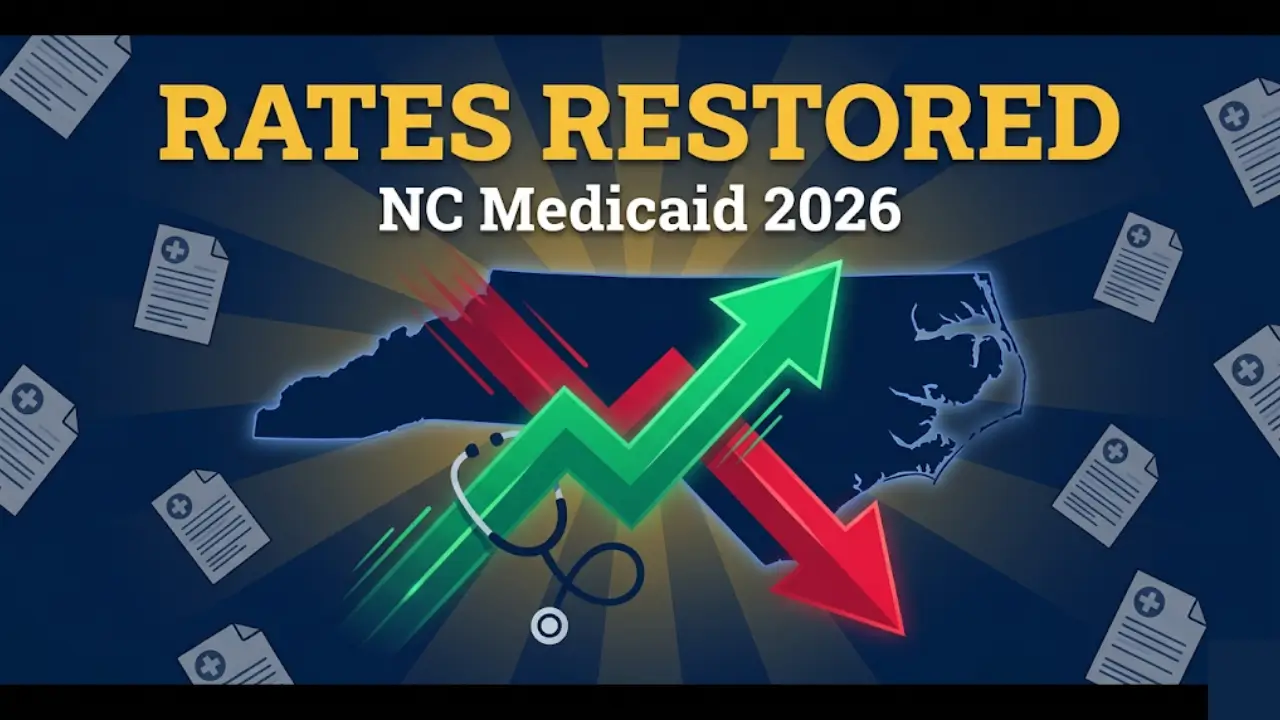
The North Carolina Medicaid fee schedule for 2026 has been fully restored to pre-cut levels. The N.C. Department of Health and Human Services (NCDHHS) reversed all rate reductions from late 2025.
This article explains exactly what changed, which services are affected, and what providers and patients need to know right now.
Quick Summary
- ✅ Rate cuts reversed: 3%–10% reductions from October 2025 are cancelled
- ✅ Effective rate: Restored to September 30, 2025 levels
- ✅ Updated fee schedules published January 5, 2026 on the NCDHHS portal
- ✅ Providers do not need to resubmit claims — plans reprocess automatically
- ✅ Patients: 2026 eligibility income limits have also been updated (see below)
- 🔗 Use our Medicaid eligibility calculator to check your 2026 coverage
What Is the Medicaid Fee Schedule?
The Medicaid fee schedule is a list of approved payment rates. It tells healthcare providers exactly how much they will be paid for each service they deliver to Medicaid patients.
In North Carolina, NCDHHS sets and publishes these rates. They apply to managed care plans and fee-for-service billing statewide.
Why Do Fee Schedules Matter?
Fee schedules directly affect provider participation. When rates are cut, some providers stop accepting Medicaid patients.
When rates are restored — as happened in North Carolina in early 2026 — providers can continue offering care without financial loss.
Who Sets North Carolina’s Fee Schedule?
NCDHHS sets the rates in accordance with federal Medicaid rules. Managed care organizations (MCOs) operating in North Carolina must then follow these rates within their contracts.
What Happened to the North Carolina Medicaid Fee Schedule in 2026?
The 2026 fee schedule story in North Carolina is really about a reversal. A set of cuts that were briefly put in place in late 2025 were cancelled and undone.
Here is the full timeline of what happened:
- October 1, 2025: NCDHHS implemented rate reductions of 3%–10% across multiple service categories.
- December 10, 2025: NCDHHS reversed those rate reductions entirely.
- January 5, 2026: Updated fee schedules reflecting the full restoration were published to the NCDHHS Fee Schedules Portal.
The bottom line for 2026: The effective reimbursement rates are the same as they were on September 30, 2025. The cuts never took permanent hold.
For a side-by-side look at how North Carolina compares to other states, see the full Medicaid fee schedule by program type for 2026.
Which Services Were Affected by the Rate Reversal?
Several major service categories saw cuts in late 2025. All of those cuts have now been reversed for 2026.
Physician Services
An 8% reduction in physician services was implemented on October 1, 2025. That reduction has been fully reversed. Rates are back to September 2025 levels.
Dental Services
A 3% reduction was applied to dental services. It has been cancelled. Providers billing for dental under North Carolina Medicaid should now receive full pre-cut rates.
Behavioral Health Services
Two separate cuts hit behavioral health. An 8% reduction applied to “overlapping physician codes.” A 3% reduction applied to other enhanced services. Both are now reversed.
Skilled Nursing Facility (SNF) Services
A 10% reduction was put in place for skilled nursing facilities. That cut has been fully reversed for 2026.
Ambulatory Surgery Services
Ambulatory surgery centers saw a 10% cut. It has been reversed. Rates are restored to September 2025 levels.
General Services (Ambulance, DME, Home Health, Dialysis)
A 3% cut was applied across ambulance, durable medical equipment (DME), home health, and dialysis services. All of those reductions are cancelled for 2026.
Here is the full summary in one place:
| Service Category | Rate Cut (Oct. 2025) | 2026 Status |
|---|---|---|
| Physician Services | –8% | ✅ Fully Restored |
| Dental Services | –3% | ✅ Fully Restored |
| Behavioral Health (Physician Codes) | –8% | ✅ Fully Restored |
| Behavioral Health (Enhanced Services) | –3% | ✅ Fully Restored |
| Skilled Nursing Facilities (SNF) | –10% | ✅ Fully Restored |
| Ambulatory Surgery Centers | –10% | ✅ Fully Restored |
| Ambulance Services | –3% | ✅ Fully Restored |
| Durable Medical Equipment (DME) | –3% | ✅ Fully Restored |
| Home Health Services | –3% | ✅ Fully Restored |
| Dialysis Services | –3% | ✅ Fully Restored |
Source: NCDHHS Fee Schedules Portal, January 5, 2026 update
2026 Operational Timeline for Providers
If you are a North Carolina Medicaid provider, here is the key timeline that affects your claims. This applies to all claims with dates of service on or after October 1, 2025.
January 5, 2026 — Updated Fee Schedules Posted
NCDHHS published the restored rates to the official NCDHHS Fee Schedules Portal. Providers can access and verify the current rates there.
February 19, 2026 — Health Plans Update Internal Systems
This was the deadline for all health plans operating in North Carolina Medicaid to update their internal billing systems with the restored rates.
March 21, 2026 — Claims Reprocessing Deadline
Health plans must reprocess all claims with dates of service on or after October 1, 2025. This means they must pay the difference between what was paid at the reduced rate and what should have been paid at the full restored rate.
Good news for providers: You do not need to resubmit these claims. Health plans are instructed to reprocess them automatically.
What If Your Claim Has Not Been Adjusted by April 2026?
If you believe a claim was paid at the reduced rate and has not been corrected, take this proactive step:
- Contact your specific health plan directly (e.g., UnitedHealthcare Community Plan Provider Portal or Blue Cross NC)
- Or call the NCTracks Call Center and request a review
Do not wait. Acting early gives you the best chance of resolving any billing discrepancy quickly.
North Carolina Medicaid Eligibility Limits 2026 (For Patient Context)
Understanding the fee schedule also means understanding who qualifies to receive care. Patient eligibility in North Carolina is based on the updated 2026 Federal Poverty Guidelines (FPG).
Providers should verify patient eligibility through NCTracks before billing.
Income Limits by Coverage Group
| Coverage Group | Income Limit | Monthly Limit (Approx.) |
|---|---|---|
| Adults (Age 19–64) | 138% FPG | ~$1,800/month (individual) |
| Adults (Family of 4) | 138% FPG | ~$3,697/month |
| Children (Age 0–18) | 216% FPG | ~$5,787/month (family of 4) |
| Pregnant Women | 201% FPG | Varies by household size |
Long-Term Care Limits (April 2026 – March 2027)
Long-term care Medicaid uses both income and asset tests.
| Limit Type | Amount |
|---|---|
| Asset Limit (Individual) | $2,000 |
| Community Spouse Resource Allowance (Maximum) | $162,660 |
These limits apply to skilled nursing facility (SNF) and home and community-based services (HCBS) under North Carolina Medicaid.
For the full income breakdown by household size, visit the dedicated North Carolina Medicaid income limits guide for 2026.
What Does North Carolina Medicaid Cover?
North Carolina Medicaid covers a wide range of essential health services. Coverage applies to all eligible enrollees, regardless of whether they are in managed care or fee-for-service.
Covered services under the 2026 fee schedule include:
- Doctor visits (primary care and specialist)
- Hospital stays (inpatient and outpatient)
- Dental care (including preventive and restorative)
- Behavioral health (mental health therapy and substance use treatment)
- Prescription drugs
- Durable medical equipment (DME)
- Home health services
- Skilled nursing facility (SNF) care
- Ambulance services
- Dialysis / kidney care
- Prenatal and maternity care
- Preventive screenings and lab work
North Carolina also offers CHIP (Health Insurance for Children) for children in families that earn too much for Medicaid but cannot afford private insurance. Learn more at healthcare.gov/medicaid-chip/.
How to Check Your Medicaid Eligibility in North Carolina
Providers need to verify that a patient is enrolled in North Carolina Medicaid before submitting a claim. Patients need to confirm their own eligibility before seeking care.
Here is how to do both:
Step 1: Go to the NC Medicaid Direct portal or NCTracks.
Step 2: Enter the patient’s Medicaid ID or personal information.
Step 3: Confirm the active coverage period and the plan type (managed care or fee-for-service).
Step 4: Verify the applicable fee schedule for the service being provided.
Step 5: Submit the claim using the correct billing code under the restored 2026 rate.
Patients who are unsure if they qualify can use our free Medicaid eligibility calculator to see if they qualify in 2026 before applying.
How to Apply for North Carolina Medicaid in 2026
If you or a family member is uninsured and needs coverage, applying is free and straightforward.
Step 1: Visit epass.nc.gov — North Carolina’s online benefits portal.
Step 2: Create an account or log in if you already have one.
Step 3: Start a new application and select Medicaid or Health Coverage.
Step 4: Enter your household size, income, and personal information.
Step 5: Submit the application and watch for a letter from NCDHHS.
You can also apply by phone, in person at your local Department of Social Services (DSS) office, or by mailing a paper application.
What Happens After You Apply?
After you submit your application, North Carolina Medicaid has up to 45 days to make a decision. For disability-based applications, the decision period extends to 90 days.
Here is what to expect:
- Within 1–2 weeks: You may receive a request for more documents (like pay stubs or proof of residency).
- Within 45 days: You will get a written notice by mail. It will say whether you are approved, denied, or if more information is needed.
- If approved: Your Medicaid card will arrive by mail. Coverage may begin retroactively to the date you applied or even earlier in some cases.
- If denied: You have the right to appeal. The notice will explain how.
Once enrolled, most North Carolina Medicaid recipients are assigned to a managed care plan. You will receive information about choosing a plan if you have not already been auto-assigned.
How North Carolina Compares to Other States
North Carolina expanded Medicaid in 2023, bringing coverage to hundreds of thousands of previously uninsured adults. The 2026 rate restoration makes North Carolina one of the stronger Medicaid payers in the Southeast.
To see how North Carolina’s income limits stack up against other states, check the full Medicaid income limits comparison across all 50 states for 2026.
Frequently Asked Questions (FAQ)
Q: What is the North Carolina Medicaid fee schedule for 2026?
A: The 2026 NC Medicaid fee schedule restores all rates to the levels in effect on September 30, 2025. Rate reductions of 3%–10% that were briefly applied starting October 1, 2025 were reversed by NCDHHS on December 10, 2025. Updated schedules were posted on January 5, 2026.
Q: Do providers need to resubmit claims from late 2025?
A: No. Providers do not need to resubmit claims. Health plans were instructed to automatically reprocess all claims with dates of service from October 1, 2025 onward. The reprocessing deadline for health plans was March 21, 2026. If your claim hasn’t been corrected, contact your health plan or NCTracks directly.
Q: Which services had their rates restored in 2026?
A: All major service categories had their cuts reversed. These include physician services (8% cut reversed), dental (3%), behavioral health (3%–8%), skilled nursing facilities (10%), ambulatory surgery (10%), and general services like ambulance, DME, home health, and dialysis (3% each).
Q: What are the Medicaid income limits in North Carolina for 2026?
A: In 2026, adults aged 19–64 qualify at 138% FPG (about $1,800/month for an individual). Children qualify at 216% FPG. Pregnant women qualify at 201% FPG. Long-term care has an asset limit of $2,000 for individuals, with a community spouse allowance up to $162,660.
Q: Does North Carolina Medicaid cover dental in 2026?
A: Yes. North Carolina Medicaid covers dental services for eligible adults and children. The 3% rate cut applied to dental providers in late 2025 has been fully reversed. Providers are now reimbursed at the pre-cut rate for all dental services billed under the 2026 fee schedule.
Q: How long does North Carolina Medicaid take to approve an application in 2026?
A: NCDHHS has up to 45 days to process a standard Medicaid application. Disability-related applications may take up to 90 days. You may be asked to provide documents like proof of income or residency. Once approved, you will receive your Medicaid card by mail.
Sources & Disclaimer
Sources:
- Medicaid.gov — Official Federal Medicaid Information
- NCDHHS Medicaid Fee Schedules Portal
- Healthcare.gov — Medicaid & CHIP Overview
Last Updated: March 2026
Disclaimer: CheckMedicaid.com is not affiliated with any government agency. This content is for educational purposes only. For official eligibility determinations, contact the NC Department of Health and Human Services or visit Medicaid.gov.