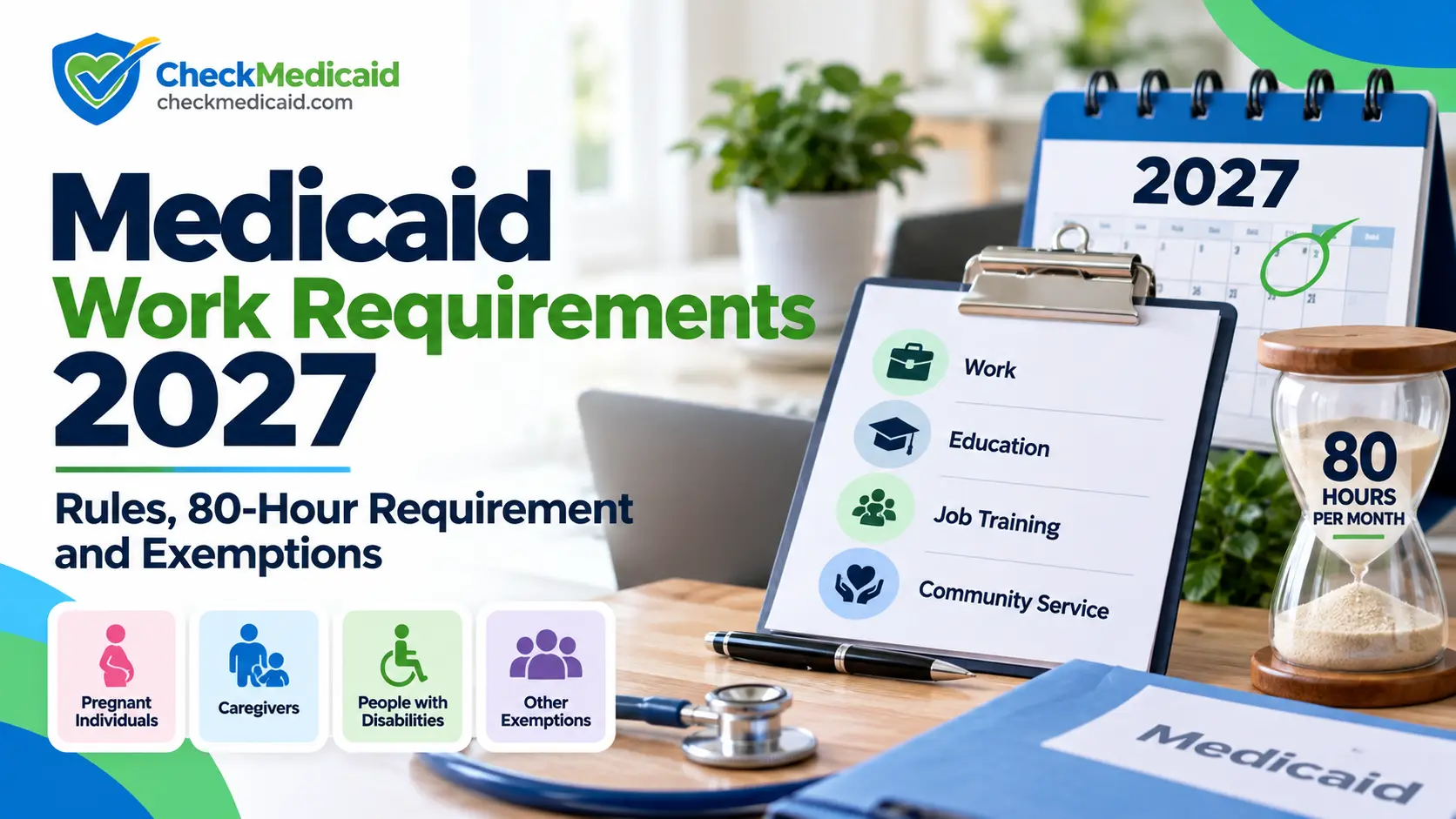
Medicaid Work Requirements 2027 will generally require certain adults ages 19–64 to complete qualifying work, education, job-training, or community-service activities for at least 80 hours per month to qualify for or maintain Medicaid coverage.
What if you qualify for Medicaid today but are unsure whether new rules could affect your coverage next year?
The important thing is to understand whether the requirement applies to your eligibility category, which activities count, and what you may need to report.
In this guide, we’ll explain the Medicaid work requirements, the 80-hour rule, qualifying activities, exemptions, implementation dates, and steps you can take to prepare for 2027.
Table of Contents
What Are Medicaid Work Requirements 2027?
Medicaid Work Requirements 2027 are federal community-engagement rules that make qualifying activities a condition of eligibility for certain adult Medicaid beneficiaries. States must generally implement them by January 1, 2027, although some may start earlier.
The requirement was established under federal legislation enacted in 2025. It does not mean every person enrolled in Medicaid must find a job or report working hours.
The rule generally targets non-pregnant adults ages 19–64 who are not entitled to or enrolled in Medicare and receive coverage through the Medicaid adult group or certain qualifying demonstration programs.
Your eligibility category matters. For a broader overview of coverage categories, visit our guide to Medicaid eligibility in 2026.
Who Must Meet the 80-Hour Medicaid Work Requirement?
Certain non-exempt adults in the affected Medicaid coverage groups must demonstrate qualifying activities each month. The requirement generally involves 80 hours per month, but the precise rules and verification process depend on federal requirements and state implementation.
You may need to check whether the rule applies to you if you:
- Are between 19 and 64 years old.
- Are not pregnant.
- Are not entitled to or enrolled in Medicare.
- Receive Medicaid through the affected adult eligibility group or a qualifying demonstration program.
- Do not qualify for an applicable exclusion, exemption, or exception.
Meeting the income rules alone may not satisfy every eligibility condition if you are subject to the new requirement.
However, being unemployed does not automatically mean you cannot qualify. Education, certain job-training programs, community service, and combinations of qualifying activities may count.
What Activities Count Toward the 80-Hour Requirement?
You may meet the monthly requirement through qualifying work or other approved activities. You can generally combine eligible activities to reach 80 hours instead of completing all the hours through one activity.
| Qualifying activity | How it may count |
| Paid employment | Hours worked in qualifying employment |
| Community service | Eligible volunteer or community-service activities |
| Job training | Participation in qualifying work or training programs |
| Education | Enrollment in an educational program at least half-time, under applicable rules |
| Combined activities | A combination of qualifying activities totaling 80 hours |
| Qualifying earnings | Monthly income of at least $580 under the 2026 calculation |
The $580 monthly income threshold comes from multiplying the federal minimum wage of $7.25 by 80 hours. Seasonal workers may qualify under a separate calculation. The dollar amount may change if the applicable federal minimum wage changes.
Keep relevant records, such as pay statements, work schedules, training records, or school enrollment documents. Ask your state Medicaid agency which forms of evidence it accepts rather than assuming every document will be sufficient.
Who Is Exempt From Medicaid Work Requirements 2027?
Several groups are excluded from the federal requirement or may qualify for an exemption. The exact circumstances and documentation rules matter, so do not assume that a medical condition or family responsibility automatically establishes an exemption.
Potentially exempt groups include:
- Pregnant and eligible postpartum individuals, under the applicable rules.
- Medically frail individuals or people with qualifying special medical needs.
- Parents, caretakers, or family caregivers caring for a dependent child age 13 or younger or a person with a disability.
- American Indians and Alaska Natives covered by the applicable statutory provisions.
- Certain veterans with a total disability rating.
- Former foster care youth who meet the relevant criteria.
- Certain people participating in qualifying substance-use treatment programs.
- Certain individuals who meet applicable SNAP or TANF work-requirement provisions.
The medically frail exemption requires particular attention: a diagnosis alone may not establish eligibility under the applicable federal standards. The person’s condition and its impact on their ability to meet the requirement may be relevant.
For a more detailed breakdown of categories and potential proof, read our dedicated guide to Medicaid work requirement exemptions.
When Do Medicaid Work Requirements Start?
The federal implementation deadline is January 1, 2027, but a state may choose an earlier start date where permitted. That means the date and process you need to follow can depend on where you live.
Before assuming that the rule has already started—or that you have until January 2027- check your state’s official Medicaid announcements.
You can also review your state’s financial eligibility rules in our Medicaid income limits by state guide. Remember that income eligibility and the community-engagement requirement are separate questions.
What Happens If You Do Not Meet the Requirement?
Failing to meet the requirement may affect eligibility for someone who is subject to it and does not qualify for an exemption or exception. However, a missed month does not mean every Medicaid beneficiary automatically loses coverage.
If you receive a notice:
- Read the deadline and instructions carefully.
- Contact your state Medicaid agency if you do not understand what is being requested.
- Submit the requested evidence using the method specified in the notice.
- Explain any qualifying exemption or change in circumstances.
- Keep copies of submitted documents and confirmation records.
If your coverage is later terminated, ask the agency about your options, including whether you can appeal or reapply. Do not ignore notices or assume that your existing coverage will continue without further action.
How Can You Prepare for Medicaid Work Requirements in 2027?
You can take practical steps now without assuming that the new rule applies to you.
- Check your coverage category: Confirm how you qualify for Medicaid and whether it falls within the affected group.
- Review official notices: Keep your mailing address, phone number, and other contact details current.
- Understand qualifying activities: Ask which work, education, training, or service activities your state recognizes.
- Keep useful records: Save pay statements, school records, training documentation, or other relevant evidence.
- Check potential exemptions: If you believe you are exempt, ask how the state determines and records that status.
- Monitor renewal instructions: The requirement may be reviewed when your eligibility is renewed, depending on the applicable rules.
For official federal guidance, use the Medicaid.gov community engagement requirements page. Your state Medicaid agency remains the best source for your personal status, state-specific dates, and reporting instructions.
Check Your Medicaid Status Before the Rules Change
The new Medicaid work requirements will not affect every Medicaid beneficiary in the same way. Your coverage category, qualifying activities, exemption status, and state’s implementation process all matter.
Do not wait until a renewal notice arrives to understand your situation. Check your eligibility category, keep your contact information updated, and review official instructions before submitting any required information.
Visit CheckMedicaid to explore our eligibility and income-limit guides, then confirm your personal requirements with your state Medicaid agency. Getting accurate information early can help you prepare and respond to notices on time.
Disclaimer: This article provides general educational information, not a determination of Medicaid eligibility or legal advice. Federal rules, state implementation dates, and individual circumstances may affect how the requirement applies to you. Verify current instructions with your state Medicaid agency.
Frequently Asked Questions
1. When do Medicaid work requirements begin in 2027?
States must generally implement the federal community-engagement requirement by January 1, 2027. A state may implement it earlier where permitted, so check your state’s official guidance.
2. How many hours do you need to work to keep Medicaid?
If the requirement applies to you, the general standard is 80 hours per month of qualifying activities. Certain education, training, community service, and combinations of activities may count. Qualifying earnings can also satisfy the rule.
3. Can you keep Medicaid if you are unemployed?
Potentially, yes. Unemployment alone does not determine whether you qualify. Eligible education, job training, community service, qualifying earnings, or an applicable exemption may satisfy the relevant rules.
4. Who is exempt from Medicaid work requirements?
Potential exemptions or exclusions include certain pregnant or postpartum individuals, medically frail people, qualifying caregivers, American Indians and Alaska Natives covered by the law, certain disabled veterans, and other specified groups. You must meet the applicable criteria.
5. What happens if you cannot prove your Medicaid work hours?
If the state cannot verify compliance or an applicable exemption, it must issue a notice giving you 30 calendar days to demonstrate compliance or show that the requirement does not apply. Follow the notice carefully and contact your state agency if you need help.