Written & Reviewed by Akash Biswas, MSW | Former Medicaid Caseworker Trainer | Verified against official Medicaid.gov, KFF, and state agency guidelines | Last Updated: March 2026
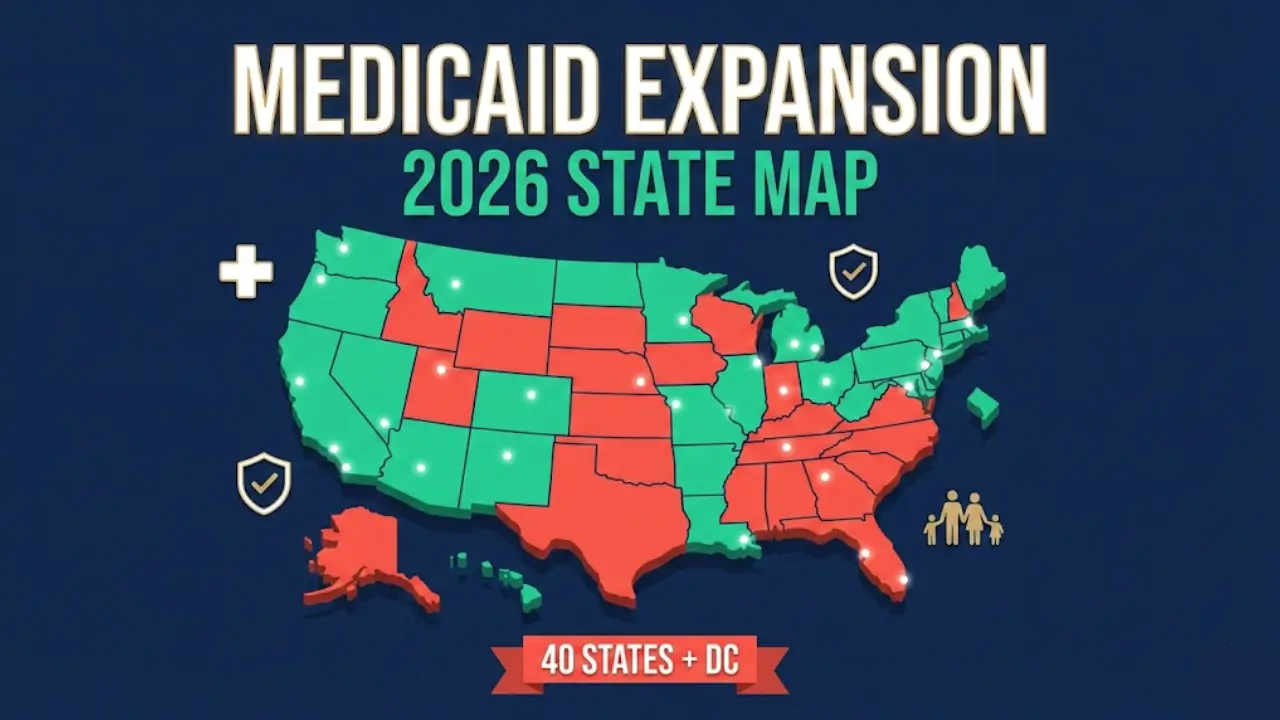
As of March 2026, 40 states and Washington, D.C. have expanded Medicaid under the Affordable Care Act (ACA).
Ten states have not expanded. No new states joined the expansion list during the first quarter of 2026.
If you live in an expansion state, you may qualify for Medicaid if your income is at or below 138% of the Federal Poverty Level (FPL).
That equals about $22,025 per year for a single adult in 2026.
This guide gives you the full list of expansion and non-expansion states, updated income limits, and what to do next.
Quick Summary:
- 40 states + DC have expanded Medicaid as of 2026
- 10 states have not expanded — about 1.4 million people fall into a coverage gap
- Adults in expansion states may qualify with income up to 138% FPL
- The 2026 FPL for one person is $15,960 per year (48 contiguous states)
- New federal work requirements take effect January 1, 2027
- Check the Medicaid income limits by state in 2026 to see if you qualify
What Is Medicaid Expansion?
Medicaid expansion is a key part of the Affordable Care Act (ACA). It allows states to cover more low-income adults through Medicaid.
Before expansion, most states only covered very specific groups — like children, pregnant women, and people with disabilities.
How Expansion Changed Eligibility
Under the ACA, states can now offer Medicaid to nearly all adults aged 19 to 64. The income limit is 138% of the Federal Poverty Level.
This includes adults without children, who were mostly left out before expansion.
The Supreme Court Made It Optional
The ACA originally required all states to expand. But in 2012, the U.S. Supreme Court ruled that expansion must be voluntary.
Since then, states have chosen whether or not to participate. This created a patchwork of coverage across the country.
How Expansion Is Funded
The federal government pays 90% of the cost for the Medicaid expansion population. States pay the remaining 10%.
Before 2017, the federal share was even higher — up to 100%. A temporary bonus offered under the American Rescue Plan (ARP) for new expansion states was eliminated starting in 2026 under the budget reconciliation law signed July 4, 2025.
Full List of Medicaid Expansion States in 2026
As of January 1, 2026, these 40 states and Washington, D.C. offer Medicaid to adults with income up to 138% of the Federal Poverty Level.
North Carolina, which launched full expansion in December 2023, remains the most recent state to implement the program.
Northeast (9 States)
| State | Expansion Status |
|---|---|
| Connecticut | Expanded |
| Maine | Expanded |
| Massachusetts | Expanded |
| New Hampshire | Expanded |
| New Jersey | Expanded |
| New York | Expanded |
| Pennsylvania | Expanded |
| Rhode Island | Expanded |
| Vermont | Expanded |
Midwest (10 States)
| State | Expansion Status |
|---|---|
| Illinois | Expanded |
| Indiana | Expanded |
| Iowa | Expanded |
| Michigan | Expanded |
| Minnesota | Expanded |
| Missouri | Expanded |
| Nebraska | Expanded |
| North Dakota | Expanded |
| Ohio | Expanded |
| South Dakota | Expanded |
South (10 States + DC)
| State | Expansion Status |
|---|---|
| Arkansas | Expanded |
| Delaware | Expanded |
| Kentucky | Expanded |
| Louisiana | Expanded |
| Maryland | Expanded |
| North Carolina | Expanded |
| Oklahoma | Expanded |
| Virginia | Expanded |
| West Virginia | Expanded |
| Washington, D.C. | Expanded |
West (12 States)
| State | Expansion Status |
|---|---|
| Alaska | Expanded |
| Arizona | Expanded |
| California | Expanded |
| Colorado | Expanded |
| Hawaii | Expanded |
| Idaho | Expanded |
| Montana | Expanded |
| Nevada | Expanded |
| New Mexico | Expanded |
| Oregon | Expanded |
| Utah | Expanded |
| Washington | Expanded |
The 10 Non-Expansion States in 2026
Ten states have not adopted full Medicaid expansion as of March 2026. Residents in these states who earn below 100% of the Federal Poverty Level may fall into a “coverage gap.”
This means they earn too much for Medicaid but too little for Marketplace subsidies.
Non-Expansion States: 2026 Status at a Glance
| State | 2026 Status |
|---|---|
| Texas | Non-expansion. Leads the nation in uninsured residents in the coverage gap. |
| Florida | Non-expansion. A ballot initiative to force expansion has been pushed back to 2028. |
| Georgia | Partial expansion only. The “Pathways to Coverage” program (with work requirements) was extended through December 2026, but this is not full ACA expansion. |
| Mississippi | Active debate. HB 114 (introduced January 2026) proposes expansion with work requirements, but it has not passed into law. |
| Kansas | Active bill. HB 2600 (introduced January 2026) proposes expansion starting January 1, 2027 — no change for 2026. |
| Wisconsin | Partial coverage. Covers adults up to 100% FPL but has not accepted federal expansion funds to cover up to 138%. |
| Tennessee | Non-expansion. Uses a modified block grant waiver instead. |
| Alabama | No active legislation moved forward in Q1 2026. |
| South Carolina | Remains non-expansion with no confirmed 2026 changes. |
| Wyoming | Legislative opposition continues in the 2026 session despite budget proposals. |
What Is the Coverage Gap?
The coverage gap affects people in non-expansion states. Their income is too high for traditional Medicaid in their state.
But it is below 100% FPL, so they also cannot get Marketplace premium tax credits.
An estimated 1.4 million uninsured adults are stuck in this gap. About 97% of them live in the South. Texas alone accounts for roughly 42% of all people in the coverage gap.
To understand how income limits work for your state, review the Medicaid eligibility requirements for 2026.
Medicaid Income Limits for Expansion States in 2026
In expansion states, adults qualify for Medicaid if their Modified Adjusted Gross Income (MAGI) falls at or below 138% of the Federal Poverty Level.
The 2026 FPL figures were published by the U.S. Department of Health and Human Services on January 13, 2026.
2026 Income Limits by Household Size (48 Contiguous States + DC)
| Household Size | 100% FPL (Annual) | 138% FPL (Annual) | 138% FPL (Monthly) |
|---|---|---|---|
| 1 | $15,960 | $22,025 | $1,835 |
| 2 | $21,640 | $29,863 | $2,489 |
| 3 | $27,320 | $37,702 | $3,142 |
| 4 | $33,000 | $45,540 | $3,795 |
| 5 | $38,680 | $53,378 | $4,448 |
| 6 | $44,360 | $61,217 | $5,101 |
| 7 | $50,040 | $69,055 | $5,755 |
| 8 | $55,720 | $76,894 | $6,408 |
For each additional person, add $5,680 (100% FPL) or $7,838 (138% FPL).
Source: 2026 Federal Poverty Guidelines — U.S. Department of Health and Human Services, ASPE.
Alaska and Hawaii
Alaska and Hawaii have higher FPL amounts due to higher living costs. In 2026, the 100% FPL for a single person is $19,950 in Alaska and $18,360 in Hawaii. This means the 138% income limit is also higher in those states.
What Counts as Income?
Medicaid uses MAGI — Modified Adjusted Gross Income — to check your eligibility. MAGI includes wages, salary, self-employment income, Social Security benefits (taxable portion), and some other income types.
It does not include Supplemental Security Income (SSI) or certain non-taxable income. Visit the Medicaid Fee Schedule 2026 to learn about covered services and reimbursement rates in your state.
Key 2026 Developments to Watch
Several important changes and debates are shaping Medicaid expansion in 2026. Here is what you need to know about the biggest updates this year.
Georgia: The “Pathways to Coverage” Extension
Georgia runs a partial expansion program called “Pathways to Coverage.” It is not full ACA expansion.
The program requires 80 hours per month of work or qualifying activity.
In late 2025, federal regulators approved an extension through December 31, 2026. Enrollment remains very low — roughly 4,300 to 11,600 people enrolled versus an estimated 300,000 to 450,000 who would be eligible under full expansion.
Mississippi: The 2026 Legislative Push
Mississippi is the main state where expansion is actively debated in 2026. The Mississippi Health Care Security and Promotion Act of 2026 (HB 114) was filed in January.
It seeks federal waivers for expansion with work requirements. As of March 2026, this remains a legislative proposal. It has not been signed into law.
Kansas: Expansion Proposed for 2027
Kansas has an active bill — HB 2600 — introduced in January 2026. It proposes Medicaid expansion starting January 1, 2027.
Governor Laura Kelly appeared to step back from her push for expansion in her latest budget proposal. No change takes effect for 2026.
Idaho: Voter-Approved Expansion Stays
In late 2025, a panel of Idaho state lawmakers suggested repealing the state’s voter-approved Medicaid expansion.
Governor Brad Little said he is not in favor of pulling back the program. Idaho remains a full expansion state in 2026.
Federal Work Requirements Coming in 2027
The budget reconciliation law signed on July 4, 2025 (the “One Big Beautiful Bill Act”) introduces mandatory work requirements for Medicaid expansion enrollees.
These take effect January 1, 2027. Adults aged 19 to 64 must complete at least 80 hours per month of work, job training, education, or community service.
Exemptions apply for pregnant individuals, people with disabilities, caregivers of children under age 13, full-time students, and others.
HHS must issue interim guidance by June 2026. Nebraska has announced it will begin enforcing work requirements early, starting May 1, 2026.
ARP Bonus Funding Eliminated
The American Rescue Plan once offered a temporary two-year bonus in federal matching funds for states that newly expanded Medicaid.
That bonus was eliminated starting in 2026 under the reconciliation law.
States that expand now will still receive the standard 90% federal match, but without the extra incentive.
What Does Medicaid Cover?
Medicaid offers a wide range of health benefits. Coverage can vary by state, but all expansion states must cover a minimum set of services.
Here is a general overview of what Medicaid covers in most states.
Core Benefits
- Doctor visits and primary care
- Hospital stays (inpatient and outpatient)
- Lab tests, X-rays, and imaging
- Prescription drugs
- Mental health and substance use treatment
- Preventive care and screenings
- Maternity and newborn care
- Emergency services
Additional Benefits (Vary by State)
Some states also cover dental care, vision care, hearing aids, physical therapy, home health services, and transportation to medical appointments.
Coverage depends on your state’s Medicaid plan. Some states use managed care organizations (MCOs) to deliver benefits. Others use fee-for-service models.
How to Apply for Medicaid in 2026
You can apply for Medicaid at any time. There is no open enrollment period. If you qualify, your coverage can start right away. Here are the steps to get started.
Step 1: Check Your Eligibility
Look up your state’s income limits. In expansion states, you likely qualify if your household income is at or below 138% FPL. Use the income table above or visit your state Medicaid agency website.
Step 2: Gather Your Documents
You will need proof of income (pay stubs or tax return), proof of identity (driver’s license or state ID), Social Security number, proof of citizenship or immigration status, and proof of residency.
Step 3: Submit Your Application
You can apply online through your state Medicaid portal, by phone, by mail, or in person at a local Medicaid office. You can also apply through HealthCare.gov if your state uses the federal marketplace.
Step 4: Complete Any Follow-Up
Your state may ask for more documents. Respond quickly to avoid delays. Most states process applications within 30 to 45 days.
What Happens After You Apply?
After you submit your application, your state Medicaid agency reviews it. The eligibility determination process usually takes 30 to 45 days. Some states process faster.
Approval and Enrollment
If approved, you will receive a Medicaid card or member ID. Your coverage start date depends on your state. Some states backdate coverage to the first day of the month you applied. Others start coverage on the approval date.
If You Are Denied
If denied, you have the right to appeal. Your denial notice will explain why and how to file an appeal. You may also want to re-check your application for errors or contact a local Medicaid office for help.
Renewals
Most states require you to renew Medicaid once per year. You will get a renewal notice by mail or online. Always respond before the deadline. Starting in 2027, expansion enrollees will also need to verify work activity every six months due to the new federal work requirements.
FAQ
Q: How many states have expanded Medicaid in 2026? A
As of March 2026, 40 states plus Washington, D.C. have expanded Medicaid under the ACA. Ten states have not expanded. No new states joined the expansion list in Q1 2026. North Carolina was the last state to implement expansion in December 2023.
Q: What is the Medicaid income limit for a single person in 2026?
A: In expansion states, a single adult can qualify with annual income up to about $22,025. That is 138% of the 2026 Federal Poverty Level. In non-expansion states, limits are much lower and vary by state. Check the Medicaid income limits by state in 2026 for details.
Q: What is the Medicaid coverage gap?
A: The coverage gap affects people in non-expansion states. They earn too much for traditional Medicaid but too little for Marketplace subsidies. About 1.4 million uninsured adults fall into this gap. Most live in Southern states like Texas, Florida, and Georgia.
Q: Will Medicaid have work requirements in 2026?
A: Federal law now requires work requirements for Medicaid expansion enrollees starting January 1, 2027. Adults ages 19 to 64 must complete 80 hours per month of work, education, or community service. Several exemptions apply. Nebraska plans to enforce requirements early, starting May 2026.
Q: Does Georgia have full Medicaid expansion?
A: No. Georgia runs a partial expansion program called “Pathways to Coverage.” It requires 80 hours of work activity per month. Enrollment is far below what full expansion would cover. The program was extended through December 2026 but does not count as full ACA expansion.
Q: Can I apply for Medicaid at any time?
A: Yes. Medicaid has no open enrollment period. You can apply any day of the year. If you qualify, coverage can begin right away. Apply through your state Medicaid agency website, by phone, or through HealthCare.gov.
Sources & Disclaimer
Last Updated: March 2026
Sources:
- Medicaid.gov — Official Federal Medicaid Site
- KFF — Status of State Medicaid Expansion Decisions (Feb 2026)
- HealthCare.gov — Medicaid Expansion & You
- ASPE — 2026 Federal Poverty Guidelines
- HealthInsurance.org — State-by-State Medicaid Expansion Guide
- KFF — Tracking Implementation of 2025 Reconciliation Law: Medicaid Work Requirements
Disclaimer: CheckMedicaid.com is not affiliated with any government agency. This content is for educational purposes only. For official eligibility, contact your state Medicaid office or visit Medicaid.gov.