Written & Reviewed by Akash Biswas, MSW | Former Medicaid Caseworker Trainer | Verified against KMAP, KanCare, and Medicaid.gov official guidelines | Last Updated: March 2026
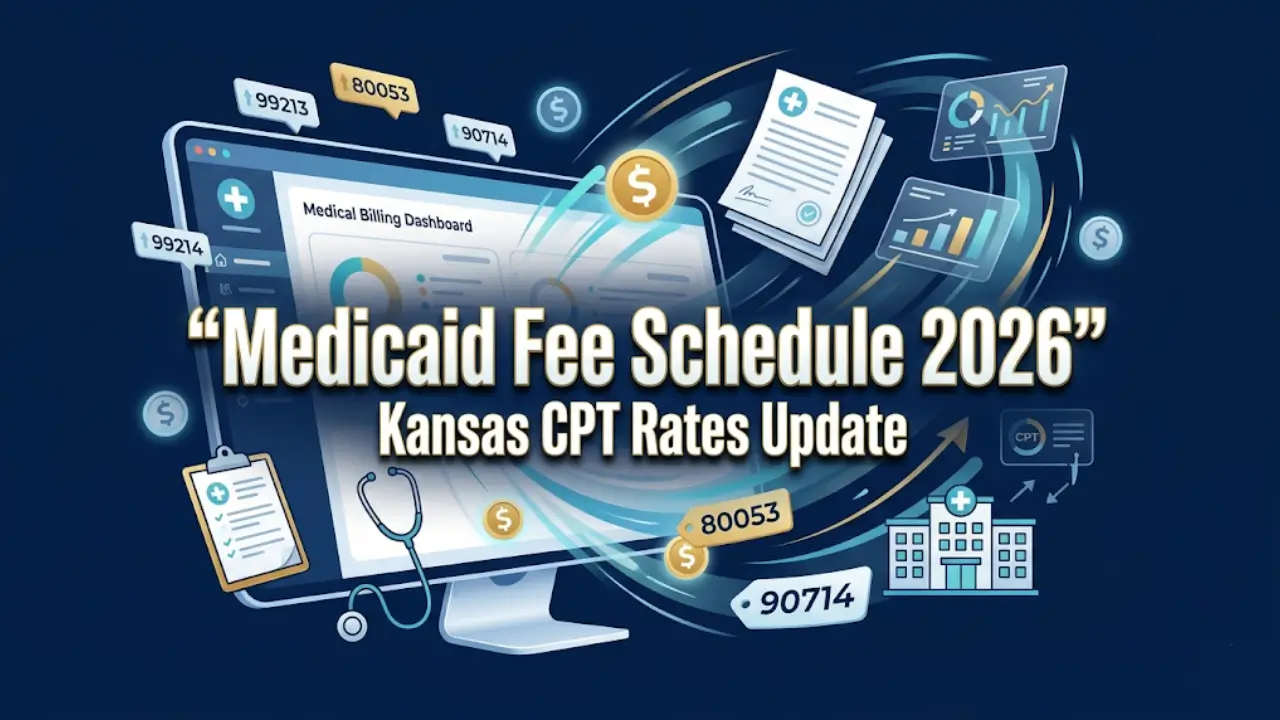
The Kansas Medicaid fee schedule is the official list of payment rates for medical services covered under Kansas Medicaid, also called KanCare.
It tells healthcare providers exactly how much they will be paid for each service they provide to Medicaid members.
This guide explains how the fee schedule works, who sets the rates, and what it means for both patients and providers in Kansas.
Quick Summary:
- Kansas Medicaid is managed through the Kansas Medical Assistance Program (KMAP), administered by KDHE
- Fee schedules are published on the KMAP public portal at portal.kmap-state-ks.us
- Kansas uses a managed care model — three MCOs (Healthy Blue, Sunflower Health Plan, and UnitedHealthcare) deliver most services
- Rates are set using CPT and HCPCS codes, and Kansas rates are generally at or below Medicare rates
- Rates are updated annually or more often — key updates happen each July 1 (start of the state fiscal year)
- To check if you qualify for KanCare, use the Medicaid Eligibility Calculator 2026 for a quick, free estimate
What Is the Kansas Medicaid Fee Schedule?
The Kansas Medicaid fee schedule is a pricing guide used by the state to pay healthcare providers.
It lists a set dollar amount — called a reimbursement rate — for each covered medical service.
Each service is identified by a billing code. There are two main types:
CPT Codes (Current Procedural Terminology)
CPT codes are used to describe medical procedures and services. They are maintained by the American Medical Association (AMA).
Examples include codes for doctor visits, lab tests, surgery, and therapy sessions.
These are the most common codes used by physicians and clinics.
HCPCS Codes (Healthcare Common Procedure Coding System)
HCPCS codes are managed by the Centers for Medicare & Medicaid Services (CMS). HCPCS Level I is identical to CPT codes.
HCPCS Level II covers medical supplies, equipment, and non-physician services — like wheelchairs, prosthetics, and home health items.
Kansas Medicaid uses both levels in its fee schedules.
How Rates Are Set
Kansas sets its Medicaid fee schedule based on Medicare rates as a benchmark.
Under federal law (42 CFR 447.204), rates must be high enough to give Medicaid members access to care at least equal to the general public.
According to official Medicaid.gov documentation, the Kansas Medicaid fee schedule rate must be equal to or less than the maximum allowable Medicare rate for the same service.
If a service has no Medicare rate, Kansas sets a rate based on similar services.
How the Kansas Medicaid Fee Schedule Works in 2026
Kansas delivers Medicaid through a managed care system called KanCare. Understanding how this works will help both patients and providers know what to expect.
KanCare launched its updated 3.0 contract structure on January 1, 2025, bringing in three Managed Care Organizations (MCOs): Healthy Blue, Sunflower Health Plan, and UnitedHealthcare Community Plan of Kansas.
The Role of KMAP
The Kansas Medical Assistance Program (KMAP) is the state’s official Medicaid billing and claims system.
It is managed by Gainwell Technologies on behalf of the Kansas Department of Health and Environment (KDHE).
The KMAP public portal at portal.kmap-state-ks.us is where providers can:
- Look up fee schedules by CPT or HCPCS code
- Access provider manuals and bulletins
- Submit and track claims
- Check pricing and limitations
All official fee schedule lookups begin at the KMAP portal. Providers must accept the Reference Copyright Notice before viewing rate information.
The Role of KanCare MCOs
Each MCO — Healthy Blue, Sunflower, and UnitedHealthcare — is paid a monthly capitation rate by KDHE per enrolled member.
The MCOs then pay individual providers using their own contracted rates.
However, Kansas law requires that KanCare MCOs must pay at least 100% of the current fee-for-service Medicaid rate to all contracted in-network providers.
Out-of-network providers receive 90% of the fee-for-service rate.
Fee-for-Service vs. Managed Care
Some Kansas Medicaid members receive services through fee-for-service (FFS), where providers bill KMAP directly.
Most members, however, are enrolled in a KanCare MCO. In FFS, KMAP pays providers directly using the published fee schedule.
In managed care, MCOs pay providers — but must meet the state’s minimum floor rate.
Kansas Medicaid Fee Schedule by Service Type (2026)
Kansas publishes separate fee schedules for different types of services. Here is an overview of the key service categories and what you need to know about each in 2026.
Physician and Evaluation & Management (E&M) Services
These cover office visits, consultations, and related services. Kansas conducted a formal Medicaid Rate Study comparing its E&M rates to Medicare and four peer states (Colorado, Iowa, Missouri, and Nebraska).
The results — publicly posted on the KanCare website — show how Kansas compares.
Kansas rates for E&M services are generally set below Medicare rates. Providers use CPT codes in the 99200–99499 range for these services.
| Service Type | Billing System | Rate Basis |
|---|---|---|
| Office Visit (new patient) | CPT (E&M codes) | % of Medicare rate |
| Office Visit (established) | CPT (E&M codes) | % of Medicare rate |
| Preventive Care / Wellness | CPT codes | State-set rate |
| Telehealth Visits | CPT + modifier | Same or similar to in-person |
Dental Services
Kansas updated its dental fee schedule effective July 1, 2022, and the rates remain in effect.
The 2026 Dental Rate Increase was announced by KanCare MCOs as of July 11, 2025 for fiscal year 2026 (starting July 1, 2025).
Kansas uses CDT (dental procedure codes) for dental billing. Both government and private dental providers receive the same state-published rate.
Adult dental benefits were recently expanded, which is also reflected in ongoing rate adjustments.
Home & Community Based Services (HCBS)
HCBS rates were updated for fiscal year 2026 beginning July 1, 2025. These services support seniors and people with disabilities who want to live in their homes instead of a nursing facility.
Examples include personal care, homemaker services, adult day care, and supported employment. HCBS rates are also subject to MCO “managed care floor” minimums.
Behavioral Health Services
Behavioral health includes mental health treatment and substance use disorder services.
Kansas uses specific billing codes for community mental health centers (CMHCs) and Certified Community Behavioral Health Clinics (CCBHCs).
KanCare members pay no copays for covered mental health services.
The anesthesia conversion factor for procedures is updated each calendar year — for 2025, this was updated via KMAP bulletin and carries into 2026 services.
Radiology Services
Radiology codes (CPT codes 70020–79999) were included in the Kansas Medicaid Rate Study.
This covers diagnostic imaging, ultrasound, mammography, nuclear medicine, and radiation oncology.
Kansas compared its radiology rates against peer states and Medicare, with findings published on the KanCare website.
Durable Medical Equipment (DME)
DME is billed using HCPCS Level II codes. Kansas updates DME rates annually.
The most recent annual DME rate adjustment aligned with Medicare fee schedule updates for fiscal year 2025, and similar annual updates apply for FY2026.
Pharmacy / Physician Administered Drugs (PADs)
Drug reimbursement rates for physician-administered drugs are updated periodically, including a significant update effective January 1, 2024.
Providers check current PAD rates in the KMAP portal under “Reference Codes — Search by Procedure.” High-Dollar Rare Disease (HDRD) drugs have separate billing guidance through each MCO.
Kansas Medicaid Fee Schedule: Key 2026 Rate Updates
Here is a summary of the most important Kansas Medicaid rate changes affecting fiscal year 2026 (July 1, 2025 – June 30, 2026):
| Update | Effective Date | Source |
|---|---|---|
| HCBS Rate Increase (FY2026) | July 1, 2025 | KMAP Bulletin |
| Dental Rate Increase (FY2026) | July 1, 2025 | KMAP Bulletin |
| HCBS I/DD Waiver — Billing & Rate Updates | July 11, 2025 | KanCare MCO Bulletins |
| HCBS Assistive Services Rate Update | July 23, 2025 | KMAP Bulletin |
| MCO Pharmacy Billing Code Update | January 2026 | KDHE |
| Anesthesia Conversion Factor Update | January 2025 / ongoing | KMAP |
Providers should always check the KMAP public portal for the most current rates, as updates may occur mid-year via official bulletins.
How Kansas Medicaid Rates Compare to Medicare
Medicaid typically pays 30–40% less than Medicare nationally. Kansas is no exception. The state formally measured this gap through its Medicaid Rate Study, comparing rates to Medicare and four neighboring states.
Key findings from the Kansas Medicaid Rate Study (published 2024–2025):
- Dental codes were the first category published; adult dental rate increases followed
- E&M codes and radiology codes have also been studied and published
- Additional service categories are being posted in phases on the KanCare website
You can review the official Kansas Medicaid Rate Study at kancare.ks.gov/data-policy/data-reports/kansas-medicaid-rate-study.
Starting July 1, 2026, new federal transparency rules require all states — including Kansas — to post Medicaid fee schedules online, update them within one month of approval, and clearly compare rates to Medicare.
This is designed to make payment information more accessible for both providers and the public. For a broader look at how Kansas rates compare nationally, see our guide on the Medicaid Fee Schedule 2026 for all states.
Who Qualifies for Kansas Medicaid (KanCare) in 2026?
The fee schedule only matters if you are enrolled in KanCare. Here is a quick overview of who qualifies.
Kansas has not expanded Medicaid under the ACA, meaning most low-income adults without children or disabilities do not qualify.
| Group | Income Limit (FPL) |
|---|---|
| Children (birth to age 1) | Up to 166% FPL |
| Children (ages 1–5) | Up to 149% FPL |
| Children (ages 6–18) | Up to 133% FPL |
| CHIP (children not eligible for Medicaid) | Up to 227% FPL |
| Pregnant Women | Up to 166% FPL |
| Parents / Caretakers of children | Up to 38% FPL |
| Aged, Blind, or Disabled (single) | Up to $994/month income |
| Nursing Home (single) | Assets under $2,000 |
Income limits based on 2026 Federal Poverty Level. Source: KDHE / KanCare official eligibility guidelines.
For a detailed breakdown of income thresholds by household size, read our full guide on Kansas Medicaid Income Limits 2026.
To see how Kansas compares to other states and find limits in your area, visit our resource on Medicaid income limits by state 2026.
How to Access the Kansas Medicaid Fee Schedule
Providers and the public can access the official Kansas Medicaid fee schedule through these steps:
- Go to the KMAP public portal: Visit portal.kmap-state-ks.us
- Click on the “Provider” tab at the top of the page
- Select “Interactive Tools” from the menu
- Click “Provider Pricing” then “Fee Schedules”
- Accept the Reference Copyright Notice — scroll to the bottom and click “Accept”
- Search by CPT/HCPCS code, procedure, or schedule list to find specific rates
You can also search by specific procedure code under “Reference Codes — Search by Procedure” in the Provider Secure Portal to verify current rates, prior authorization requirements, and billing limitations.
What Happens After You Apply for KanCare?
Once your KanCare application is approved, you will receive a Medicaid card and be assigned to one of the three MCOs. Here is what to expect:
- Coverage start date: Usually begins the month you apply. In some cases, coverage can go back up to three months before your application date.
- MCO assignment: You may choose Healthy Blue, Sunflower Health Plan, or UnitedHealthcare. If you do not choose, one will be assigned to you.
- No-cost care: KanCare members pay no copays for most covered services, including mental health.
- Annual renewal: You must renew your coverage each year. Keep your address updated at kancare.ks.gov or call 1-800-792-4884.
- Provider selection: Use the provider directory on your MCO’s website to find doctors, dentists, and specialists who accept KanCare.
Applications can be submitted online at kanaccess.ks.gov, by phone at 1-800-792-4884, or by mail to KanCare Clearinghouse, P.O. Box 3599, Topeka, KS 66601-9738.
FAQ: Kansas Medicaid Fee Schedule 2026
Q: Where can I find the official Kansas Medicaid fee schedule for 2026?
A: The official Kansas Medicaid fee schedule is published on the KMAP public portal at portal.kmap-state-ks.us. Go to the Provider tab, select Interactive Tools, then Provider Pricing, and click Fee Schedules. You must accept the Reference Copyright Notice to view the rates. Always check the portal for the most current updates.
Q: How often are Kansas Medicaid rates updated?
A: Kansas Medicaid rates are updated at least once a year, typically at the start of the state fiscal year on July 1. Some categories — like pharmacy drugs and DME — may be updated more frequently throughout the year via official KMAP bulletins. Always verify the current effective date when checking any specific rate.
Q: Do KanCare MCOs have to follow the state fee schedule?
A: Yes, KanCare managed care organizations must pay at least 100% of the current state fee-for-service Medicaid rate to all contracted in-network providers. Out-of-network providers receive 90% of the fee-for-service rate. MCOs may negotiate higher rates with providers, but cannot pay below the state minimum floor.
Q: Are Kansas Medicaid rates the same as Medicare rates?
A: No. Kansas Medicaid rates are generally lower than Medicare rates. Kansas conducted a formal Medicaid Rate Study comparing its rates to Medicare and four peer states. Nationally, Medicaid pays roughly 30–40% less than Medicare. Kansas publishes rate study results at kancare.ks.gov.
Q: Does Kansas Medicaid cover dental in 2026?
A: Yes. Kansas Medicaid covers dental services for children through EPSDT. Adult dental benefits have been expanded in recent years, and a dental rate increase took effect July 1, 2025 for fiscal year 2026. Check with your KanCare MCO for the specific dental services covered under your plan.
Q: What is the difference between fee-for-service Medicaid and KanCare managed care in Kansas?
A: In fee-for-service, providers bill KMAP directly and are paid according to the published fee schedule. In KanCare managed care, the state pays MCOs a monthly capitation rate, and MCOs pay providers from that budget. Most Kansas Medicaid members are enrolled in KanCare managed care through one of the three MCOs.
Sources & Disclaimer
Sources:
- Kansas Medical Assistance Program (KMAP) Public Portal: portal.kmap-state-ks.us
- KanCare — Kansas Medicaid Program: kancare.ks.gov
- Kansas Medicaid Rate Study: kancare.ks.gov/data-policy/data-reports/kansas-medicaid-rate-study
- Medicaid.gov — Federal Medicaid Information: medicaid.gov
- Kansas Department of Health and Environment (KDHE): kdhe.ks.gov
- Healthcare.gov — ACA & Medicaid Overview: healthcare.gov/medicaid-chip
- Medicaid.gov Kansas State Plan Amendment KS-22-0024
Last Updated: March 2026
Disclaimer: CheckMedicaid.com is not affiliated with any government agency. This content is for educational purposes only. For official eligibility and rate information, contact the Kansas Department of Health and Environment (KDHE), visit the KMAP public portal, or call KanCare at 1-800-792-4884.