
Applying for Medicaid in California, known as Medi-Cal, often feels more complicated than it should.
Many applicants assume it’s just an online form, only to run into requests for documents, long processing times, or confusing notices they don’t fully understand.
What’s really happening is this: Medi-Cal is a large eligibility system run jointly by the federal government and the State of California.
Your application moves through automated checks, county-level reviews, and verification rules that most people are never told about.
What Medi-Cal Is and Why the Application Process Matters
Medi-Cal is California’s Medicaid program, providing free or low-cost health coverage to millions of residents.
It covers doctor visits, hospital care, prescriptions, mental health services, maternity care, and long-term services for eligible individuals.
What makes Medi-Cal different from many programs is scale and decentralization. While federal Medicaid rules apply, California counties handle application processing and case management.
This means your experience can vary depending on where and how you apply.
The application process matters because Medi-Cal eligibility is often determined by small details: monthly income timing, household structure, or how documents are submitted.
Understanding these details helps you avoid unnecessary delays or incorrect denials.
How the Medi-Cal Eligibility System Works
Medi-Cal uses a layered eligibility system that combines automation with county caseworker review.
First, your application data is checked against electronic databases. These include income records, tax data, and identity verification systems.
If the information matches, approval can happen relatively quickly. However, when something doesn’t line up, such as fluctuating income or missing documentation, the system flags your case.
At that point, a county eligibility worker manually reviews your application and may request more information.
This is why two people with similar situations can have very different timelines. Clean, consistent data moves faster through the system. Incomplete or unclear information slows everything down.
Medi-Cal Program Categories You Should Understand
Medi-Cal is not a single program. It’s a collection of eligibility pathways, each with different rules.
- MAGI Medi-Cal
This applies to most adults, children, parents, and pregnant individuals. Eligibility is based on monthly income and household size. Assets do not count. - Non-MAGI Medi-Cal
This applies to seniors, people with disabilities, and certain medical-need cases. Income and assets are both evaluated. - Expansion Adult Medi-Cal
Covers adults ages 19–64 without dependents under California’s Medicaid expansion rules.
Knowing which category applies to you helps explain why the county asks certain questions or documents.
What You Need Before You Apply
Preparing properly before applying saves time later.
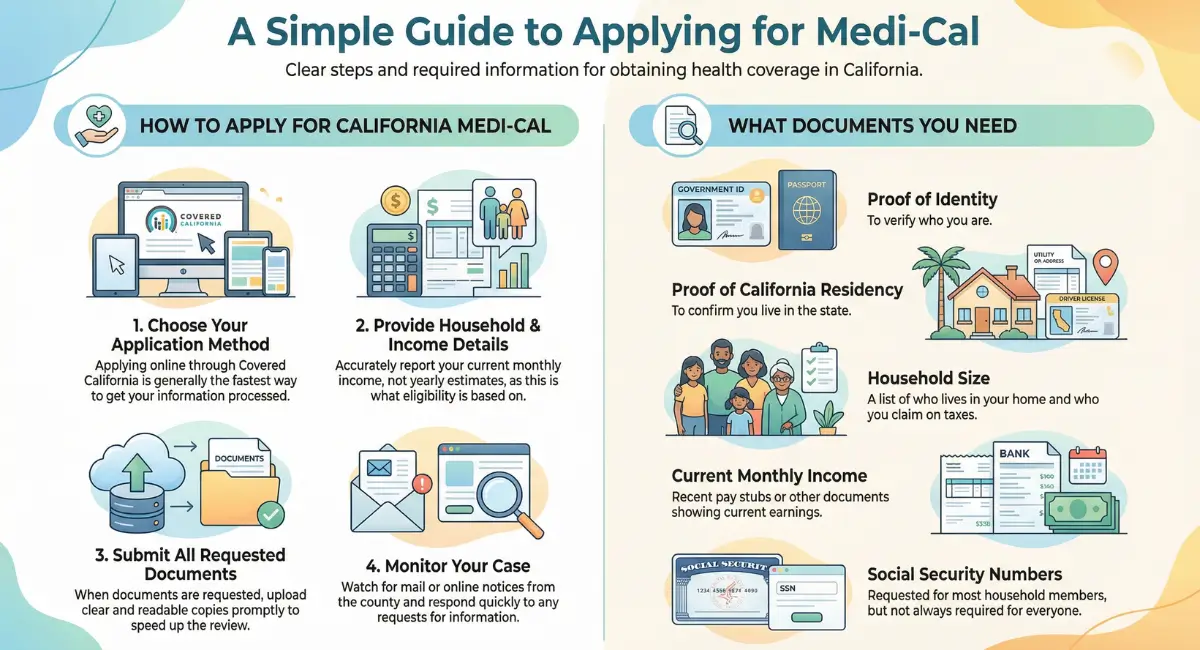
From a technical standpoint, online applications require stable internet access and the ability to upload documents. Digital submissions are generally processed faster than paper forms.
From an eligibility standpoint, you should be ready to verify:
- Your identity
- California residency
- Household size
- Current monthly income
Social Security Numbers are requested but not always required for every household member, especially for children or emergency coverage.
One of the most important preparation steps is understanding your current income, not your yearly estimate. Medi-Cal decisions are usually based on monthly income.
Step-by-Step: How to Apply for Medicaid in California
Step 1: Choose How You’ll Apply
You can apply:
- Online through Covered California
- By phone with county or Covered California assistance
- By mail using a paper application
- In person at a county social services office
Online applications tend to move faster because they connect directly to verification systems.
Step 2: Enter Household Information Carefully
Household size affects income limits. Include dependents you claim on taxes and anyone required by Medi-Cal rules.
Mistakes here often lead to recalculations and follow-up requests.
Step 3: Report Monthly Income Accurately
Use current monthly income, not guesses or yearly averages. Include wages, self-employment income, and any regular payments.
For people with variable income, this step is especially important.
Step 4: Submit Supporting Documents
If documents are requested, upload clear and readable copies. Poor image quality almost always leads to delays.
You can often submit documents after the application, but faster submission speeds up processing.
Step 5: Monitor Your Case
After submitting, watch for notices from the county. Requests for information usually have deadlines. Missing them can pause or close your case.
Most applications are processed within a few weeks, but timelines vary by county and case complexity.
What Happens After You Apply
Once submitted, your application enters county processing.
Automated checks run first. If everything matches, eligibility can be approved without much manual work. If not, a county worker reviews your case and may request clarification or documents.
This stage is where responsiveness matters most. Applicants who respond quickly to county requests usually experience no delays.
Real-World Scenarios That Affect Approval
A worker with inconsistent income may qualify one month and not the next. Medi-Cal evaluates income monthly, which can work in your favor if earnings change.
A family applying together may have some members approved immediately while others require additional review. This is normal and does not mean denial.
An elderly or person with a disability may face asset questions that do not apply to younger adults. Understanding which rules apply prevents confusion.
These scenarios show why Medi-Cal decisions are rarely “instant” and why patience and accuracy matter.
Advantages and Limitations of Medi-Cal
Advantages
- Broad healthcare coverage
- No premiums for many enrollees
- Monthly income flexibility
- Protection during job or income changes
Limitations
- County processing delays
- Complex eligibility rules
- Documentation follow-ups
- Inconsistent timelines across counties
Knowing both helps set realistic expectations.
Common Issues and How to Avoid Them
One common issue is income mismatch between what you report and what databases show. Submitting recent pay stubs usually resolves this.
Another issue is missing county notices. Always check mail and online accounts regularly.
Finally, unclear documents slow processing. Clear uploads save weeks of back-and-forth.
When problems persist, contacting the county or visiting an office can help move things forward.
Best Practices for a Smooth Medi-Cal Application
Apply online when possible.
Use exact income figures.
Submit documents early.
Respond quickly to county requests.
Keep copies of everything.
These steps align with how Medi-Cal is actually processed.
Frequently Asked Questions
1. How long does it take to get approved for Medi-Cal?
Most applications are processed within a few weeks, but timelines vary by county and case complexity.
2. Is Medi-Cal based on monthly or yearly income?
Medi-Cal generally uses monthly income, which is important for people with changing earnings.
3. Can I apply for Medi-Cal if I already have insurance?
Yes. Having insurance does not automatically disqualify you from Medi-Cal eligibility.
4. What if my income changes after I apply?
You should report changes. Medi-Cal eligibility can adjust based on new income information.
5. Do assets matter for Medi-Cal?
Assets matter mainly for seniors and disability-based Medi-Cal, not MAGI programs.
6. Can family members have different Medi-Cal outcomes?
Yes. Each household member is evaluated individually under Medi-Cal rules.
7. What happens if I miss a document deadline?
Your case may be paused or denied, but you can usually reapply or submit missing documents.
8. Is applying online better than applying by mail?
Online applications are usually faster because they connect directly to verification systems.
9. Can I get Medi-Cal while waiting for approval?
In some cases, temporary or retroactive coverage may apply once approved.
10. What is the most reliable way to apply for Medicaid in California?
The most reliable approach is to apply online with accurate income information and prompt document submission when learning how to apply for Medicaid in California.
Conclusion
Understanding how to apply for Medicaid in California means understanding Medi-Cal as a system, not just an application.
It is designed to balance access, accuracy, and accountability and small details can make a big difference.
When you apply with accurate information, respond quickly, and understand how county processing works, you reduce delays and improve your chances of smooth approval.