
My name is Akash Biswas. I like to read hard government rules and make them easy to understand. Many people find Medicaid and Medicare confusing, and that is okay. My goal is to help you understand who can get help, how to apply, and what to do next.
Last Updated: December 1, 2025
Does Medicaid Cover Wisdom Teeth Removal? Yes, but it depends.
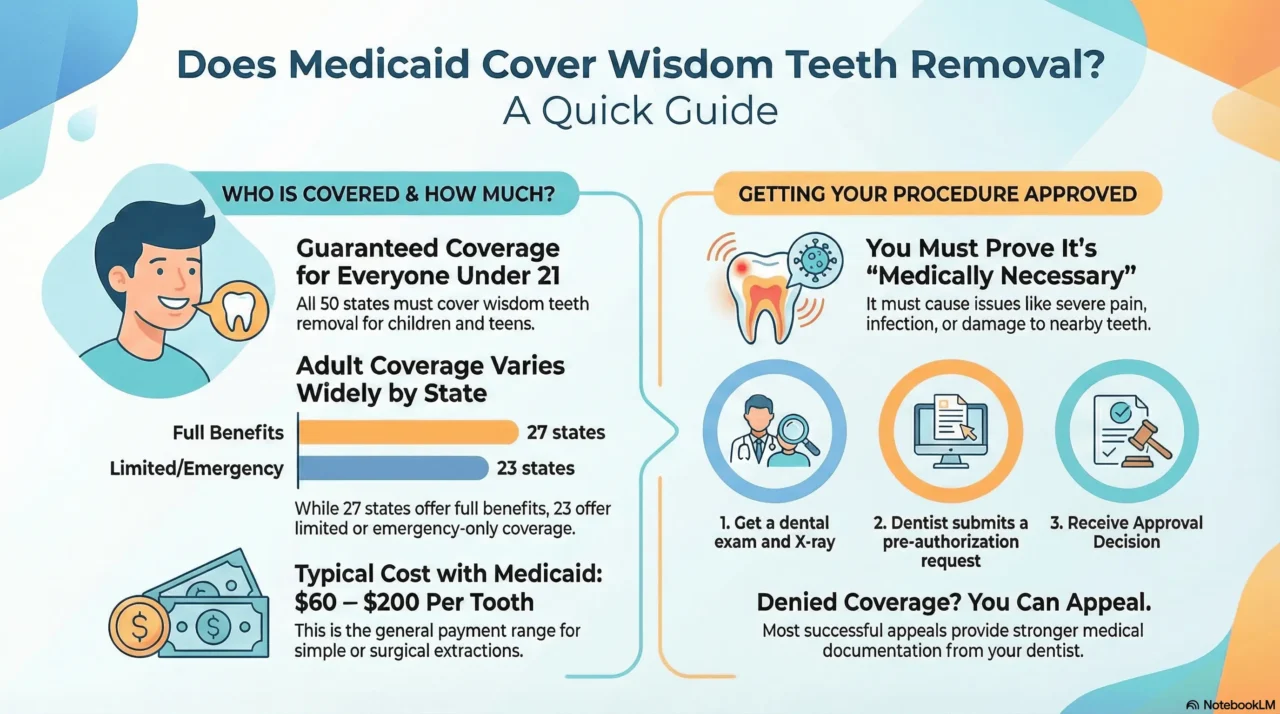
Medicaid covers wisdom teeth removal for all kids under 21 in every state. For adults, coverage depends on the state, the plan, and medical need.
Medicaid is run by state Medicaid agencies and guided by CMS.gov rules.
Fast Facts
- Kids under 21 always get coverage under EPSDT (a federal rule).
- Adults get coverage only in some states.
- Many states cover wisdom teeth only when there is pain, infection, or swelling.
- Some states cover simple and surgical removal.
- You may need X-rays and a dentist’s note for approval.
- Check your state plan before treatment.
See if you qualify: Medicaid Eligibility Calculator
Which Medicaid Dental Plans Include Coverage for Wisdom Teeth Extraction?
Coverage for Children and Teens
Every state Medicaid program covers wisdom teeth removal for anyone under 21. This includes:
- Traditional fee-for-service Medicaid
- Medicaid managed care plans
- CHIP (Children’s Health Insurance Program)
You can use Medicaid to cover wisdom teeth removal for your child or teenager without restrictions in all 50 states.
Medicaid Dental Plans with Better Coverage for Adults
The best Medicaid dental coverage options for wisdom teeth removal are in these 27 states:
Full Coverage States: California, Colorado, Connecticut, Idaho, Illinois, Iowa, Kentucky, Massachusetts, Michigan, Minnesota, Montana, Nebraska, New Jersey, New Mexico, New York, North Carolina, North Dakota, Ohio, Oregon, Pennsylvania, Rhode Island, South Dakota, Vermont, Washington, Wisconsin, Wyoming, and Washington DC.
These Medicaid dental plans with better coverage for oral surgery procedures typically include:
- Comprehensive exams and X-rays
- Surgical and simple extractions
- Anesthesia and sedation
- Follow-up care
- Annual benefit limits of $1,000 or more
Limited Coverage States: Alaska, Arkansas, Delaware, Georgia, Hawaii, Indiana, Kansas, Louisiana, Maine, Missouri, Nevada, Oklahoma, South Carolina, and Wyoming offer some coverage with restrictions.
Emergency-Only States: Arizona, Florida, Maryland, Mississippi, New Hampshire, Texas, Utah, Virginia, and West Virginia only cover urgent cases.
What Are the Requirements to Get Wisdom Teeth Removal Covered by Medicaid?
Medical Necessity Requirements
To get approval for wisdom teeth extraction under Medicaid, your dentist must show your teeth cause health problems:
- Severe pain that does not go away
- Infection or abscess with swelling
- Impacted teeth stuck in your jaw bone
- Damage to nearby teeth or bone
- Cysts or tumors around the tooth
- Widespread tooth decay
- Problems eating or talking
- Risk before chemotherapy or organ transplant
Does Medicaid Cover Surgical Removal Versus Simple Extraction?
Yes. Medicaid dental benefits cover surgical removal versus simple extraction of wisdom teeth when medically necessary. The type depends on your tooth position:
Simple Extraction: The tooth is visible above the gum line. Your dentist can pull it out with basic tools. Medicaid pays $60 to $150 per tooth.
Surgical Extraction: The tooth is stuck under gum tissue or in bone. An oral surgeon must cut the gum and may need to remove bone. Medicaid pays $100 to $200 per tooth.
Documentation Needed
What documentation is needed to submit a Medicaid claim for wisdom teeth extraction:
- Recent dental X-rays showing impaction or damage
- Clinical exam notes from your dentist
- Medical diagnosis codes
- Written explanation of why removal is necessary
- Referral from your primary doctor (in some states)
How Do I Check If My Medicaid Plan Covers Oral Surgery for Wisdom Teeth?
Step 1: Contact Your State Medicaid Office
Call the phone number on your Medicaid card. Ask these questions:
- Does my plan cover wisdom teeth removal for adults?
- What are the coverage limits per year?
- Do I need pre-authorization?
- Which dentists accept my plan?
Step 2: Review Your Member Handbook
Your state Medicaid website has a dental benefits handbook. Look for sections on:
- Oral surgery coverage
- Annual dollar limits
- Prior authorization requirements
- Covered and excluded services
Step 3: Call Medicaid-Approved Oral Surgeons
Are there any Medicaid-approved oral surgeons who specialize in wisdom teeth removal? Yes. Search your state’s provider directory for “oral surgeon” or “oral maxillofacial surgeon.” Call offices to confirm:
- They accept new Medicaid patients
- They perform wisdom teeth extractions
- They handle pre-authorization paperwork
How to Find Low-Cost Wisdom Teeth Removal with Medicaid
Can I Find a Dentist Near Me?
To find a dentist that accepts Medicaid for wisdom teeth removal near you:
- Use Your State’s Provider Search Tool: Every state has an online directory. Search by zip code and select “oral surgery” or “dentist.”
- Call 1-800-DENTIST: This referral service can find Medicaid dentists in your area.
- Visit Community Health Centers: Federally qualified health centers accept all Medicaid plans and offer dental services.
- Contact Dental Schools: University dental programs offer low-cost care with Medicaid acceptance.
Are There Low-Cost Clinics?
Yes, there are low-cost clinics that perform wisdom teeth removal under Medicaid:
- Federally Qualified Health Centers (FQHCs)
- Community dental clinics
- University dental schools
- Hospital dental departments
- Free dental clinics (for emergency cases)
These facilities often have shorter wait times and accept all Medicaid plans.
Find Medicaid dentists in your area using our provider search tool.
Hospital Versus Dental Office: Does Location Affect Coverage?
Does Medicaid Cover Wisdom Teeth Removal in Different Settings?
Yes, Medicaid covers wisdom teeth removal if done in a hospital versus a dental office. The location depends on your medical needs:
Dental Office: Most extractions happen here. Covered in all states with dental benefits.
Oral Surgery Center: Surgical facility for complex cases. Covered when medically necessary.
Hospital Operating Room: Required for patients with heart conditions, bleeding disorders, or severe impaction. Covered under medical benefits, not dental.
Hospital procedures may require separate pre-authorization through your medical Medicaid coverage instead of dental coverage.
How Long Does Medicaid Approval Take?
Pre-Authorization Timeline
How long does it take to get Medicaid approval for wisdom teeth removal surgery:
- Routine cases: 5 to 14 business days
- Emergency cases: 24 to 72 hours
- Complex cases: Up to 30 days
Your dentist submits the request electronically. You will receive a letter with the decision.
What Steps Should I Take to Get Approval?
Steps to get approval for wisdom teeth extraction under Medicaid:
- Schedule a dental exam
- Get X-rays showing the problem
- Have your dentist complete pre-authorization forms
- Submit medical history if requested
- Wait for approval letter
- Schedule surgery within the approved timeframe (usually 60 to 90 days)
You can schedule wisdom teeth removal with a Medicaid-participating dental provider online through some state portals, but most require calling the office directly.
Costs and Out-of-Pocket Expenses
Is Wisdom Teeth Removal Fully Covered?
Is wisdom teeth removal fully covered by Medicaid or are there out-of-pocket costs? It depends on your state:
States with Full Coverage: Most pay 100% with no copay for medically necessary removal.
States with Limited Coverage: You may pay:
- Copays of $3 to $25 per visit
- Coinsurance of 10% to 20% of costs
- Costs above annual benefit limits ($500 to $1,000)
Emergency-Only States: You pay for non-emergency removal.
Can I Get a Cost Estimate First?
Yes, you can get a pre-treatment estimate for wisdom teeth removal costs on Medicaid. Ask your dentist to:
- Submit a pre-determination request
- Get written cost breakdown
- Confirm what Medicaid will pay
- Explain any out-of-pocket costs
This helps you avoid surprise bills.
How Do Coverage Limits Affect My Procedure?
Medicaid dental coverage limits affect wisdom teeth removal procedures by capping total benefits:
- If your state limit is $1,000 per year and you need all four teeth removed, the full cost may exceed your limit
- Some states reset limits on January 1st each year
- Emergency procedures may not count toward annual limits
- Medical coverage (not dental) may pay for hospital-based extractions
Plan your procedure timing to maximize benefits.
State-by-State Coverage Differences
Does Coverage Vary by State?
Yes, Medicaid coverage for wisdom teeth removal varies by state significantly. Federal law requires children’s coverage everywhere, but adult coverage is optional.
How to Compare Coverage Options
To compare Medicaid dental coverage options for wisdom teeth removal:
| Your State Category | Adult Coverage Level | What’s Covered | Annual Limit |
|---|---|---|---|
| Extensive (27 states) | Full dental benefits | Preventive, basic, major surgery | $1,000+ or unlimited |
| Limited (14 states) | Some dental benefits | Basic services only | $500-$1,000 |
| Emergency (9 states) | Urgent care only | Pain, infection, trauma | Varies |
| Minimal (2 states) | Almost nothing | Rare emergencies | N/A |
Check your state’s specific Medicaid dental handbook for exact coverage details.
What If Medicaid Denies Coverage?
Best Ways to Appeal
What are the best ways to appeal if Medicaid denies coverage for wisdom teeth removal:
- Understand Why: Read the denial letter carefully. Common reasons include:
- Procedure deemed not medically necessary
- Incomplete documentation
- Provider not enrolled in Medicaid
- Annual benefit limit exceeded
- Gather More Evidence: Ask your dentist for:
- Additional X-rays showing damage
- Detailed clinical notes
- Letter explaining medical necessity
- Photos of the affected area
- File a Formal Appeal: Submit within the deadline (usually 30 to 60 days):
- Complete appeal form from denial letter
- Include all supporting documents
- Send by certified mail
- Request a Fair Hearing: If the appeal is denied, request a hearing before an administrative law judge.
- Get Legal Help: Contact your state’s legal aid office for free assistance.
Most appeals succeed when stronger medical documentation is provided.
Frequently Asked Questions
Does Medicaid cover wisdom teeth removal for adults?
It depends on your state. Twenty-six states plus Washington DC cover medically necessary wisdom teeth removal for adults. Fourteen states offer limited coverage. Nine states only cover emergencies. Alabama and Tennessee offer almost no coverage.
What if my state only covers emergency dental care?
You can still get coverage if your wisdom teeth cause severe pain, infection, or swelling. Your dentist must document the emergency. Non-emergency removal is not covered.
Can I use any dentist?
No. You must use a dentist that accepts Medicaid. Check your state’s provider directory or call the dentist’s office to confirm before making an appointment.
What if I need all four wisdom teeth removed?
If all four teeth are medically necessary, Medicaid typically covers removal of all four. However, some states may require removing them over multiple appointments due to annual benefit limits.
How do I know if my wisdom teeth are impacted?
Your dentist will take X-rays during your exam. Impacted teeth don’t have room to grow normally and can be stuck in the gum or bone.
Does Medicaid cover follow-up appointments?
Yes. Follow-up visits within 30 days of surgery are typically covered to check healing and remove stitches.
Can I go to an oral surgeon instead of a regular dentist?
Yes, if your case is complex. Medicaid-approved oral surgeons who specialize in wisdom teeth removal are available in most areas. You may need a referral from your dentist first.
What happens if I go to a non-Medicaid provider?
Medicaid will not pay. You will owe the full cost, which can be $2,000 to $3,000 for all four teeth.
Government Resources
- Centers for Medicare and Medicaid Services: Medicaid.gov
- State Medicaid Offices: Contact your state’s Department of Health and Human Services
- EPSDT Information: Medicaid.gov/medicaid/benefits/dental-care
- Medicaid Benefits: Medicaid.gov/medicaid/benefits/mandatory-optional-medicaid-benefits
The Bottom Line
Medicaid typically covers wisdom teeth removal procedures for everyone under 21 nationwide. For adults, coverage depends entirely on your state and whether your wisdom teeth are causing medical problems.
Before scheduling surgery, check if your Medicaid plan covers oral surgery for wisdom teeth by calling your state office. Find a dentist that accepts Medicaid near you using your state’s provider directory. Get pre-authorization to avoid unexpected bills.
Most importantly, understand that successful coverage requires clear documentation that your wisdom teeth removal is medically necessary, not just cosmetic or preventive.
If you face a denial, don’t give up. Gather stronger evidence from your dentist and file an appeal. Many denied claims are approved after review with better documentation.