
Wondering if Medicaid will help with braces? The answer is yes in some cases, but it’s not straightforward.
Medicaid can cover braces when they’re medically necessary to fix serious health issues, like problems with eating or speaking.
It won’t pay for braces just to improve your smile or fix minor cosmetic flaws. Coverage depends on your state, age, and whether a doctor says it’s needed.
Kids under 21 often have the best shot because of federal rules that require states to cover treatments for children.
Adults face tougher odds, with only a handful of states offering any orthodontic help. This guide explains when Medicaid steps in, who qualifies, what counts as medical necessity, and what to do if you’re denied.
You’ll get steps to apply, common denial reasons, and alternatives to explore.
Related: Does Medicaid Cover Wisdom Teeth Removal?
Quick Answer: Does Medicaid Cover Braces?
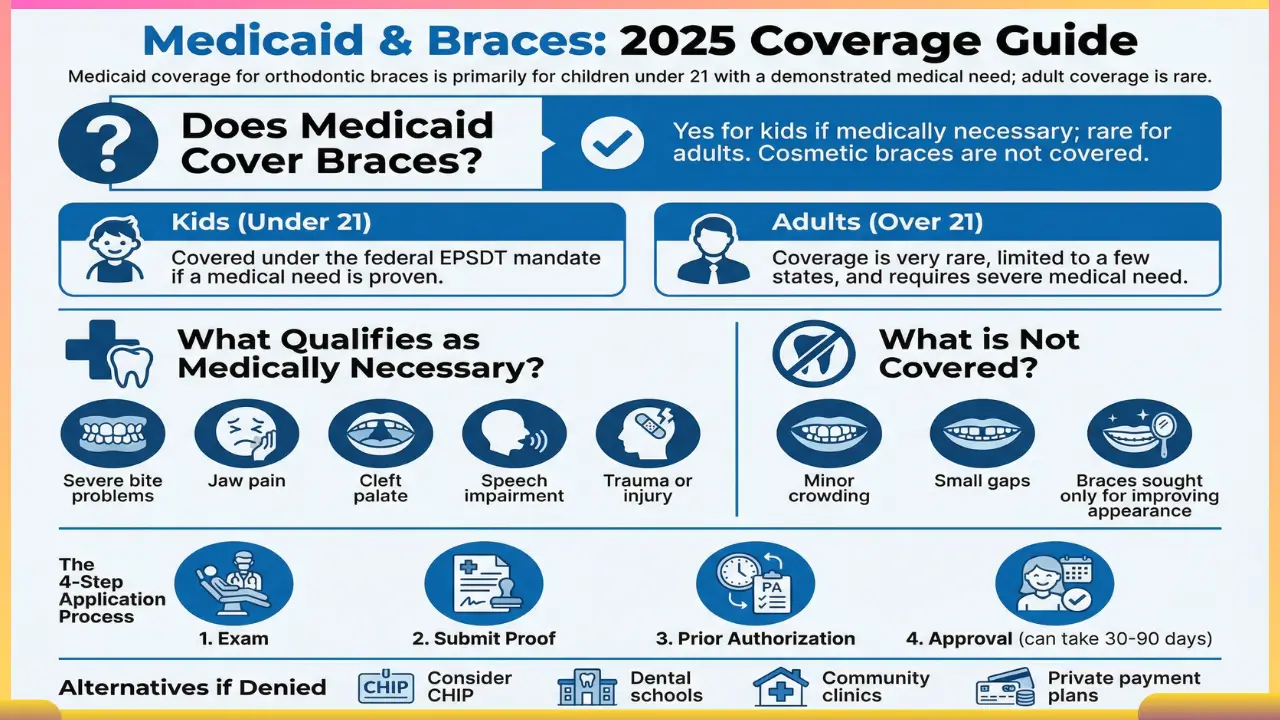
Yes, Medicaid covers braces for children and teens if medically necessary.
Coverage for adults is rare and only approved in severe medical cases.
Cosmetic braces (to look better) are not covered.
Medicaid Braces Coverage by Age Group (2025)
Children & Teens; Medicaid Braces Coverage (2025)
Federal rules under EPSDT require all states to cover medically necessary braces for kids under 21. This includes treatments for severe bite problems or jaw issues that affect health.
Coverage varies by state; some, like California, offer full orthodontic services, while others, like Texas, focus on emergencies. Check your state’s Medicaid handbook for details.
Adults; Medicaid Braces Coverage (2025)
Most states don’t cover braces for adults over 21. Only about 20 states provide any adult dental benefits, and even then, braces are approved rarely.
Qualifying cases might include severe trauma or conditions like jaw misalignment that cause pain or eating trouble. States like New York or Illinois sometimes approve, but expect a strict review.
Read More: Does Medicaid Cover Dental in 2025?
What Conditions Qualify for Medicaid to Cover Braces? (Medical Necessity)
Medicaid only pays if braces fix a real health problem, not looks.
Common approved conditions include:
- – Cleft palate or lip that affects eating or speech.
- – Severe malocclusion where teeth don’t line up, causing chewing pain.
- – Bite issues like overbite or underbite that lead to jaw problems.
- – Speech impairment from misaligned teeth.
- – Trauma from accidents that damage jaw structure.
- – Jaw growth abnormalities that need correction for normal function.
Your orthodontist must prove it’s necessary with exams and records.
What Medicaid Does Not Cover (Cosmetic Exclusions)
Medicaid skips anything not tied to health. Examples:
– Minor crowding of teeth.
– Small gaps between teeth.
– Overlapping teeth without pain.
– Braces just for straighter smiles or better appearance.
These count as cosmetic, so you’ll pay out of pocket.
Medicaid Orthodontic Coverage Rules by State (2025)
Rules differ across states, so contact your local Medicaid office. Some, like California and New York, cover braces for kids with medical needs and limited adult cases.
Others, like Florida or Alabama stick to emergencies only, with little orthodontic help. In 2025, all states must cover kids under EPSDT, but adults depend on if the state funds dental benefits.
Always check your state’s plan, use healthcare.gov or call for updates.
| Coverage Level | States (Examples) |
| Full Coverage | California, New York, Illinois |
| Partial Coverage | Texas, Michigan, Ohio |
| Limited Coverage | Florida, Alabama, Tennessee |
Income Requirements for Medicaid Braces (2025)
Medicaid doesn’t have special income limits for braces. You must meet your state’s standard Medicaid eligibility first. For kids, limits are higher, often up to 200% of federal poverty level. Adults face stricter rules in non-expansion states.
How to Apply for Medicaid Braces (Step-by-Step)
1. Visit a Medicaid-approved orthodontist for an exam.
2. Get X-rays, photos, and a doctor’s note on why it’s medically necessary.
3. Have the orthodontist submit a prior authorization form to Medicaid.
4. Medicaid reviews the case, often with a dental expert.
5. Wait for approval or denial; it can take 30-90 days.
6. If approved, start treatment; appeal if denied.
Why Medicaid Denies Braces Coverage (Top Reasons)
– Not medically necessary, it’s seen as cosmetic.
– Incomplete paperwork or missing records.
– Orthodontist not in Medicaid network.
– Age limits, over 21 in most states.
– Not meeting overall Medicaid eligibility.
Alternatives if Medicaid Doesn’t Cover Braces
If denied, try these:
- CHIP for kids often covers braces if needed.
- Dental schools for low-cost orthodontic care.
- Community clinics or free programs like Smiles Change Lives.
- Payment plans from private orthodontists.
- Clear aligners like Invisalign, if your case is mild (check affordability).
FAQs for Medicaid & Braces
Does Medicaid cover braces in 2025?
Yes for kids under 21 if medically necessary; adults rarely qualify.
Does Medicaid cover Invisalign in 2025?
Sometimes, if it’s the best medical option over metal braces.
What age does Medicaid stop covering braces in 2025?
Usually 21, but some states extend for ongoing treatment.
Do adults get Medicaid braces coverage in 2025?
Rarely, only in states with adult dental benefits for severe cases.
Does Medicaid cover braces for overbite in 2025?
Yes, if the overbite causes health issues like pain or eating problems.
Does Medicaid require X-rays before approving braces in 2025?
Yes, X-rays and records prove medical necessity.
How long does Medicaid take to approve braces in 2025?
30-90 days, depending on your state.
Are retainers covered under Medicaid in 2025?
Often yes, as part of approved orthodontic treatment.
Does Medicaid cover dental cleanings and exams in 2025?
Yes for kids; adults vary by state.
Does Medicaid cover emergency orthodontic care in 2025?
Yes, like fixing broken braces that cause injury.
Final Summary
Medicaid covers braces in 2025 only when medically necessary, like for severe bite issues or speech problems. Kids under 21 have the strongest coverage under federal rules, while adults rarely get approvals. Cosmetic fixes aren’t included focus on health needs. Start with a Medicaid orthodontist exam and prior authorization. If denied, look at CHIP, dental schools, or payment plans. Check your state’s rules for the best shot.