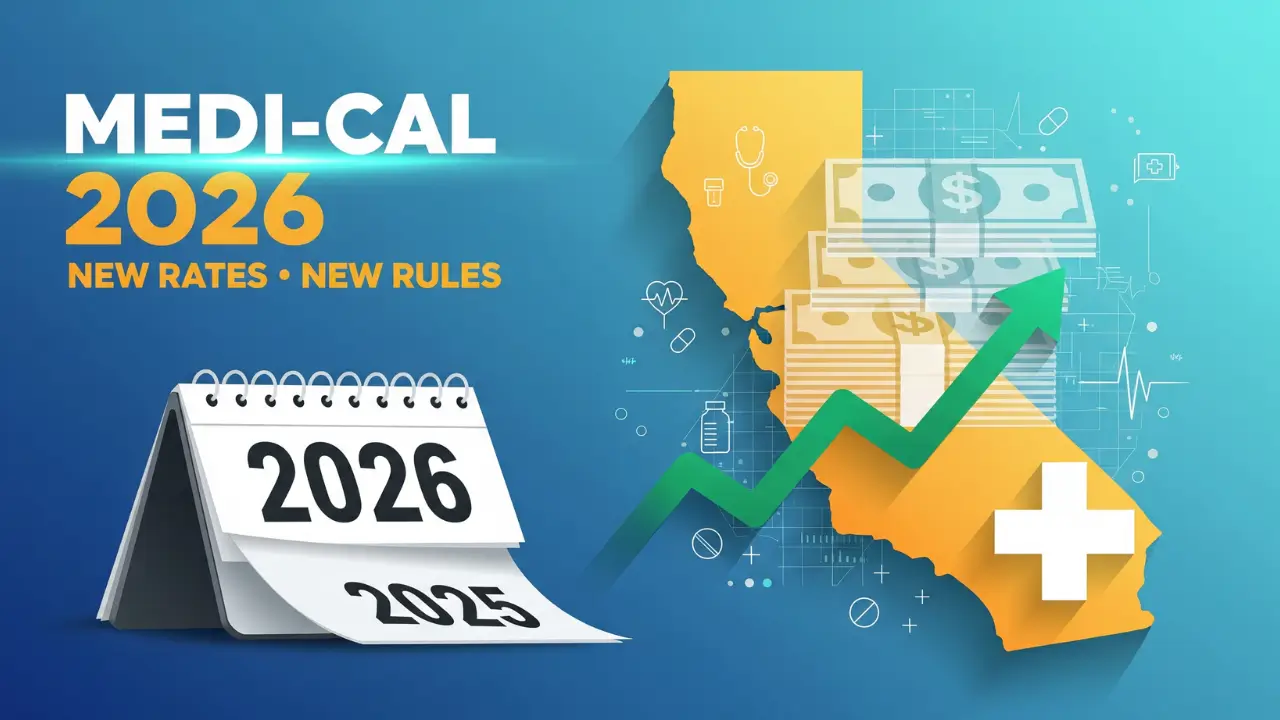
California’s Medi-Cal program made major changes on January 1, 2026. Provider rates increased for doctors and facilities.
New asset limits now apply to some beneficiaries. These updates come from Proposition 35 and the 2025 State Budget.
Quick Summary:
- Provider rates increased to 87.5% of Medicare rates
- New asset limit: $130,000 for individuals
- Nursing facility rates updated January 1, 2026
- Home care rates rose with the minimum wage increase
- Emergency doctor payments continue through June 2026
- Full fee schedule published online by July 1, 2026
What Changed in 2026?
California voters passed Proposition 35 in 2024. This made the Managed Care Organization (MCO) tax permanent. The tax funds higher payments to doctors and hospitals.
The state also brought back asset limits. These affect seniors and people with disabilities who need long-term care.
Provider Payment Rates (2026)
Primary Care & Doctor Visits
Medi-Cal now pays doctors at least 87.5% of Medicare rates. This applies to three main service types:
- Primary care visits (checkups and sick visits)
- Maternity care (prenatal, delivery, and postpartum)
- Mental health services (outpatient therapy)
The 2026 Medicare conversion factor is $33.40. Medi-Cal uses this to calculate payments.
Emergency Room Doctors
Emergency physicians get supplemental payments through June 30, 2026. These extra payments apply to codes 99282-99285. Proposition 35 funds these increases.
Long-Term Care Facilities
Four types of nursing facilities got new rates on January 1, 2026:
- Distinct-Part Pediatric Subacute (DP/PSA)
- Freestanding Pediatric Subacute (FS/PSA)
- Distinct Part Nursing – Level B (DP/NF-B)
- Freestanding Nursing – Level B (F/NF-B)
Important: Providers don’t need to resubmit old claims. The state will automatically reprocess claims from January 1, 2026 forward.
Home Care & Assisted Living
Home care rates increased with California’s minimum wage rise to $16.90 per hour. The Assisted Living Waiver (ALW) now pays these daily rates:
| Tier Level | Daily Rate | Billing Code |
|---|---|---|
| Tier 1 | $95.69 | T2031 U1 |
| Tier 2 | $114.33 | T2031 U2 |
| Tier 3 | $132.97 | T2031 U3 |
| Tier 4 | $179.58 | T2031 U4 |
| Tier 5 | $270.80 | T2031 U5 |
Personal care and respite services pay $5.28 per 15-minute unit (codes T1019, T1005).
Mental Health Services
Specialty Mental Health Services (SMHS) rates were updated January 2, 2026. Outpatient therapy and counseling services now pay higher rates.
New Asset Limits for Beneficiaries
California brought back asset tests on January 1, 2026. These apply to Non-MAGI Medi-Cal programs. This includes aged, blind, disabled individuals, and long-term care applicants.
Asset Limit Amounts:
- One person: $130,000
- Two people (couple): $195,000
- Each additional person: Add $65,000
Home Equity Limit:
Your home equity cannot exceed $1 million if you need long-term care coverage.
What Counts as an Asset?
Assets include:
- Bank accounts and savings
- Stocks and bonds
- Second homes or rental property
- Vehicles beyond one car
Your primary home and one vehicle usually don’t count.
Lookback Period
California now has a 30-month lookback period. If you gave away assets during this time, you may face a penalty period. This means delayed coverage for long-term care.
If you’re applying for basic Medi-Cal without long-term care, different rules may apply. Check California Medicaid income limits 2026 to see if you qualify based on income alone.
Who Pays Nothing?
Most Medi-Cal members still pay zero costs. This includes:
- Premiums: $0 for most enrollees
- Copays: $0 for covered services
- Deductibles: None for standard coverage
Medicare Part B Coverage
If you have both Medicare and Medi-Cal (called “dual eligible”), Medi-Cal pays your Medicare Part B premium. The 2026 Part B premium is $202.90 per month.
Medi-Cal covers this through Medicare Savings Programs:
- QMB (Qualified Medicare Beneficiary)
- SLMB (Specified Low-Income Medicare Beneficiary)
- QI (Qualifying Individual)
Retroactive Coverage Changes
New applicants now get less retroactive coverage:
- MAGI adults: Coverage starts 1 month before application (was 3 months)
- Non-MAGI groups: Keep 3 months or reduced to 2 months depending on category
This applies to applications submitted on or after January 1, 2026.
Undocumented Adults (Ages 19+)
New enrollment for undocumented adults in full-scope Medi-Cal is restricted starting January 1, 2026. This is part of the state budget deficit reduction measures.
Emergency services remain available to everyone regardless of immigration status.
How to Find Specific Rates
California doesn’t publish one big PDF with all rates. Instead, you look up rates by service type:
Official Rate Tools:
- Medi-Cal Rates Explorer – Check rates for specific procedure codes: DHCS Medi-Cal Rates
- Long-Term Care Rates – View nursing facility reimbursement: LTC Rate Information
- Fee Schedule Transparency – By July 1, 2026, the full fee-for-service schedule will be published online. It will compare Medi-Cal rates to Medicare rates.
For a complete understanding of eligibility, review the Medicaid fee schedule 2026 for the national context.
What Is Proposition 35?
Proposition 35 passed in November 2024. California voters approved it by a wide margin. Here’s what it does:
Key Points:
- Makes the MCO tax permanent (no expiration date)
- Requires tax revenue to fund provider rate increases
- Prevents the state from diverting funds to the general budget
- Ensures the 87.5% Medicare benchmark continues
2026 Spending Plan:
- $2 billion supports managed care plan payments
- Emergency physician payments extended
- Ground emergency medical transport (GEMT) add-ons continue
Telehealth Updates
Frequency limits on telehealth visits for nursing facility patients were permanently removed. This aligns with federal rules.
Doctors can now provide subsequent nursing facility visits via telehealth without visit count restrictions.
FAQs
What is the California Medi-Cal fee schedule for 2026?
It’s the list of payment rates the state pays doctors, hospitals, and other providers. Rates increased in 2026 to at least 87.5% of Medicare levels for primary care, maternity, and mental health services. Providers check rates online by service code.
How much are the new Medi-Cal asset limits in 2026?
The asset limit is $130,000 for one person and $195,000 for a couple. Add $65,000 for each additional household member. This applies to aged, blind, disabled, and long-term care applicants starting January 1, 2026.
Do Medi-Cal patients pay copays in 2026?
No. Most Medi-Cal members pay $0 in premiums, copays, and deductibles. Some higher-income individuals may have a “Share of Cost” similar to a deductible. Dual-eligible members also get their Medicare Part B premium covered.
When will California publish the full Medi-Cal fee schedule?
The complete fee-for-service schedule must be published online by July 1, 2026. It will be machine-readable and include a comparison to Medicare rates. This is required by new federal transparency rules.
What is the Medi-Cal reimbursement rate for home care in 2026?
Assisted Living Waiver rates range from $95.69 to $270.80 per day depending on tier level. Personal care services pay $5.28 per 15-minute unit. These rates increased to align with California’s $16.90 minimum wage.
Does Proposition 35 affect my Medi-Cal coverage?
Not directly for beneficiaries. Prop 35 increases payments to doctors and providers to improve access to care. It ensures rate increases continue by making the MCO tax permanent. This may help you find more doctors accepting Medi-Cal.
How to Apply for Medi-Cal
You can apply online, by phone, or in person:
- Online: Visit BenefitsCal to apply
- Phone: Call 1-800-540-7717 (Monday-Friday, 8 AM – 5 PM)
- In Person: Visit your county social services office
You’ll need:
- Proof of identity (ID or birth certificate)
- Social Security number (if you have one)
- Proof of income (pay stubs, tax returns)
- Asset information (bank statements if applying for Non-MAGI)
Most people get a decision within 45 days. Pregnant women and children often get approved faster.
Official Sources
This article uses information from:
- California Department of Health Care Services (DHCS)
- Centers for Medicare & Medicaid Services (CMS)
- 2025-26 California State Budget
- Proposition 35 Spending Plan (DHCS)
For questions about your specific situation, contact your local county Medi-Cal office or call the Medi-Cal helpline.
Need Help? If you have questions about eligibility, rates, or how to apply, contact your county Medi-Cal office or call 1-800-540-7717.