Ohio Medicaid covers more than 3 million people with health services like doctor visits, hospital stays, and prescriptions at little or no cost.
In 2025, eligibility focuses on income and assets, updated with federal poverty levels to match rising costs.
This guide is for parents checking kids’ options, adults seeking expansion coverage, pregnant women needing prenatal help, seniors on fixed incomes, or disabled folks exploring waivers.
You’ll find the Federal Poverty Level basics, limits by group, household size tips, MAGI vs non-MAGI, countable income, asset rules, monthly vs annual math, docs needed, and charts with numbers.
How Medicaid Eligibility Works in Ohio (MAGI vs Non-MAGI)
MAGI Groups (Income-Based)
MAGI-based Medicaid uses tax rules for families. It covers adults in expansion up to 138% FPL, children up to 206% FPL, pregnant women up to 205% FPL, and parents/caretakers up to 90% FPL.
This path has no asset test and applies a 5% income disregard for wiggle room.
Non-MAGI Groups
Non-MAGI covers aged (65+), blind, disabled, SSI-linked, long-term care (nursing homes, waivers), and Medicare Savings.
It checks monthly income plus assets, with medical needs like nursing home-level care.
Special paths include spend-down (use excess income on bills) and waivers like PASSPORT for home care.
Ohio Medicaid Income Limits 2025
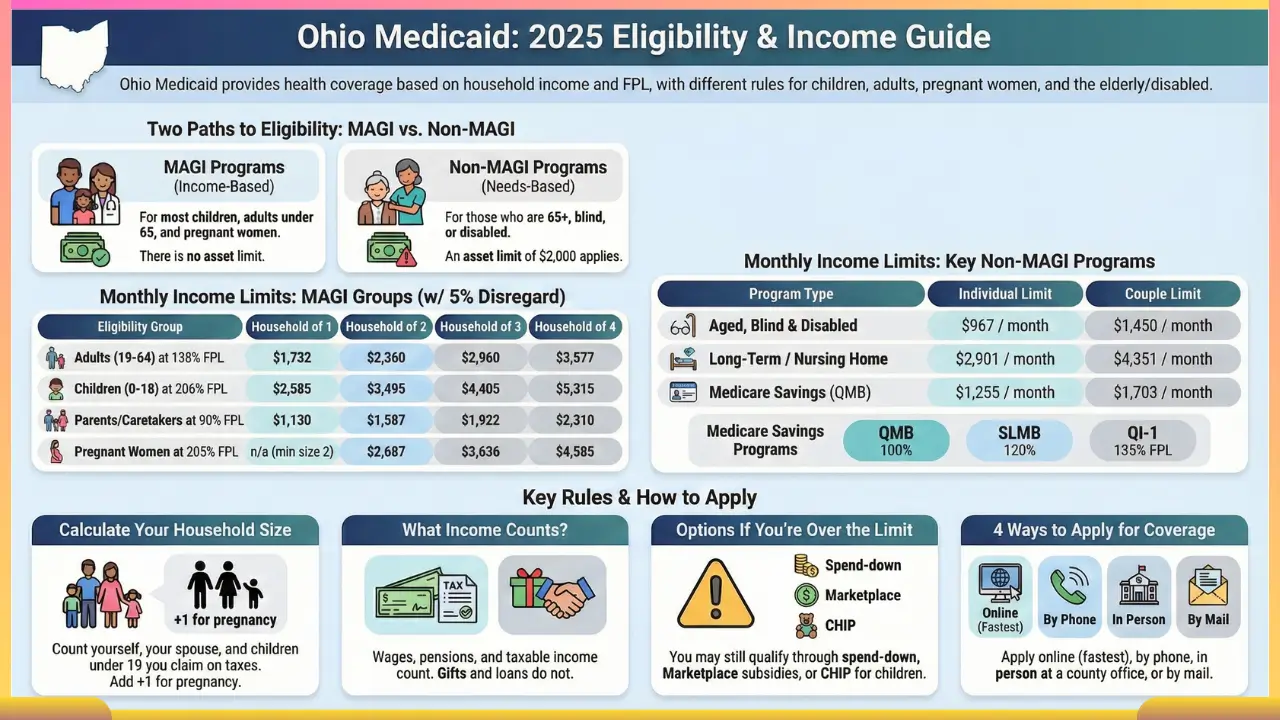
Limits update April 1 with FPL changes. Ohio uses FPL percentages for MAGI and SSI rates for non-MAGI. Family size counts you, spouse, kids under 19, +1 for pregnancy.
Tax household (MAGI) includes tax dependents; Medicaid household (non-MAGI) adds shared-cost folks.
For 2025, FPL is $1,255 monthly ($15,060 yearly) for one, +$440 ($5,280) per extra. The 5% disregard boosts MAGI limits slightly.
Children (0–18)
Ohio covers children 0-18 up to 206% FPL through Medicaid and CHIP, emphasizing preventive care like checkups and vaccines. No asset test; family-friendly with seamless transitions.
Children 0–18 (206% FPL)
| Family Size | Monthly Income Limit | Annual Income Limit |
| 1 | $2,585 | $31,020 |
| 2 | $3,495 | $41,940 |
| 3 | $4,405 | $52,860 |
| 4 | $5,315 | $63,780 |
Adult Expansion (19–64)
Ohio’s expansion covers adults 19-64 up to 138% FPL, no kids required, for basics like doctor visits and meds. It’s a safety net for working low-income folks.
Adult Expansion (138% FPL)
| Family Size | Monthly Income Limit | Annual Income Limit |
| 1 | $1,732 | $20,784 |
| 2 | $2,360 | $28,320 |
| 3 | $2,960 | $35,520 |
| 4 | $3,577 | $42,924 |
Pregnant Women
Pregnant women qualify up to 205% FPL, counting the unborn baby as +1, with coverage lasting 12 months postpartum for checkups and family planning. It’s built for healthy pregnancies.
Pregnant Women (205% FPL)
| Family Size | Monthly Income Limit | Annual Income Limit |
| 2 (Mom + Baby) | $2,687 | $32,244 |
| 3 | $3,636 | $43,632 |
| 4 | $4,585 | $55,020 |
Parents & Caretaker Relatives
Parents or caretakers qualify up to 90% FPL if caring for a child under 19, linking to family support with low thresholds.
Parents / Caretakers (90% FPL)
| Family Size | Monthly Income Limit | Annual Income Limit |
| 1 | $1,130 | $13,560 |
| 2 | $1,587 | $19,044 |
| 3 | $1,922 | $23,064 |
| 4 | $2,310 | $27,720 |
Aged, Blind & Disabled (ABD Medicaid)
ABD uses non-MAGI with SSI limits: $967 monthly for individuals ($1,450 couples), automatic for SSI recipients. Spend-down allows using excess on bills.
Aged, Blind & Disabled (SSI-Based)
| Group | Monthly Income Limit | Annual Income Limit |
| Individual | $967 | $11,604 |
| Couple | $1,450 | $17,400 |
Long-Term Care / Nursing Home
Long-term care allows up to 300% SSI ($2,901 monthly individual) with $2,000 asset limit ($3,000 couple). Spousal impoverishment protects non-applicant spouses up to $157,920 assets and $3,715 monthly income.
Long-Term Care (300% SSI)
| Group | Monthly Income Limit | Annual Income Limit |
| Individual | $2,901 | $34,812 |
| Couple | $4,351 | $52,212 |
Medicare Savings Programs (QMB, SLMB, QI-1)
QMB up to 100% FPL ($1,255 monthly individual) pays Medicare premiums; SLMB 120% ($1,506); QI-1 135% ($1,694). Assets $2,000/$3,000 for QMB.
QMB (100% FPL)
| Family Size | Monthly Income Limit | Annual Income Limit |
| 1 | $1,255 | $15,060 |
| 2 | $1,703 | $20,436 |
| 3 | $2,135 | $25,620 |
| 4 | $2,575 | $30,900 |
SLMB (120% FPL)
| Family Size | Monthly Income Limit | Annual Income Limit |
| 1 | $1,506 | $18,072 |
| 2 | $2,044 | $24,528 |
| 3 | $2,562 | $30,744 |
| 4 | $3,090 | $37,080 |
QI-1 (135% FPL)
| Family Size | Monthly Income Limit | Annual Income Limit |
| 1 | $1,694 | $20,328 |
| 2 | $2,300 | $27,600 |
| 3 | $2,882 | $34,584 |
| 4 | $3,476 | $41,712 |
Asset Limits (For Non-MAGI Groups)
Non-MAGI groups like elderly/disabled have asset limits: $2,000 for individuals, $3,000 for couples. Exempt: Home (equity up to $688,000), one car, household goods, burial funds ($1,500). MAGI groups skip assets. Ohio Medicaid asset limits protect essentials, trusts or spend-down can help if over.
How to Calculate Your Household Size in Ohio
Household size counts you, spouse, kids under 19, +1 for pregnancy. For MAGI, it’s tax dependents; non-MAGI adds shared-cost folks like roommates.
Example: Married couple with two kids = 4; pregnant mom alone = 2.
Shared custody? Count the child if you claim on taxes. Complex cases? HHS clarifies, get it right to avoid denial.
How Income Is Calculated (MAGI Formula Explained Simply)
Countable income: Wages, SSI, pensions, interest. Non-countable: Gifts, loans, Native payments.
MAGI adds 5% disregard, e.g., $20,000 yearly for one = $1,667 monthly, disregard makes $1,583 countable (under 138% FPL $1,732). Deductions: Childcare, student loans.
Example: Single adult $1,900 monthly qualifies after disregard; family of 3 $4,000 = $3,333, over 138% ($3,065) so no. Use ODM tool.
Special Rules for Pregnant Women
Pregnant women qualify up to 205% FPL ($2,687 monthly for mom + baby), counting the unborn as +1.
Coverage lasts 12 months postpartum for checkups and planning. Baby gets auto-Medicaid for a year. It’s a boost for Healthy Start, no asset test.
Medicaid Waivers & Long-Term Care (If Applicable)
Ohio’s waivers like PASSPORT (home care) allow up to 300% SSI ($2,901 monthly) with $2,000 assets.
Nursing home same limit, spousal protections up to $157,920 for non-applicant spouse and $3,715 monthly income.
Spend-down uses excess on bills. Waivers need nursing level care, apply for home vs facility.
What If You’re Over the Limit?
Over income? Spend-down pays medical bills to qualify. Marketplace subsidies for 100-400% FPL. CHIP for kids up to 206% FPL. A medically needy path for non-MAGI deducts costs.
Appeal denials, free legal aid helps. Exceptions for emergencies or changes.
Required Documents for Applying
Income: Pay stubs, tax returns, W-2s. ID: Driver’s license, birth certificate. Residency: Utility bill. Pregnancy: Doctor note. Disability: SSA letter. Self-employed: Profit/loss. Upload digital, keep copies.
How to Apply for Ohio Medicaid
1. Apply Online : Use benefits.ohio.gov quick screen, upload docs, 45 days processing.
2. Apply by Phone : Call 800-324-8680 for help, bilingual.
3. Apply in Person: Visit the county Job & Family Services office.
4. Apply by Mail: Download form from medicaid.ohio.gov, send to local office.
5. Automatic Newborn Enrollment: Report birth to ODM, baby gets 12 months auto. Shutdown added delays, but online’s fastest.
FAQ
What is the income limit for a single adult in Ohio in 2025?
Single adults 19-64 qualify up to 138% FPL ($1,732 monthly, $20,784 yearly). No kids needed, expansion covers basics.
Can working adults qualify for Medicaid in Ohio?
Yes, up to 138% FPL if working low-wage, MAGI counts earnings after 5% disregard. Waivers help disabled workers up to 250% FPL.
Do I need to be a U.S. citizen?
Yes, for full Medicaid, qualified immigrants wait 5 years. Undocumented get emergency coverage for crises like labor.
What if my income changes month to month?
Average last three months for MAGI; project annual for non-MAGI. Report changes within 10 days to adjust.
How long does approval take?
Up to 45 days, but presumptive for pregnant is 5 days. Shutdown backlog adds 1-2 weeks, track online.
Does Ohio have emergency Medicaid?
Yes, for life-threats like accidents or birth, even undocumented. Covers treatment, not follow-up.
Final Summary
Ohio Medicaid income limits 2025 keep care reachable, FPL charts show paths for all groups, from kids at 206% to seniors on SSI. Assets matter only for non-MAGI, and changes like pregnancy boost limits. Apply soon, ODM guides you. If close, check the 5% disregard or waivers. Your health’s priority, get started today.